WorldWar-2.com

Operation Compass

Italian Invasion of Egypt and British Counter-Offensive | September 1940 – February 1941

‘The only thing that matters is to beat the enemy. This must be done with furious energy and without regard for any risks.’
Anthony Eden – Secretary of State for War of the United Kingdom – 10th December 1940

Introduction to Operation Compass

Operation Compass grew out of Italy’s failed advance into Egypt in September 1940. After declaring war on the United Kingdom and France in June, Benito Mussolini sought rapid victories in North Africa, hoping to expand Italian influence across the Mediterranean and threaten Britain’s position in Egypt and the Suez Canal.

From Cyrenaica, Marshal Rodolfo Graziani’s Italian 10th Army crossed the frontier and advanced toward Sidi Barrani. The offensive soon stalled, however, as fuel shortages, limited transport, water difficulties, and cautious leadership forced the Italians to halt. Instead of pressing deeper into Egypt, they constructed a chain of isolated fortified camps stretching from Sidi Barrani on the coast southward into the desert.

Taking advantage of Italian overextension and poor coordination, British and Commonwealth forces under General Sir Archibald Wavell launched Operation Compass in December 1940. Initially conceived as a limited five-day raid, the attack rapidly developed into a major offensive that shattered the Italian camp system, recaptured Cyrenaica, and destroyed much of the Italian 10th Army.

The scale of the defeat alarmed Adolf Hitler, who feared the collapse of the Axis position in North Africa. In February 1941 he ordered Operation Sonnenblume, dispatching Generalleutnant Erwin Rommel and the Afrika Korps to Libya to stabilise the front.

Italian Flag

Benito Mussolini

Duce of Italy

A written order to Marshal Graziani demanding an immediate invasion of Egypt to coincide with the German invasion of Britain - 19th August 1940

‘Now, the day on which the first German platoon sets foot on English soil, you must attack... I only ask you to attack the British forces facing you.’

September 1940

The Italian Offensive into Egypt

13th September 1940

Originally planned to coincide with the expected German invasion of England (Operation Sea Lion), Mussolini’s ambition to seize the Suez Canal and disrupt British imperial communications encouraged him to order Marshal Rodolfo Graziani’s Italian 10th Army to proceed with the planned offensive (Operazione E) into Egypt from Cyrenaica following the postponement of Sea Lion.

Despite the size of the 10th Army, numbering around 200,000 men, it suffered from severe shortages of vehicles caused by previous campaigns in Ethiopia and Spain, and had to be reinforced by cannibalising units from the 5th Army, which was covering the inactive Libyan–Tunisian frontier to the west. This enabled the Italians to assemble around 2,500 motor vehicles and approximately 70 M11/39 medium tanks for the offensive.

As the 10th Army advanced eastward across the Egyptian border from Cyrenaica, the main thrust was led by the XXIII Corps under General Annibale Bergonzoli, consisting of the 62nd “Marmarica” Infantry Division and the 63rd “Cirene” Infantry Division, together with the Libyan Corps under General Sebastiano Gallina, comprising the 1st and 2nd Libyan Divisions. While these formations advanced along the coast road, the Maletti Group — a mixed force of motorised infantry and tank battalions — was tasked with outflanking the British to the south. Together, these formations fielded approximately 600 tanks and 1,600 artillery pieces, supported by around 330 aircraft of the Regia Aeronautica. In reserve behind them were the XXI and XXII Corps, including the 61st “Sirte”, 64th “Catanzaro”, and 4th Blackshirt Divisions.

Facing them was Major-General Richard O’Connor’s much smaller but highly trained and mobile Western Desert Force, numbering approximately 36,000 men, 275 tanks, and 120 artillery pieces. The force was built around the 7th Armoured Division (“Desert Rats”), the 4th Indian Infantry Division, and screening patrols from the 11th Hussars (Prince Albert’s Own), with the 4th and 7th Royal Horse Artillery and the 7th Royal Tank Regiment held in reserve. They were supported by 142 aircraft of the RAF.

Rather than meeting the Italians in a head-on battle, the British utilised their superior mobility to conduct a disciplined fighting withdrawal. Using armoured cars and mobile patrols to carry out delaying actions while avoiding decisive engagement, British forces continually reported Italian movements as they withdrew towards prepared defensive positions nearer Mersa Matruh. The slow and cautious pace of the Italian advance allowed British commanders to preserve their limited strength while gathering vital intelligence on Graziani’s ultimate intentions.
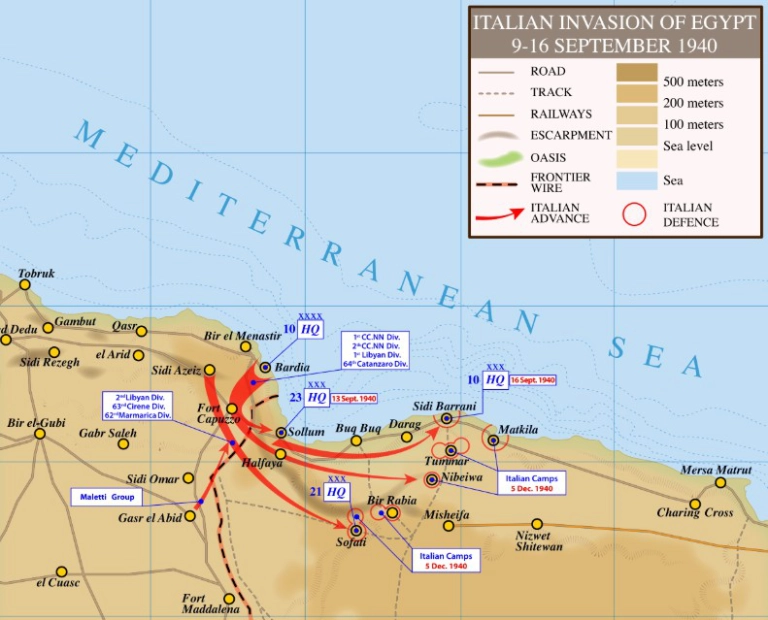
Map of the Italian advance from Libya into Egypt toward Sidi Barrani, September 1940
Map showing the Italian 10th Army’s advance from Libya into Egypt in September 1940. The offensive halted around Sidi Barrani, where fortified camps were constructed.
16th September 1940

The Italians capture Sidi Barrani and Maktila, approximately 16 kilometres to the east. Graziani now halts the advance of the 10th Army after pushing around 100 kilometres into Egypt, though still some 130 kilometres west of the main British defensive positions at Mersa Matruh, due to mounting supply and logistical difficulties. Despite this, Mussolini orders Graziani to continue the advance a further 480 kilometres towards Alexandria, while Field Marshal Pietro Badoglio promises to provide an unrealistic 1,000 tanks to sustain the offensive’s momentum. Graziani refuses, however, warning that the 10th Army risked defeat and could not advance any deeper into Egypt without adequate supplies and transport.

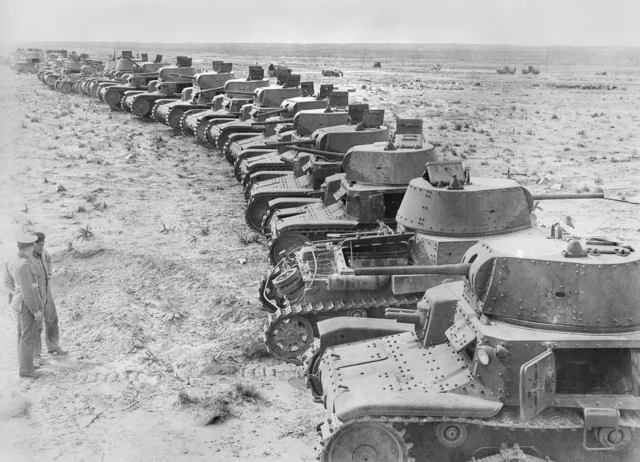
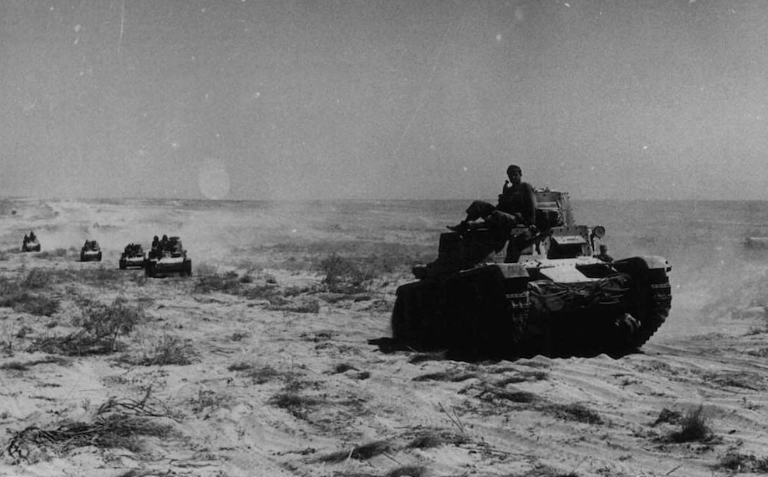
Italian M11/39 tanks advancing through the desert during the invasion of Egypt, September 1940.
Italian M11/39 tanks advancing into Egypt as part of the 10th Army's push toward Sidi Barrani, September 1940.
17th September 1940

At around 1am, British carrier-based aircraft from HMS Illustrious strike the port of Benghazi, sinking the destroyer Borea in harbour, while Aquilone is lost after striking a mine whilst attempting to flee the port. Two merchant ships, Maria Eugenia and Gloria Stella, are also sunk during the raid, resulting in the loss of 10,392 tons of shipping capacity and dealing a significant blow to the supply situation of the Italian 10th Army.

With the 10th Army’s plans for a deeper advance stalled and its forces now on the defensive, Graziani orders his units to begin constructing a chain of fortified camps intended to serve as staging points for a later advance. These positions were established around Maktila, Sidi Barrani, and Tummar, extending south-westward through Nibeiwa, Rabia, and Sofafi into the desert along the new front line. While the camps were individually well fortified, they were separated by vast stretches of open desert, leaving gaps of between 8 and 32 kilometres that were often beyond the range of mutual artillery support. British reconnaissance patrols soon identified this weakness.

Italian Flag

Italian High Command (Comando Supremo)

Official State Communiqué

Following the capture of Sidi Barrani by Italian forces - 17th September 1940

‘The Italian flag is flying over the soil of Egypt. The British are in full retreat.’
18th September 1940

As the 10th Army digs in, British forces begin an aggressive campaign of harassment across the desert using small, highly mobile “Jock Columns”, mixed formations of motorised infantry, 11th Hussars armoured cars, and light artillery. Simultaneously, RAF bombers strike supply routes and vehicle parks around Sidi Barrani in an effort to disrupt the flow of water, fuel, and supplies from the frontier, ensuring the Italian advance remains stalled while giving the Western Desert Force vital weeks to strengthen its defensive line at Mersa Matruh.

October 1940

3rd October 1940

British patrol activity intensifies around the newly established Italian fortified camps. Reconnaissance by the 11th Hussars and the 7th Support Group focuses on the vast, undefended stretches of desert between the camps at Nibeiwa, Tummar, and the Sofafi strongpoints, confirming a critical flaw in the Italian defensive system with the discovery of the Enba Gap, a 20-mile corridor of open desert between Nibeiwa and Sofafi that is firm enough to support heavy vehicles and lacks permanent Italian outposts or minefields. The discovery would play a decisive role in shaping Major General O’Connor’s future plans, offering the British the opportunity to bypass the Italian coastal defences entirely in favour of a deep armoured flanking manoeuvre.

12th October 1940

At 01:40am, the British light cruiser HMS Ajax intercepts elements of the Italian 1st Torpedo Boat Squadron and 11th Destroyer Flotilla, which are patrolling the Malta Channel around 30 miles south-east of Sicily in an attempt to intercept the British convoy MB6, which HMS Ajax is escorting from Alexandria to Malta. Known as the Battle of Cape Passero, the engagement sees HMS Ajax, equipped with a Type 279 radar set, detect and engage the Italian ships before they are fully prepared for action. By 01:48am, the Italian torpedo boats Airone and Ariel have been sunk. Shortly afterwards, at around 01:50am, HMS Ajax is hit seven times by a full broadside from the destroyer Artigliere, knocking out a radar set and two guns. HMS Ajax responds by scoring several hits on Artigliere shortly after 2am, killing her commanding officer, Commander Carlo Margottini, disabling her engines, and starting major fires aboard the vessel. Having fired nearly 500 shells and suffered moderate damage, HMS Ajax eventually ceases fire and breaks off pursuit of the remaining three destroyers of the flotilla.

13th October 1940

The crippled Italian destroyer Artigliere is spotted dead in the water at around 08:00am by a Sunderland flying boat. The British cruiser HMS York arrives on the scene shortly afterwards at approximately 08:30am. With the Italian crew abandoning ship, HMS York waits until the survivors are clear in their life rafts before firing a single torpedo at 09:05am, causing a massive explosion that sinks the destroyer almost immediately. HMS York then throws additional inflatable life rafts into the water for Italian sailors who cannot be accommodated in their own boats and broadcasts the location of the survivors in plain English over a commercial radio frequency so that the Italian Navy can dispatch rescue vessels. Most of Artigliere’s surviving crew, numbering around 100 men, are eventually rescued later that day by Italian naval forces.

28th October 1940

Italian strategic focus shifts away from North Africa as Mussolini launches the invasion of Greece from Albania. The new campaign dilutes the Italian war effort in North Africa, forcing the diversion of logistical resources and units of the Regia Aeronautica to the Albanian front. With Italy now increasingly overextended, Marshal Graziani’s 10th Army is forced to remain static in Egypt. British planners in Cairo quickly recognise there is now a window of opportunity with the Italians distracted and begin secretly preparing plans for a limited offensive intended to drive the Italians back out of Egypt.

November 1940

Operation Judgement - Taranto Attacked

11th November 1940

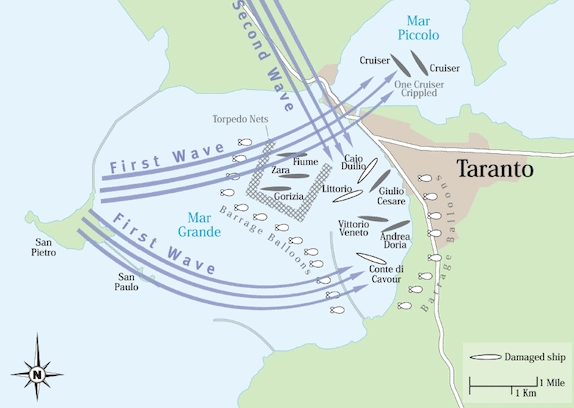
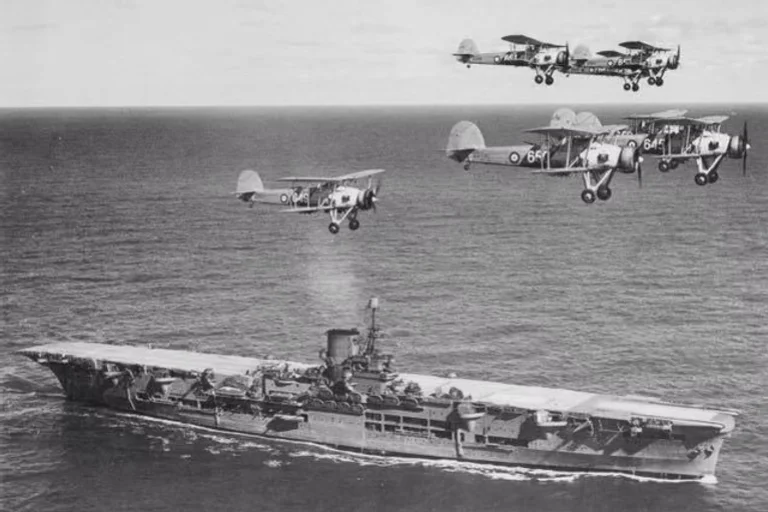
Operating from the Ionian Sea, around 170 miles south-east of the Italian naval base at Taranto, the British Mediterranean Fleet’s Force A, centred around the aircraft carrier HMS Illustrious and escorted by the battleships HMS Warspite, HMS Valiant, HMS Malaya, and HMS Ramillies, together with the 3rd Cruiser Squadron comprising HMS York and HMS Gloucester and a screen of 13 destroyers, begins Operation Judgement by launching a major air strike against the Italian naval base. Anchored in the harbour that night are six battleships, seven heavy cruisers, two light cruisers, and 28 destroyers.

The operation is executed in two waves:

  • 20:35: The first wave of 12 Fairey Swordfish takes off from HMS Illustrious. Arriving over Taranto at 22:58, the aircraft catch the Italians by surprise to devastating effect, scoring three torpedo hits: two on the battleship Littorio and one on Conte di Cavour.
  • 21:28: The second wave of nine Fairey Swordfish departs, arriving over the target at 23:55 amid much heavier anti-aircraft fire. Despite the alerted defences, the attackers score two additional torpedo hits: one on the battleship Duilio and another on the already damaged Littorio.

By 01:22 the following morning, the last British aircraft returns to HMS Illustrious. For the loss of two Swordfish aircraft, with two airmen killed and two captured, the British cripple one battleship (Conte di Cavour) and heavily damage two modern battleships (Littorio and Duilio), both of which require five to six months of repairs. Minor damage is also inflicted upon the cruiser Trento and the destroyer Libeccio. The attack effectively neutralises half of Italy’s battleship strength in a single night.

The dramatic shift in naval superiority secures British control of key Mediterranean supply routes and provides the Royal Navy with a major strategic advantage ahead of the forthcoming offensive in North Africa.

Map showing the Royal Navy air attack on the Italian fleet at Taranto harbour on 11th November 1940
Map illustrating the Royal Navy’s carrier-based air attack on the Italian fleet at Taranto harbour on 11th November 1940, showing the attack waves and damaged Italian battleships.
Fairey Swordfish torpedo bombers flying from HMS Illustrious before the Royal Navy attack on Taranto harbour, November 1940
Fairey Swordfish torpedo bombers from HMS Illustrious prepare for the Royal Navy’s carrier strike against the Italian fleet at Taranto harbour in November 1940.
25th November 1940

Major-General Richard O’Connor and General Archibald Wavell finalise the operational orders for Operation Compass, which is envisioned as a limited, high-speed raid. Due to the urgent need for troops on other fronts, the operation is strictly limited to five days. Its objective is to “disrupt and destroy” the Italian 10th Army’s forward camps, specifically targeting the Maletti Group and the Libyan Divisions, before withdrawing to the main British defensive line at Mersa Matruh ahead of any effective Italian response.

26th November 1940

Major-General O’Connor’s Western Desert Force begins “Training Exercise No. 1” at Point 71, a remote desert location specifically chosen for its resemblance to the terrain of the Enba Gap and featuring mock-up camps closely modelled on the Italian fortifications at Nibeiwa. The exercise serves as a full-scale dress rehearsal for Operation Compass, focusing on coordinated assault tactics between the 4th Indian Division, under Major-General Beresford-Peirse, and the 7th Royal Tank Regiment. It allows the infantry and heavily armoured Matilda II tanks to rehearse the complex manoeuvre of approaching and attacking a fortified perimeter from the rear, the “back door” strategy intended for the assault on Nibeiwa.

Absolute secrecy is maintained to prevent Italian aerial reconnaissance or spies from detecting any shift in British intentions, while the vast majority of the troops are led to believe the operation is merely a routine exercise. To reinforce the deception, administrative orders are issued for the establishment of semi-permanent winter camps and the distribution of cold-weather equipment, successfully convincing both the British rank and file and Italian intelligence that no major offensive is imminent.

28th November 1940

Final intelligence reports identify the fortified camp at Nibeiwa as the linchpin of the Italian defensive line. Commanded by General Pietro Maletti, the camp is a formidable rectangular fortress of sangars and trenches, with heavy minefields and anti-tank guns concentrated almost exclusively along its eastern and southern faces to repel any frontal British assault.

Following close reconnaissance by the 4th Indian Division, a fatal design flaw is identified on the north-western side of the camp, where Italian supply convoys are observed entering through a gap in the minefields.

General O’Connor approves a plan centred on the heavily armoured Matilda II tanks of the 7th Royal Tank Regiment, attached to the 4th Indian Division, conducting a wide night march around the camp to bypass its main defences entirely and launch a surprise attack on the Italian rear through this unguarded “back door”.

United Kingdom Flag

General Sir Archibald Wavell

Commander-in-Chief Middle East

Writing to Lieutenant-General Sir Henry Maitland Wilson before the launch of Operation Compass - 28th November 1940

‘I do not entertain extravagant hopes of this operation, but I do wish to make certain that if a big opportunity occurs we are prepared morally, mentally and administratively to use it to the fullest.’

December 1940

5th December 1940

The Italian torpedo boat Calipso, a modern Spica-class escort, is sunk after striking a mine approximately 6 miles east of Misrata (near Tripoli). The mine had been laid by the British minelaying submarine HMS Rorqual during one of its clandestine patrols across Italian supply routes. This loss further exposes the vulnerability of Italy’s maritime supply routes to Libya.

7th December 1940

Under the cover of a moonless night, the Western Desert Force begins “Training Exercise No. 2”, a 60-mile approach march towards the forward assembly area known as “Piccadilly”, a featureless stretch of desert south-west of the Italian camps. To maintain complete surprise, the movement is conducted in strict radio silence and without headlights. At this stage, the truth is finally revealed to the troops that this is no longer an exercise, and Major-General O’Connor issues orders informing his commanders that Operation Compass will begin on the morning of 9th December.

8th December 1940

The British strike force begins its final approach, moving through the 20-mile-wide Enba Gap in the Italian defensive line between the Nibeiwa and Rabia camps. The 7th Armoured Division and 4th Indian Division navigate with remarkable precision across the trackless desert to reach their designated start lines west of the fortifications. By nightfall, the 7th Royal Tank Regiment is concealed in the dead ground behind Nibeiwa Camp, while British artillery and RAF Blenheim bombers carry out diversionary attacks against the front of the Italian positions to mask the noise of the approaching tanks.

Although General Maletti reports hearing the distant movement of vehicles in the desert darkness, the Italian High Command dismisses the warning, believing it to be a routine supply convoy. The British advance remains undetected, and the Italian camps make no major preparations for an immediate attack.

Elements of Major-General Iven Mackay’s newly arrived 6th Australian Division continue concentrating in Egypt as Operation Compass enters its final preparatory stage. Although not expected to take part in the projected five-day offensive, the Australians are expected to assume responsibility for the defensive sectors around Mersa Matruh following its conclusion, relieving the experienced 4th Indian Division for operations elsewhere in the Middle East.

United Kingdom Flag

Major-General Richard O’Connor

Commander of the Western Desert Force

Speaking to his staff before the launch of Operation Compass - 7th December 1940

‘I am going to attack the enemy. If he is as strong as reported, I shall be beaten. If he is not, I shall beat him.’
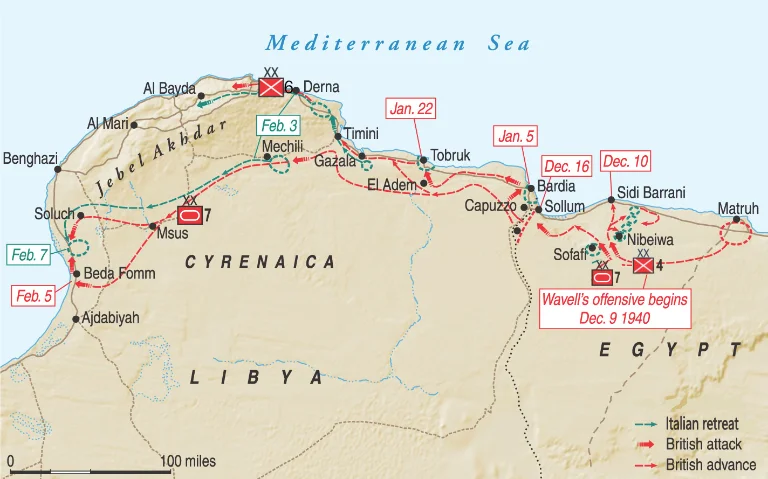
Operational map showing the British and Commonwealth advance during Operation Compass from Sidi Barrani through Bardia, Tobruk and Beda Fomm
Map showing the British and Commonwealth advance during Operation Compass, from the destruction of the Italian camps near Sidi Barrani to the capture of Bardia, Tobruk and the final interception of the Italian 10th Army at Beda Fomm.

Operation Compass Begins

9th December 1940

The Western Desert Force, commanded by Major-General O’Connor, begins Operation Compass, committing 31,000 troops, 275 tanks, 120 artillery guns, and 142 RAF aircraft to a high-stakes raid against the fortified positions of the Italian 10th Army in Egypt, consisting of approximately 80,000 troops, 120 tanks, 250 artillery guns, and 150 aircraft, with a further 100,000 troops, 400 tanks, 1,300 artillery guns, and 180 aircraft positioned behind the frontline in Libya.

At 07:15, Matilda II infantry tanks of the 7th Royal Tank Regiment launch a surprise assault through the unmined north-western entrance of the Nibeiwa fortified camp, catching the Italian defenders completely off balance. The infantry of the 11th Indian Infantry Brigade follow closely behind the armour into the perimeter. Although many Italian troops fight back desperately as they attempt to organise a defence, they are systematically overrun. Emerging from his tent in his pyjamas, General Pietro Maletti is killed at his command post whilst firing a machine gun at the advancing British troops. By 09:00, organised resistance by the Maletti Group at Nibeiwa has largely collapsed, and approximately 4,000 Italian troops are captured.

With the destruction of Nibeiwa, the southern anchor of the Italian defensive line is removed, exposing the flank of the entire camp system. O’Connor immediately capitalises on the breakthrough by ordering the 4th Indian Division and the remaining operational Matilda tanks of the 7th Royal Tank Regiment north towards the Tummar positions. These camps are defended primarily by elements of the Italian 2nd Libyan Division, numbering around 5,000 troops supported by artillery batteries, anti-tank guns, and fortified strongpoints.

  • 13:50: After a hasty redeployment and brief artillery bombardment, the 5th Indian Infantry Brigade, supported by the 7th Royal Tank Regiment, launches an assault on Tummar West. Learning from the morning’s success, the Matildas once again bypass the main minefields and attack from the north-west. The outer defences are quickly breached, but the Italian garrison rallies and puts up fierce bunker-by-bunker resistance.
  • 16:00: With Tummar West largely neutralised and thousands more Italian prisoners being rounded up, elements of the 5th Indian Brigade push aggressively eastward. They catch the garrison of Tummar East completely exposed whilst elements of the 4th Libyan Infantry Regiment, the 9th Libyan Infantry Battalion, and units of the 2nd Libyan Divisional Artillery attempt a poorly coordinated counter-attack in the open desert. The Italian force is shattered, and the camp is secured shortly before darkness falls.

Simultaneously, the 7th Armoured Division executes a wide flanking manoeuvre further west to isolate the battlefield:

  • 14:00: The 4th Armoured Brigade drives deep into the desert, bypassing the fighting at the Tummar camps entirely to sever the Via Balbia between Sidi Barrani and Buq Buq. By cutting the road near the coastal bottleneck at Azziziya, they isolate the Italian forward camps from their main supply bases at Sidi Barrani and Bardia.
  • 15:30: In the open desert, the light and cruiser tanks of the 7th Armoured Brigade intercept fleeing transport columns from the 1st Libyan Division. They also engage armoured units of the Maletti Group’s II Tank Battalion (M11/39 medium tanks) and LX Tank Battalion (tankettes). As these units attempt to screen the retreat, they are outmatched by the speed and superior wireless coordination of the British armour. Numerous Italian vehicles are abandoned or destroyed as the 7th Armoured Brigade sweeps across their line of retreat.

By dusk, O’Connor’s dual-pronged strategy has achieved complete tactical success, tearing a massive hole through the centre of the Italian 10th Army’s defensive line and penetrating all the way to the coast. In the process, British and Commonwealth forces maul elements of two Italian divisions, capture more than 10,000 prisoners together with dozens of tanks and artillery pieces, and isolate the remaining forward Italian positions, many of which remain largely unaware that their rear lines have already been severed.

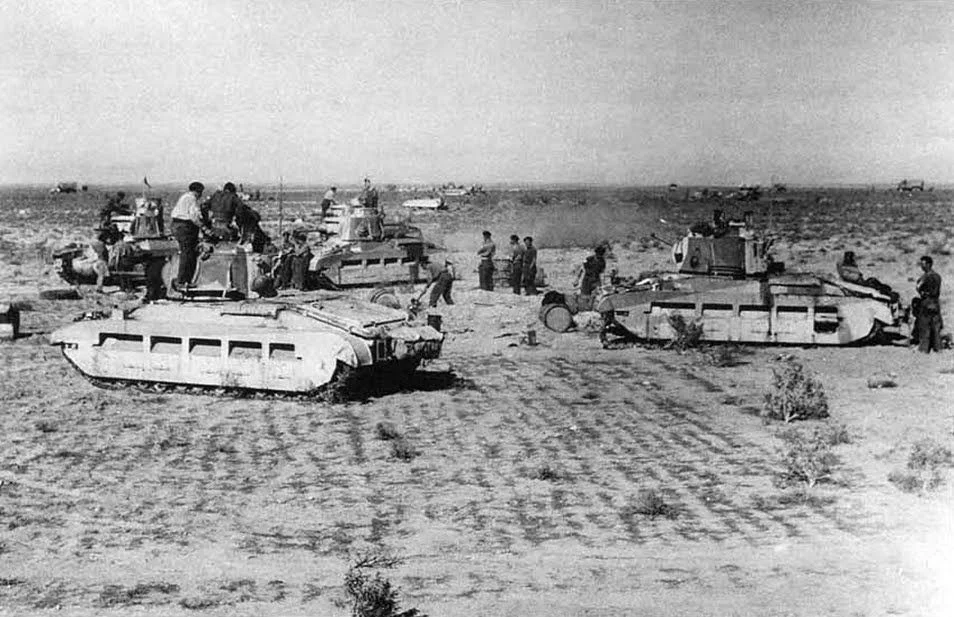
British Matilda II infantry tanks advancing across the North African desert during Operation Compass, 1940
British Matilda II infantry tanks manoeuvre across the desert during Operation Compass, where their heavy armour played a major role in the defeat of the Italian 10th Army in North Africa during December 1940.
10th December 1940

At 05:30 on day 2 of Operation Compass, British artillery opens a heavy bombardment against the positions of the Italian 1st Libyan Division and the 4th “3 Gennaio” Blackshirt Division around Sidi Barrani. Strong winds and blowing sand helps to conceal the approach of the British armour, allowing the Matilda II tanks of the 7th Royal Tank Regiment to close on the Italian wire before being detected. Supporting the land offensive, units of the Mediterranean Fleet, including the monitor HMS Terror and the gunboats HMS Aphis and HMS Ladybird, shell Italian coastal batteries and defensive positions, disrupting attempts to coordinate a response along the coast.

At 10:00, the 16th British Infantry Brigade, supported by the remaining operational Matilda II tanks, launches a frontal assault through the desert storm. The Italian defenders, particularly troops of the 1st Libyan Division, fight stubbornly from stone sangars, trenches, and machine-gun nests. Yet the Italians possess little capable of stopping the heavily armoured Matildas. Emerging through the dust and smoke like “iron monsters”, the British tanks shrug off repeated hits as Italian 47mm anti-tank rounds bounce harmlessly from their thick frontal armour.

By 13:30, the 4th “3 Gennaio” Blackshirt Division discovers its retreat routes have been severed by the 7th Armoured Division to the west and the advancing 16th Brigade to the south. Under mounting pressure from multiple directions, the division’s command collapses and thousands of Blackshirts surrender alongside their commander, General Filippo Diamanti, as British and Indian forces systematically overrun the remaining strongpoints.

After a full day of heavy and often close-quarters fighting, British and Indian troops finally break into Sidi Barrani at around 17:30, and by nightfall most the town and “Sidi Barrani Pocket” have been cleared, yielding a further 20,000 prisoners and completing the destruction of the forward Italian camp system.

The victory, however, comes at a hidden cost. The 7th Royal Tank Regiment is now reduced to only around 15 to 20 operational Matilda II tanks, as combat damage and the abrasive desert sand inflict increasing strain on the engines and tracks. O’Connor also faces growing logistical problems managing the vast numbers of Italian prisoners.

11th December 1940

During the morning, the remaining Italian positions around the harbour and nearby dunes at Sidi Barrani, held largely by remnants of the 4th “3 Gennaio” Blackshirt Division and other surviving elements of the Libyan Corps, surrender to the 16th British Infantry Brigade, with General Sebastiano Gallina, commander of the Libyan Corps, among those captured. Further east, Maktila, held primarily by the battered 1st Libyan Division, is overrun by Selby Force, an ad hoc formation built around the Coldstream Guards, King’s Royal Rifle Corps, supporting artillery, and elements of the 7th Support Group.

Italian XXI Corps units defending the Rabia and Sofafi camps, primarily elements of the 63rd “Cirene” and 64th “Catanzaro” Infantry Divisions, begin a disorganised retreat westward towards Buq Buq and the Libyan frontier as the collapse of the Sidi Barrani position threatens to cut them off entirely.

Following the complete destruction of the Italian forward camp system, the Western Desert Force has captured approximately 38,000 prisoners, together with 237 artillery pieces and 73 tanks, at a cost of fewer than 700 British and Commonwealth casualties and 25 tanks, although most of the tank losses are mechanical and many will later be returned to service.

The scale of the Italian collapse convinces General Wavell to abandon the original concept of Operation Compass as a limited five-day raid and instead authorise continued offensive operations against the retreating Italian 10th Army.

With the success of Operation Compass now exceeding all expectations, General Wavell orders the experienced 4th Indian Division to prepare for transfer to Sudan for operations against Italian East Africa. Its place in the Western Desert Force is to be taken by the newly arrived 6th Australian Division, although it will require several more days before it is fully prepared for offensive operations.

United Kingdom Flag

Major-General Richard O’Connor

Commander of the Western Desert Force

Reporting the scale of Italian prisoners captured during Operation Compass – 11th December 1940

‘Total of prisoners as yet unknown, but they are about five acres of officers and two hundred acres of other ranks.’

British Pathé Footage: Aftermath of Sidi Barrani (December 1940)

Contemporary British Pathé newsreel footage documenting the immediate aftermath of the battle at Sidi Barrani. The film captures the logistical scale of Operation Compass, showing Allied forces sorting through vast amounts of captured Italian military equipment and organizing the evacuation of thousands of Tenth Army prisoners across the desert.
12th December 1940

As the Italian 63rd “Cirene” and 64th “Catanzaro” Divisions attempt to flee westward toward the Libyan frontier, they become heavily congested along the narrow coastal road. Near Buq Buq, with the Italian columns hemmed in between the salt marshes and the sea, the 7th Hussars and 8th Hussars of the 7th Armoured Brigade, equipped with Cruiser tanks, attack the flank of the trapped columns, routing them. By evening, a further 14,000 Italians and 68 guns have been captured, effectively destroying the remaining cohesive elements of the Italian XXI Corps in Egypt.

13th December 1940

The vanguard of the 7th Armoured Division reaches the Egyptian–Libyan frontier, bypassing Sollum as light tanks of the 11th Hussars breach the Italian-built “Frontier Wire” and push into Cyrenaica toward Fort Capuzzo, marking the first British invasion of Italian territory during the war.

United Kingdom Flag

Winston Churchill

Prime Minister of the United Kingdom

A telegram sent to Wavell after the initial success at Sidi Barrani - 13th December 1940

‘I am sure you will do your best to make this a 'crushing victory' and not a 'mere successful operation.’
14th December 1940

Cruiser tanks of the 4th Armoured Brigade, 7th Armoured Division, sweep wide around the heavily fortified port of Bardia to the south and west, severing the tracks linking the town with the inland stronghold of Sidi Azeiz. The move cuts communications between Bardia and Tobruk, effectively trapping what remains of General Annibale “Rino” Bergonzoli’s Italian XXIII Corps inside the Bardia perimeter.

The isolated garrison consists of the 62nd “Marmarica” Infantry Division, remnants of the 63rd “Cirene” Infantry Division, the 1st “23 Marzo” and 2nd “28 Ottobre” Blackshirt Divisions, XXIII Corps artillery units, and Frontier Guard (Guardia alla Frontiera) troops, specialist fortress forces responsible for manning the permanent concrete bunkers and fortifications of the “Bardia Line”. In total, around 45,000 Italian and Libyan troops, supported by approximately 430 guns and 120 tanks, are now isolated inside the fortress.

15th December 1940

Lacking the infantry and heavy artillery necessary to storm Bardia’s 18-mile defensive perimeter, the 7th Armoured Division establishes a firm blockade to prevent any Italian breakout attempt whilst awaiting the arrival of the 6th Australian Division. Meanwhile, the RAF and Royal Navy begin a systematic bombardment of the port.

16th December 1940

The 4th Armoured Brigade assaults Fort Capuzzo, which is defended by a garrison from the Frontier Guard (GaF) and elements of the 63rd “Cirene” Infantry Division. Fearing total encirclement, the Italians attempt a hurried withdrawal toward Bardia. During the brief engagement and subsequent pursuit, approximately 500 Italians are captured, with dozens more killed or wounded. Only a motorised column of around 800 men, largely from the 63rd “Cirene” Division, succeeds in outrunning the British armour and reaching Bardia.

Simultaneously, the 11th Hussars and elements of the 7th Support Group move to assault the small coastal port of Sollum, which is held by remnants of the 1st Libyan Division and local Frontier Guard units. The Italians are quickly overrun, suffering around 300 killed or captured. With Sollum now in British hands the Halfaya Pass is now secure.

Further inland, the 6th Royal Tank Regiment and the motorized infantry of the 2nd Battalion, Rifle Brigade (Prince Consort’s Own) seize the strategic crossroads and airfield at Sidi Azeiz. Defended by XXIII Corps rearguard units and artillery from the “Cirene” Division, this sector witnesses the day’s largest capitulation, with around 1,200 Italians taken prisoner and over 800 supply trucks captured, while the British suffer only a handful of wounded.

20th December 1940

The Royal Navy officially begins using the port of Sollum as a forward supply base. Although the Italians had sabotaged the harbour facilities, naval engineers and supply parties were quickly able to restore enough capacity to begin landing urgently needed water, fuel, and ammunition. This marks a major logistical improvement for the Western Desert Force, which had previously been forced to haul supplies from the Mersa Matruh railhead, around 100 miles to the east. Supplies now only need to travel around 15-25 miles from Sollum to British and Australian units positioned around the Bardia perimeter.

27th December 1940

With the 6th Australian Division now largely in position around the Bardia “Box”, aided in part by the large number of Italian transport vehicles captured during the assault on Sidi Azeiz on the 16th December, the first combat engagements of Operation Compass involving Australian troops begin as patrols probe the Italian perimeter. Reconnaissance parties from the 2/5th Battalion of the 17th Australian Brigade move towards the south-western sector of the defences to test Italian reaction times and fire patterns. They are met with heavy machine-gun fire and a barrage of Italian flares, resulting in the first Australian soldier being wounded during the campaign. The action confirms to Major-General Iven Mackay that the Frontier Guard (GaF) and 62nd “Marmarica” Division units manning the perimeter remain alert and well-supplied with ammunition.

28th December 1940

To gather technical intelligence on the Italian fortifications around Bardia and assess the morale of the defenders, small teams of Australian sappers and infantry from the 16th Australian Brigade crawl to the outer edge of the Italian barbed-wire entanglements under cover of a moonless night. Using silent wire-cutters, they create several small gaps in the perimeter before withdrawing undetected, deliberately leaving the damage clearly visible. Observing the wire through binoculars the following morning, the Australians note that the Italian garrison makes no attempt to repair the breaches, indicating an unwillingness to patrol the “no man’s land” between the perimeter wire and the anti-tank ditch.

29th December 1940

Under cover of darkness, reconnaissance patrols from the 2/6th Battalion of the 16th Australian Brigade survey the Italian wire near Post 11 in the western sector of the Bardia perimeter. The Australians physically measure the anti-tank ditch and discover that it has become partially filled with drifted sand, making it traversable for tanks. This vital intelligence identifies a vulnerable “soft spot” in the 18-mile perimeter that can be exploited when the main assault is launched.

31st December 1940

To disrupt the 45,000 Italians trapped in Bardia from resting or reorganising, the Royal Navy and RAF launch a coordinated New Year’s Eve bombardment. The gunboats HMS Aphis and HMS Ladybird, together with the monitor HMS Terror, shell the harbour and coastal defences with sustained 6-inch and 15-inch gunfire. Inside the fortress, General Bergonzoli reports to Tripoli that his troops are exhausted by the “terrible and constant” bombardment from sea and air.

January 1941

1st January 1941

To ensure the upcoming assault on Bardia by the 6th Australian Division has maximum striking power, the remaining 22 serviceable Matilda II tanks of the 7th Royal Tank Regiment are moved into concealed assembly areas behind the 16th Australian Brigade. Because the Matilda’s engine noise is distinctive and carries across the desert at night, RAF aircraft fly low along the Italian perimeter to mask the sound of the approaching tanks. Meanwhile, Australian engineers complete the preparation of hundreds of Bangalore torpedoes, which will be used to blast gaps through the Italian barbed-wire defences.

Western Desert Force (WDF) is officially redesignated as XIII Corps.

2nd January 1941

A tense quiet settles over the Bardia perimeter as Major-General Iven Mackay issues his final orders for “Operation Post 11”, the planned breach of the Italian defences. Throughout the day, Australian officers carry out final binocular observations of the Italian positions, ensuring every bunker, strongpoint, and machine-gun nest is plotted for the artillery bombardment. In a final psychological strain on the defenders, the Royal Navy and RAF maintain intermittent but harassing bombardments, forcing the Italians to remain inside their shelters and preventing them from observing the final British and Australian preparations. By nightfall, nearly 2,000 men from the 2/1st and 2/2nd Battalions of the 16th Australian Brigade begin moving silently towards their jump-off positions, crawling to within only a few hundred yards of the Italian wire.

The Battle of Bardia

3rd January 1941

XIII Corps launches its assault on Bardia with the Australian 6th Division and the 7th Royal Tank Regiment. Defending the fortress is General Annibale “Rino” Bergonzoli’s Italian XXIII Corps, built primarily around the 62nd Infantry Division “Marmarica”, Frontier Guard (GaF) fortress troops, the 1st and 2nd CC.NN. Divisions, and remnants of the 63rd Infantry Division “Cirene”, supported by large numbers of corps artillery. While the Italians possess a substantial numerical advantage in infantry and guns, the British and Commonwealth forces maintain a decisive technological and qualitative edge.

  • XIII Corps: 16,000 troops, 22 Matilda II tanks, 118 guns, 100 aircraft.
  • Italian XXIII Corps: 45,000 troops, 120 tanks, 430 guns.

At 05:30, the silence is shattered by a massive artillery barrage from more than 100 British and Australian guns, coordinated with the 15-inch naval guns of HMS Terror offshore. Under cover of this bombardment, the 2/1st Battalion of the 16th Australian Brigade rushes the wire. Engineers detonate Bangalore torpedoes to blast wide gaps through the entanglements, while other sappers use shovels and pickaxes to create crossings over the anti-tank ditch near Post 11.

By 07:00, the first Matilda II infantry tanks of the 7th Royal Tank Regiment rumble through the breaches. Many defenders of the 62nd “Marmarica” Division, stunned by the bombardment and unable to stop the heavily armoured tanks, begin surrendering in large numbers as Australian infantry and Matildas overrun the concrete strongpoints. However, the garrison at Post 11 puts up determined resistance, engaging A Company of the 2/1st Battalion in brutal close-quarters fighting with grenades and bayonets. In capturing the position, the Australians suffer 5 killed and 30 wounded, while inflicting approximately 24 Italian dead, 50 wounded, and taking around 350 prisoners.

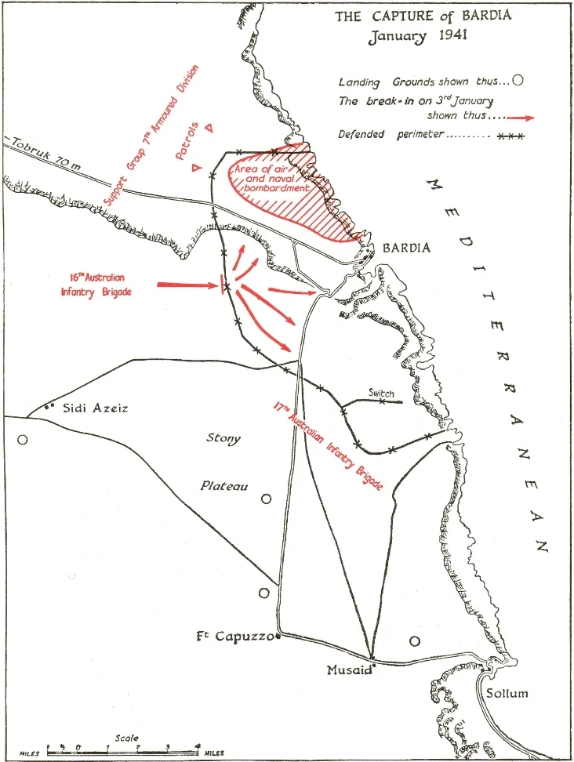
By midday, the 16th Australian Brigade has punched a breach roughly two miles wide and one mile deep into the Bardia perimeter. Following close behind, the 17th Australian Brigade passes through the gap and swings south to begin clearing the secondary Italian defensive line.

Throughout the afternoon, Australian infantry and Matilda II tanks methodically roll up the Italian strongpoints from the rear, isolating bunker positions and forcing repeated surrenders. In several sectors, Italian artillery crews continue fighting stubbornly even after being surrounded, while pockets of Blackshirt and Frontier Guard troops resist around fortified posts and communication trenches.

By evening, more than 8,000 Italian prisoners have been captured, large sections of the western perimeter are in Australian and British hands, and the supposedly “impenetrable” Bardia fortress system has been decisively shattered.

Map showing the Australian assault on Bardia during Operation Compass, including the 16th and 17th Australian Brigades' breakthrough of the Italian defensive perimeter on 3rd January 1941.
Map showing the opening assault of the Battle of Bardia on 3rd January 1941. The 16th Australian Brigade breached the western sector of the Italian defensive perimeter, allowing the 17th Australian Brigade and supporting Matilda II tanks of the 7th Royal Tank Regiment to expand the breakthrough during Operation Compass.
4th January 1941

At first light, the 16th Australian Brigade resumes its advance toward the centre of the Bardia fortress, supported by the remaining Matilda II tanks. Despite the chaos of the previous day, the Italians attempt to reorganize their defence along the Wadi Gerfan, a deep natural obstacle protecting the town of Bardia. However, the speed of the Australian infantry and the psychological impact of the "invincible" Matildas prevent a cohesive Italian counter-attack.

At about 16:00, the 2/2nd and 2/5th Battalions reach the escarpment overlooking the lower town and harbour. From these heights, the Australians witness thousands of Italian soldiers milling about the town in a state of confusion. Under a white flag of surrender, the local Italian commander, General Ruggero Tracchia, and his staff emerge to negotiate the immediate surrender of the town area itself to the Australians and by approximately 17:00, Bardia is officially occupied and the Australian flag is raised over the town hall.

Recognizing that the fortress is entirely compromised, the overall Italian commander, General Annibale “Electric Whiskers” Bergonzoli (nicknamed for his wire-brush beard), concludes that the situation is hopeless. Along with his senior staff, Bergonzoli slips out of the perimeter and begins a desperate escape on foot through the desert toward Tobruk, leaving his remaining divisions to face their fate.

With the sun setting, the sheer scale of the victory becomes a logistical burden as the haul of Italian prisoners swells to nearly 30,000, far outnumbering the available Australian guards who herd the Italians into makeshift "cages" on the desert floor. Aside from prisoners, the Australian units find themselves in possession of the town's captured stores, which include millions of rounds of ammunition, thousands of tons of food, and hundreds of abandoned trucks.

5th January 1941

The remaining pockets of Italian resistance in the northern "Gerfah" sector of the fortress, consisting primarily of the 2nd CC.NN. Blackshirt Division "28 Ottobre" and remnants of the 62nd Infantry Division "Marmarica", recognise that they are cut off, outflanked, and lack effective weapons capable of dealing with the Matilda II tanks. At approximately 13:30, they surrender unconditionally to the 19th Australian Brigade.

The three-day operation proves a total disaster for the Italian 10th Army, with losses amounting to approximately 1,700 killed, 3,740 wounded, and more than 36,000 captured, including four generals and their staffs. In addition, vast quantities of military equipment fall into Australian hands, including around 400 artillery pieces, 130 tanks, and more than 700 transport vehicles. In stark contrast, the 6th Australian Division suffers just 130 killed and 326 wounded.

British Pathé Footage: The War in Libya - Bardia (January 1941)

Original British Movietone newsreel coverage capturing the heavy coastal bombardment and subsequent capture of the Libyan fortress town of Bardia by Australian and British forces in early January 1941.
6th January 1941

With Bardia's surrender, the British 7th Armoured Division immediately pivots its operational focus towards the heavily fortified port city of Tobruk, 60 miles to the west. In the van is the 4th Armoured Brigade, with the cruiser tanks of the 2nd Royal Tank Regiment and the light tanks of the 7th Hussars driving along the Via Balbia coastal highway, while the armoured cars of the 11th Hussars screen ahead across the desert tracks in an effort to reach and isolate the city before the Italians can escape.

Meanwhile, the 6th Australian Division remains at Bardia to secure the 36,000 prisoners and sort through the immense quantities of captured military stores.

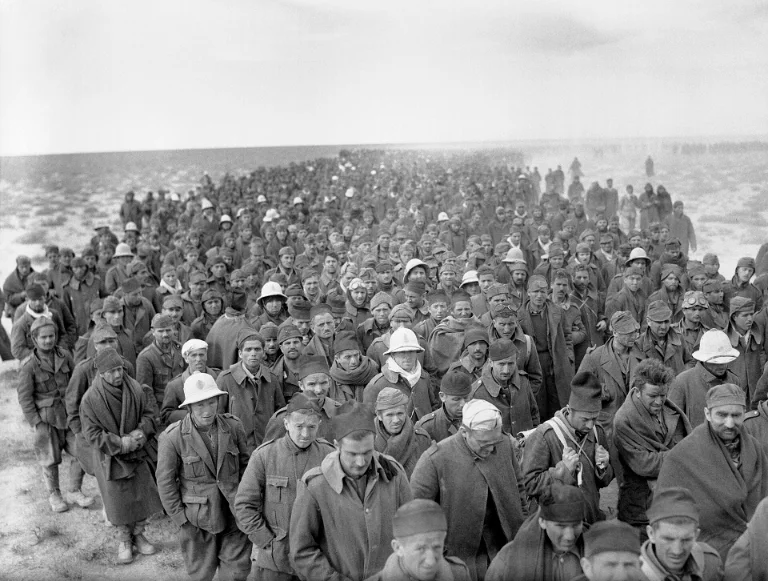
Italian prisoners of war captured during the Battle of Bardia march into captivity following the British offensive during Operation Compass, January 1941.
Italian prisoners of war captured following the fall of Bardia march into captivity during the British Operation Compass offensive in January 1941.
7th January 1941

The 7th Armoured Division reaches the outskirts of Tobruk, with the armoured cars of the 11th Hussars and the cruiser tanks of the 7th Armoured Brigade sweeping around the southern flank of the fortress and capturing Acroma, approximately 10 miles west of Tobruk, thereby cutting the western routes leading towards Derna and Mechili. Meanwhile, the 4th Armoured Brigade positions itself to seal the eastern and south-eastern approaches. By nightfall, Tobruk is completely isolated from the rest of Cyrenaica.

Trapped inside the perimeter is General Enrico Pitassi Mannella's XXII Army Corps, consisting primarily of the 61st Infantry Division "Sirte", the Volontari della Libia and 140th Blackshirt Battalions, the elite 22nd and 51st Bersaglieri Motorcycle Companies, and the 4th Tank Infantry Regiment. Together, these forces total around 25,000 men, 230 field guns, and 70 tanks. They defend a 30-mile semi-circular perimeter around the city, complete with anti-tank ditches, barbed wire, and concrete bunkers built to the same design principles as those encountered at Bardia.

8th January 1941

Following a swift march from Bardia, the 19th Australian Brigade arrives outside the eastern defences of Tobruk to reinforce the 7th Armoured Division.

9th January 1941

The 19th Australian Brigade officially takes over operational responsibility for the eastern sector of the perimeter, relieving the British 4th Armoured Brigade. This handover allows the British armour to withdraw from the static siege lines and transition into an outer screening force operating in the desert. Meanwhile, under cover of darkness, Australian engineers move forward to begin the dangerous task of locating and mapping the Italian minefields protecting the approaches to the anti-tank ditch.

10th January 1941

The 16th Australian Brigade arrives from Bardia and deploys along the central and southern sectors of the Tobruk perimeter, freeing the 7th Armoured Brigade. Throughout the day, Italian artillery shells the Australian positions, including fire from the long-range 10-inch guns of the armoured cruiser San Giorgio, which remains blockaded in Tobruk harbour by the Royal Navy.

11th January 1941

As the handover of the perimeter nears completion, the 17th Australian Brigade moves into position, taking over the western and south-western sectors from the 11th Hussars and the 2nd Battalion, Rifle Brigade (part of the 7th Armoured Division's Support Group).

With all three of the 6th Australian Division's brigades now firmly established around the fortress's 30-mile defensive perimeter, the 7th Armoured Division fully detaches from the siege lines, establishing wide-ranging patrols towards Mechili and El Adem to screen the desert flanks against any potential Italian relief force.

The Siege of Tobruk

12th January 1941

The handover of the Tobruk investment is completed as Major-General Iven Mackay, commander of the 6th Australian Division, formally assumes responsibility for the siege from Major-General Sir Michael O'Moore Creagh's 7th Armoured Division.

He begins planning a deliberate, coordinated assault on the fortress and orders Australian patrols to intensify their nightly reconnaissance. Their task is to gather intelligence on the Italian defensive positions, identify strongpoints, and locate weaknesses in the wire and anti-tank obstacles ahead of the forthcoming attack.

13th January 1941

More than 100 guns of the 6th Australian Division and support regiments from the XIII Corps are gradually moved into carefully prepared and camouflaged firing positions facing the southern sector of the Tobruk perimeter.

Supply columns begin stockpiling vast quantities of artillery ammunition and fuel at advanced supply dumps south of the Sidi Mahmud crossroads to support the upcoming assault on Tobruk.

14th January 1941

Major-General Iven Mackay officially issues Operation Order No. 3 for the capture of Tobruk. The plan mirrors the strategy used at Bardia, with a concentrated breach planned in the central-southern sector of the perimeter between Posts 55 and 57, spearheaded by the 16th Australian Brigade.

The 7th Armoured Division consolidates its outer screening force, shifting its advanced headquarters to Acroma and transforming the position into a heavily fortified blocking line against any Italian forces attempting to advance from Derna.

15th January 1941

Night reconnaissance patrols from the 2/3rd Battalion, 16th Australian Brigade, accompanied by field engineers, clash with Italian outposts while mapping the anti-tank ditch, though neither side suffers any casualties. They confirm that the ditch in the chosen breakthrough sector is approximately 7 feet deep and is not protected by minefields along its immediate edge.

Crucially, the scouts discover that the outer concertina wire is not securely anchored to the ground in several places, although it is heavily rigged with tripwires connected to Breda hand grenades and field mines. Furthermore, the patrols successfully map the machine-gun firing arcs of Post 55, revealing a blind spot that would allow a direct frontal approach under cover of darkness.

16th January 1941

The RAF's No. 202 Group begins an intensive air campaign to systematically soften Tobruk's defences. By day, Bristol Blenheims of No. 45 and No. 55 Squadrons conduct precision attacks against Italian artillery positions and observation posts along the southern perimeter. By night, the heavier Vickers Wellington bombers of No. 70 and No. 148 Squadrons strike the town and harbour in an effort to destroy fuel dumps, supply depots, and port infrastructure.

17th January 1941

Firing air-burst shrapnel shells and utilising coordinates provided by forward observers and the blockaded cruiser San Giorgio, Italian artillery steps up its interdiction fire in an attempt to disrupt Australian field engineers clearing lanes through the outer wire. In response, Australian units use transport vehicles to deliberately churn up vast clouds of desert dust, blinding enemy observation posts and providing cover for the exposed wire-cutting parties.

18th January 1941

Engineers (sappers) from the 6th Australian Division's 2/1st and 2/8th Field Companies complete the final mapping of the Italian booby traps and concertina wire, setting up a scale replica of the Italian Post 55-57 sector in the open desert miles behind the front lines. Using this mock-up, infantry platoons from the 2/3rd Battalion, 16th Australian Brigade, spend the day rehearsing the precise timing of their wire-cutting, ditch-bridging, and assault manoeuvres.

Meanwhile, the Italian fortress commander, General Enrico Pitassi Mannella, notices the increasing concentration of Allied artillery registration on the eastern perimeter. In response, he orders the remaining tanks of the 61st Infantry Division "Sirte", consisting of immobilised M11/39 medium tanks and L3/35 tankettes, to be dug into hull-down positions along the secondary line of defence near the junction of the El Adem and Bardia roads. The buried vehicles effectively transform the position into a network of improvised anti-tank and machine-gun strongpoints.

19th January 1941

XIII Corps officially fixes the launch date for the assault on Tobruk for the morning of 21st January. To support the operation, the Royal Navy's Inshore Squadron, including the Insect-class gunboat HMS Ladybird, coordinates with the 6th Australian Division headquarters to finalise a synchronised timetable for coastal naval gunfire intended to bombard and distract the Italian eastern flank.

Under the cover of a moonless night, patrols from the 16th Australian Brigade stealthily drive white painted wooden alignment pegs into the desert floor facing Italian Posts 54, 55, and 56. These markers allow the dark adapted infantry assault waves to guide themselves to their exact jumping off points without using lights or making a sound.

From Tobruk harbour, the heavily damaged cruiser San Giorgio, now operating as a static fortress battery, uses its 10 inch (254 mm) naval guns to fire unobserved interdiction barrages towards the El Adem crossroads. Prompted by the sound of heavy vehicle traffic, the bombardment confirms that the Italian garrison anticipates an imminent assault.

20th January 1941

The coordination between XIII Corps and the RAF reaches its peak as Air Commodore Raymond Collishaw's No. 202 Group unleashes a continuous 24 hour bombardment cycle over Tobruk, with Bristol Blenheims attacking targets along the perimeter during the day and Vickers Wellingtons flying in relays throughout the night, dropping tons of high explosive bombs on the town, port facilities, and known Italian artillery positions.

Between 19:00 and 20:00, and under cover of this deafening aerial bombardment, the Matilda II tanks of the 7th Royal Tank Regiment and infantry from the 16th Australian Brigade begin moving through the darkness from their rear assembly areas. By about 22:00, the infantry are filtering through lanes marked by white-painted wooden pegs towards their final jumping-off positions, located 2,000 to 3,000 yards from the Italian wire, while the Matildas form up at their designated armored start lines just to the rear.

Australian Flag

Major-General Iven Mackay

Commander of the 6th Australian Division

Addressing his troops before the assault on the fortress of Tobruk - 20th January 1941

‘The Italians are many, but they are not the men we are. We shall go through them like a knife through butter.’

Assault on Tobruk

21st January 1941

Between 03:00 and 04:00, the Matilda II tanks of the 7th Royal Tank Regiment and the assault troops of the 16th Australian Brigade reach their final jumping off positions and lie silently on the cold desert floor opposite the Italian wire.

With Major General Iven Mackay's troops poised to launch their assault on Tobruk, they face General Enrico Pitassi Mannella's Italian XXII Corps, built around the 61st Infantry Division "Sirte", Blackshirt and Bersaglieri units, and numerous fortress troops who occupy a formidable defensive position protected by anti-tank ditches, wire entanglements, concrete bunkers, and extensive artillery.

  • XIII Corps: 22,000 troops, 18 Matilda II tanks, 114 guns, approximately 100 aircraft.
  • Italian XXII Corps: 25,000 troops, 70 tanks, 230 guns.

At 05:30, British and Australian artillery completes its final registrations and preparations for the attack. Ten minutes later, all 114 guns open fire, unleashing a coordinated barrage against the southern sector of the Tobruk perimeter. Directly in the path of the attack are positions held by troops of the Italian 61st Infantry Division "Sirte", supported by fortress machine-gun detachments and artillery crews. Under cover of the shelling, sappers from the 6th Australian Division's engineering companies detonate Bangalore torpedoes to blast gaps through the wire and rapidly bridge the anti-tank ditch between Posts 55 and 57. Led by the 2/3rd Battalion, the infantry of the 16th Australian Brigade surge through the breach while the Matilda IIs of the 7th Royal Tank Regiment lumber forward behind them.

The impact of the attack is immediate. Many Italian defenders are stunned by the intensity of the bombardment and the appearance of the heavily armoured Matildas. As at Bardia, many Italian anti-tank weapons prove incapable of penetrating the Matildas' thick armour, allowing the tanks to smash through the perimeter and support the advancing infantry. Several forward strongpoints are overrun within minutes, while others continue fighting stubbornly from concrete bunkers and trench systems. As Australian infantry clears the first defensive line, engineers widen the crossings to allow additional troops, artillery, and vehicles to enter the fortress.

By mid-morning, the 16th Australian Brigade breaks through the outer perimeter and begins advancing towards the key road junction at Sidi Mahmud. The 2/2nd Battalion fights its way north through the secondary defences, capturing strongpoints and taking hundreds of prisoners. Italian artillery batteries continue firing from isolated positions, but many are gradually surrounded and forced to surrender.

As the assault waves fan out across the fortress, the defenders lose the ability to coordinate a coherent response. Communications break down across large sections of the perimeter, while Australian infantry and Matilda tanks systematically reduce individual pockets of resistance. Once the vital crossroads at Sidi Mahmud, where the roads to Bardia, Tobruk, and El Adem converge, is secured and the surrounding area cleared, Major General Iven Mackay moves the 6th Australian Division's advanced tactical headquarters into a captured dugout between 13:00 and 14:00, allowing him to direct the battle from inside the breached fortress and maintain direct communication with his brigade commanders.

By evening, the Australians hold a deep salient inside the Tobruk perimeter. Large sections of the fortress's outer defensive system are overrun, numerous artillery positions fall into Australian hands, and Australian forces take an estimated 8,000 to 10,000 Italian prisoners. General Pitassi Mannella's garrison remains capable of resistance, but the initiative has firmly passed to the Australians.

United Kingdom Flag

General Sir Archibald Wavell

Commander-in-Chief Middle East

Letter sent from Cairo to O'Connor on the eve of Tobruk’s fall - 21st January 1941

‘I am not going to worry you with any instructions except to go ahead and do what you think is possible... the more of the Italian army you can destroy, the better.’

Capture of Tobruk

22nd January 1941

In the dark, pre-dawn hours at approximately 04:15, the crew of the crippled cruiser San Giorgio receives the order to abandon ship and set off demolition charges in the vessel's magazines, creating a massive detonation and scuttling her in the harbour to ensure her powerful naval batteries cannot be turned against Italian forces. With first light around 06:45, she can be seen resting heavily in the harbour mud, engulfed by flames and belching a colossal column of dense black smoke into the morning sky.

The 16th Australian Infantry Brigade and the remaining operational Matilda II tanks of the 7th Royal Tank Regiment resume their drive northwards and, by 10:30, troops from the 2/8th Australian Battalion reach the knoll housing the subterranean headquarters of General Enrico Pitassi Mannella. Following a brief exchange of small arms fire with the external security detail, the infantry successfully force entry into the bunker, capturing the General and his immediate staff by 11:00. When requested to issue a blanket surrender order to the entire garrison to prevent further bloodshed, Pitassi Mannella refuses, stating that communication lines are entirely severed and individual sector commanders must act on their own initiative.

By noon, Australian columns secure the commanding cliffs overlooking the northern harbour and begin pushing directly into the town of Tobruk. Although organised resistance is rapidly collapsing, several isolated strongpoints continue to hold out into the afternoon as Australian troops methodically clear the remaining urban and coastal districts. By 16:00, all meaningful resistance ceases, and Regia Marina Admiral Massimiliano Vietina meets with British and Australian commanders to sign the formal instrument of unconditional surrender, marking the fall of Tobruk.

Australian and British casualties remain remarkably light for an assault against such formidable defences, amounting to 49 killed and 306 wounded, most of them sustained by the frontline battalions of the 16th Australian Infantry Brigade during the initial breach of the perimeter.

Italian losses are far heavier, with approximately 750 troops killed and more than 2,200 wounded during the fighting, while over 25,000 personnel, including several general officers and senior naval staff, are taken prisoner. Australian and British forces also capture vast quantities of military equipment, including 236 artillery pieces, around 70 tanks and tankettes, hundreds of transport vehicles, and more than 10,000 tons of fresh water and fuel.

With the loss of Tobruk, the Italian 10th Army's situation in Cyrenaica looks desperate, whilst XIII Corps is now free to continue its advance westwards.

British Movietone Footage of the Capture of Tobruk

Contemporary British Movietone footage following the capture of Tobruk on the 22nd January 1941 during Operation Compass, the British and Commonwealth offensive that destroyed the Italian 10th Army in North Africa between December 1940 and February 1941.

The Battle for Derna

23rd January 1941

With the capitulation of Tobruk, Lieutenant-General Richard O’Connor immediately issues orders for XIII Corps to undertake a rapid, two-pronged pursuit of the remainder of the Italian 10th Army to prevent it from pulling back and establishing a stable new defensive line. The 6th Australian Division is ordered to advance northwest along the Via Balbia coastal highway toward the fortified port of Derna. Simultaneously, the British 7th Armoured Division is dispatched inland across the rough desert track towards the strategic junction of Mechili, aiming to outflank the retreating Italians and cut off their line of retreat into western Cyrenaica.

However, as the 7th Armoured Division's 4th Armoured Brigade fans out across the desert toward Mechili, it encounters the newly formed Italian Raggruppamento Babini (Special Armoured Brigade) under General Valentino Babini. Concentrated around the Mechili crossroads and equipped with the newer M13/40 medium tanks, the Italian force conducts aggressive screening operations to protect the withdrawal routes for the Italian 10th Army.

Australian Flag

Major-General Iven Mackay

Commander of the 6th Australian Division

23rd January 1941

‘We have broken their line; now we must break their hearts. Keep pressing, and do not give them an hour to regroup.’
24th January 1941

As the vanguard of the 4th Armoured Brigade, the 7th Hussars, spearheaded by Light Tank Mk VI tanks, approaches the strategic desert crossroads at Mechili, Raggruppamento Babini launches an ambush. In what becomes the first major tank-versus-tank engagement of the campaign, the superior firepower of the Italian M13/40 medium tanks quickly knocks out six British light tanks, forcing a withdrawal. Heavier British cruiser tanks and 25-pounder field artillery are swiftly brought forward in support, engaging the pursuing Italian armour as it crests a ridge. Nine M13/40s are destroyed, halting the Italian counter-attack.

In the north, the 19th Australian Infantry Brigade reaches the outer defensive network of Derna along the jagged cliffs and ravines of Wadi Derna. Their advance encounters a well-organised defence by the Italian X Corps, primarily the Italian 60th Infantry Division "Sabratha", elements of the elite Ascari del Cielo (Libyan paratrooper) battalion, and the 10th Bersaglieri Regiment from Raggruppamento Babini.

25th January 1941

In the rugged hills surrounding Derna, the 2/11th Australian Infantry Battalion, part of Brigadier Horace Robertson's 19th Australian Infantry Brigade, launches a determined daylight assault against the Italian defences at the Derna airfield and the high ground of Siret el Chreiba. The advance is met with heavy defensive fire from the 10th Bersaglieri Regiment, which utilises field artillery and heavy machine guns to sweep the exposed, flat plateau, pinning down the Australians and stopping them roughly 3,000 yards short of their objectives.

To prevent an Australian recovery, the Bersaglieri launch a bold, battalion-strength counter-attack across the open ground with artillery support. The Italian attack successfully deters the 2/11th Battalion from continuing its push toward the town, but comes at a steep price, with 40 Bersaglieri killed and 56 captured.

Simultaneously, Breda Ba.65s and Fiat CR.42 Falco biplanes, acting as fighter-bombers from the Regia Aeronautica's 50º Stormo and escorted by Fiat G.50 fighters from the 151ª Squadriglia, fly repeated low-level sorties over the battlefield, dropping light ordnance and strafing the 2/11th Battalion on the exposed plateau, pinning them down and wounding several infantrymen.

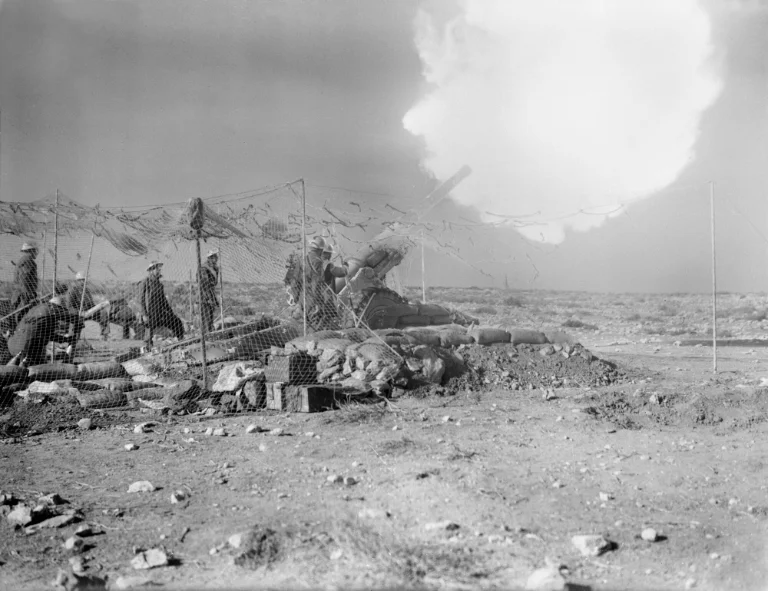
British artillery crew firing a field gun against Italian positions near Derna, Libya, during Operation Compass in February 1941.
A British artillery battery opens fire against Italian defensive positions near Derna, Libya, during XIII Corps’s advance across Cyrenaica in February 1941.
26th January 1941

The battle for Derna intensifies into a brutal war of attrition along the steep, rocky lips of Wadi Derna. As Brigadier Horace Robertson alters his tactics, he directs the 2/4th Australian Infantry Battalion to find a way across the formidable ravine. Under heavy shelling from Italian artillery dug into the opposite cliffs, the Australians manage to scramble down the jagged rock faces, slip across the wadi bed, and establish a precarious bridgehead on the western bank. To eliminate this sudden threat, the Italian 60th Infantry Division "Sabratha" launches a fierce counter-attack with infantry and light tanks against the Australians and, in desperate close-quarters fighting, successfully halts any further Australian movement toward the town.

Fifty miles to the south at Mechili, the British 7th Armoured Division spends the day methodically positioning its 4th and 7th Armoured Brigades as part of O’Connor's plan to completely encircle the strategic desert crossroads and trap Raggruppamento Babini. However, General Valentino Babini, recognising the imminent danger and utilising the cover of an afternoon sandstorm and the onset of night, skilfully withdraws his entire force from Mechili, retreating westward toward Slonta without the British noticing.

27th January 1941

At dawn, the 7th Armoured Division closes the trap around Mechili, with advance units cautiously entering the town only to find that their trap has snapped shut on thin air, dealing a major strategic disappointment to XIII Corps. With the inland flanking threat from Raggruppamento Babini gone for the moment, O’Connor orders the 7th Armoured Division to halt temporarily in order to rest and refit its tanks.

Up on the coast, the focus shifts back to the stalemate at Derna as the Regia Aeronautica makes a maximum effort to break the Australian bridgehead across the wadi. In a series of low-level sorties, Italian Savoia-Marchetti SM.79 bombers and Fiat CR.42 fighter-bombers relentlessly strike the 2/4th Battalion's exposed forward positions. Despite facing accurate anti-aircraft fire from the ground, the Italian pilots manage to disrupt the Australian supply lines across the ravine, ensuring that the frontline remains deadlocked.

28th January 1941

The Italian high command, recognising that the British breakthrough at Mechili has completely compromised its southern flank, realises that the 60th Infantry Division "Sabratha" and the attached Babini Group units risk being completely cut off if they remain on the coast. Under the cover of darkness, it orders the Italian X Corps to quietly abandon its formidable fortifications along the western ridge of Wadi Derna and conduct a well-executed withdrawal westward along the Via Balbia toward Barce and Benghazi, leaving behind only small, localised rearguards to delay the Allied advance.

When Australian patrols probe across the ravine at daybreak, they are stunned to find the Italian bunkers empty. Units of the 19th Australian Infantry Brigade quickly push forward to occupy Derna airfield and the town itself without firing a shot.

29th January 1941

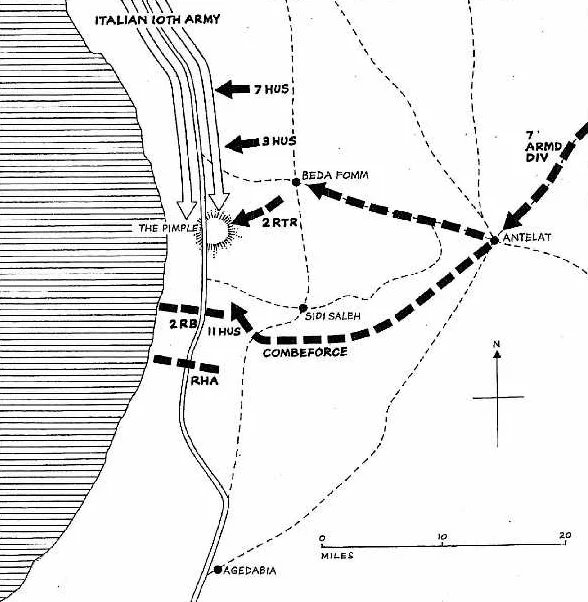
With Derna captured and the Italians in full retreat, Lieutenant-General Richard O’Connor detects a major shift in Italian intentions. Aerial reconnaissance from the RAF confirms that the entire Italian 10th Army is staging a full-scale evacuation of the Cyrenaican Bulge, streaming south along the coastal highway from Benghazi toward Tripoli. Realising that a pursuit along the coastal road by the Australians will never catch the retreating columns, O’Connor orders the 7th Armoured Division to immediately abandon its refitting schedule at Mechili and launch a high-speed dash southwest across 150 miles of unmapped, trackless desert in the Jebel Akhdar interior. The objective is to reach the coast between Beda Fomm and the outpost of Sidi Saleh, around 30 miles south-west of Antelat, thereby trapping the Italian 10th Army before it can escape and setting the stage for a dramatic race against time.

30th January 1941

The mechanical and physical strain of the desert crossing begins to take a heavy toll on the 7th Armoured Division. As the tracked vehicles of the 4th and 7th Armoured Brigades move across the jagged, boulder-strewn terrain of the inner desert, dozens of tanks suffer severe mechanical breakdowns, fractured tracks, and overheating engines.

Recognising that the lumbering main armoured columns are moving too slowly to catch the retreating Italians, O'Connor authorises the assembly of a highly mobile ad hoc flying vanguard designated "Combeforce" under the command of Lieutenant-Colonel John Combe.

Numbering approximately 2,000 men and over 300 vehicles, the force consists of around 24 to 30 armoured cars from the 11th Hussars, motorised infantry from the 2nd Battalion, Rifle Brigade (Prince Consort's Own), nine towed 25-pounder field guns from the Royal Horse Artillery, and twelve 2-pounder anti-tank guns. This completely wheeled force is organised to bypass the slower tracked armour and prepare for a maximum-speed dash to sever the Via Balbia south of Benghazi.

Italian Flag

Benito Mussolini

Prime Minister and Duce of Italy

Private remarks to Foreign Minister Galeazzo Ciano as the Derna line collapsed - 30th January 1941

‘One must look the truth in the face: our military system is built on cardboard. The soldiers have no will to hold, and the generals have completely lost their heads.’
31st January 1941

On the northern flank, the infantry of the 6th Australian Division, supported by the remaining operational tanks of the 7th Royal Tank Regiment, commences its pursuit of the Italians, pushing rapidly west from Derna along the coastal highway. They discover that the retreating Italian X Corps has carried out a thorough scorched-earth policy, blowing up every bridge, destroying culverts, and littering the Via Balbia with extensive minefields to slow down the Australian advance.

Despite these obstacles, the 2/1st Australian Field Company and other engineering units work frantically under the blistering sun, clearing mines and creating improvised desert bypasses around the destroyed bridges. By nightfall, the Australian vanguard successfully enters the town of Giovanni Berta to keep pressure on the Italian rearguard.

February 1941

1st February 1941

The 6th Australian Division's vanguard, the 19th Australian Infantry Brigade, continues its westward advance along the Via Balbia, entering the historic town of Cyrene to find that the Italian forces have already evacuated. Despite the lack of direct combat, the advance continues to be severely hampered as Italian engineers blow massive craters into the mountain passes and thoroughly mine the roadsides, forcing Australian pioneers to construct arduous detours to keep the supply columns moving.

To the south, the 7th Armoured Division presses on with its gruelling march south-west through the desert interior toward Msus. Mechanical failures continue to mount, with the division's workshop units working around the clock to harvest parts from stranded vehicles and keep the remaining cruiser and light tanks operational.

2nd February 1941

The Australian pursuit in the north accelerates as the 17th Australian Infantry Brigade captures the town of Apollonia on the coast, securing another small port facility. Intelligence gathered from local civilians and aerial reconnaissance confirms that the Italian X Corps is retreating in near-panic toward Barce. Reports from No. 208 Squadron also indicate that the Italian evacuation of Benghazi is accelerating, with massive logistical columns clogging the roads heading south.

Realising that the window to trap the enemy is closing faster than anticipated, O'Connor issues urgent orders to the 7th Armoured Division to accelerate the movement of its advanced armoured elements, which are grinding their way slowly toward Msus. At the Mechili staging base, the completely wheeled flying column designated "Combeforce" completes its final logistical preparations, having stored extra rations, water, and fuel, and is now poised to launch a breakneck dash to overtake the main division in the race to cut the Via Balbia.

Italian Flag

Lieutenant-General Giuseppe Tellera

Commander of the Italian 10th Army

Briefing his staff in Benghazi just before the final evacuation order - 2nd February 1941

‘We are no longer conducting a military retreat; we are simply running a race against an enemy who moves twice as fast as we do, and who chooses the finish line.’
3rd February 1941

During the early morning, the 4th Armoured Brigade, the leading tracked element of the 7th Armoured Division, finally arrives at the isolated Italian desert outpost of Msus and quickly overwhelms the fort's small garrison, capturing both the position and a much-needed supply of fuel. By midday, the wheeled vehicles of Combeforce also reach Msus, having rapidly closed the gap from Mechili thanks to their superior mobility over the boulder strewn desert tracks.

Later in the day, the 6th Australian Division continues its pursuit westwards along the coast, with advance elements of the 19th Australian Infantry Brigade reaching the town of Barce on the western edge of the Jebel Akhdar mountains. Upon entering the town, they discover that the retreating Italian X Corps has thoroughly devastated the local infrastructure. The railway station, supply depots, and civilian facilities have been systematically demolished, while a massive crater blasted into the main road descending the Barce Pass temporarily halts the Australian vehicles.

The Race to Beda Fomm

4th February 1941

On the coast, Australian engineers perform remarkable logistical feats, constructing a bypass around the massive crater blasted into the Barce Pass road by the retreating Italians. While the engineers work to restore the route, the 2/8th Australian Infantry Battalion secures Barce and its surrounding approaches as the remainder of the division prepares for the final advance towards Benghazi.

Meanwhile, a critical turning point occurs at dawn when O'Connor receives definitive RAF reconnaissance reports confirming that the Italian evacuation of Benghazi is nearly complete and that the main body of the Italian 10th Army is fleeing south along the Via Balbia. Realising that the enemy is on the verge of escaping, O'Connor orders the immediate deployment of Combeforce from Msus.

Lieutenant Colonel John Combe's wheeled column begins its legendary non-stop dash south west across 60 miles of heavily broken desert terrain towards the coastal highway. Moving at the absolute limit of mechanical endurance in an effort to reach the road before the retreating Italians, Combeforce is closely followed by the cruiser tanks of the 4th Armoured Brigade, whose tracked vehicles struggle to maintain the pace across the rough desert and increasingly suffer from mechanical wear.

The Battle of Beda Fomm

5th February 1941

At approximately 12:00, the leading armoured cars of the 11th Hussars finally reach the Via Balbia near Sidi Saleh, just south of Beda Fomm, becoming the first British troops to cut the coastal highway. By 16:30, the remainder of Combeforce arrives and immediately establishes a formidable roadblock across the route, deploying anti-tank guns and infantry directly in the path of the retreating Italian 10th Army. Shortly afterwards, the unsuspecting vanguard of the withdrawing Italian column begins to arrive.

Lacking proper reconnaissance or coordination, the leading Italian elements, primarily from the elite 10th Bersaglieri Regiment, attempt to punch through Combeforce's position but are repeatedly repulsed by the concentrated fire of the Rifle Brigade and its 2-pounder anti-tank guns.

With the main Italian columns beginning to pack tightly against the roadblock, the first elements of the 4th Armoured Brigade arrive. Significantly depleted from their 150-mile trek across the desert from Mechili, the 2nd Royal Tank Regiment fields a mix of worn-out A9, A10, and A13 Cruiser tanks totalling just 19 serviceable vehicles. Reinforced by the arrival of the 7th Hussars and 3rd Hussars, who add a further 20 to 30 Mark VI light tanks, the brigade aggressively strikes the vulnerable eastern flank of the Italians.

Meanwhile, to the north, the 6th Australian Division continues its advance down the Via Balbia, encountering only light rearguard opposition from the Italians as they press towards Benghazi.

Map showing Combe Force's dash across the Libyan desert to Beda Fomm and the interception of the retreating Italian 10th Army during Operation Compass, February 1941.
Map illustrating Combe Force's rapid desert advance to Beda Fomm, where British and Commonwealth forces blocked the Via Balbia and trapped the retreating Italian 10th Army during the final stages of Operation Compass in February 1941.
6th February 1941

Desperate to break the encirclement before the pursuing Australians arrive from the north to seal them in, General Giuseppe Tellera orders a massive, coordinated breakthrough attempt against Combeforce. Utilising the remaining armoured strength of the Raggruppamento Babini, approximately thirty M13/40 medium tanks, the Italians launch furious, concentrated frontal assaults against the British line. The fighting turns exceptionally brutal and chaotic as Italian armour drives directly into the thin lines of the Rifle Brigade.

However, the combination of Combeforce's stubborn defence and the arrival of the 1st Royal Tank Regiment (reassigned from the 7th Armoured Brigade with its complement of 15 to 20 Cruiser tanks) successfully blunts the assault, striking the Italian armour from a hull-down position on the low limestone ridge running parallel to the east of the highway. In the ferocious tank duel that follows, the majority of the Italian armour is systematically destroyed, and General Tellera is mortally wounded during the engagement.

Further up on the coast, the northern pincer is closing as advanced elements of the 19th Australian Infantry Brigade enter Benghazi to a rapturous welcome from the local population. The capture of the strategic port city cuts off any remaining avenue of retreat. Hemmed in on all sides and with their armoured vanguard completely shattered at Beda Fomm, the command structure of the Italian 10th Army begins to utterly collapse.

7th February 1941

At dawn, under a heavy blanket of morning mist, the final gasp of the Italian 10th Army unfolds. A desperate force of thirty Italian M13/40 tanks, the remaining operational armour that Raggruppamento Babini is able to scrape together overnight, is assembled for one final attempt to break through the Rifle Brigade's roadblock. Driven by sheer desperation, the Italian tanks push so aggressively through the fog that they penetrate the British position and drive straight into Combeforce's headquarters area. However, the British line holds firm as the last operational anti-tank guns and a localised counter-attack by the 2nd Royal Tank Regiment shatter the assault, knocking out the remaining Italian armour.

Following this defeat, the command of the Italian 10th Army, recognising the inevitable and seeing no way through the British defence with the 6th Australian Division rapidly closing in from the north, sends out a flag of truce at approximately 09:00. Acting on the authority of Lieutenant General Annibale "Electric Whiskers" Bergonzoli, they offer the unconditional surrender of the Italian 10th Army to Lieutenant-Colonel John Combe. White flags are seen appearing all along the miles-long column of trapped Italians on the Via Balbia.

As news of the surrender reaches XIII Corps headquarters, Lieutenant General Richard O'Connor signals General Sir Archibald Wavell with the brief message, "Fox killed in the open", confirming that the Italian 10th Army is destroyed in the open before it can escape into Tripolitania.

The final tally of the pocket reveals a staggering victory for XIII Corps, with Italian losses of approximately 1,100 men killed or wounded during the frantic breakout attempts and over 20,000 prisoners taken, including 22 generals and their staffs, along with the capture of 100 tanks and 216 artillery pieces. British casualties are remarkably light, amounting to just 24 killed and a similar number wounded, together with one cruiser tank and six light tanks lost during the desperate blocking actions on the road.

Captured Italian M13/40 tanks following the Battle of Beda Fomm during Operation Compass, February 1941.
Italian M13/40 medium tanks captured by British and Commonwealth forces after the Battle of Beda Fomm, where the retreating Italian 10th Army was trapped and defeated during the final stages of Operation Compass in February 1941.
8th February 1941

Operation Compass reaches its conclusion as the armoured cars of the 11th Hussars, alongside motorised elements of the 7th Armoured Division’s Support Group, push fifty miles south along the coast to occupy El Agheila without opposition, establishing a firm defensive perimeter at the border of Cyrenaica and Tripolitania.

Whilst this is happening, British and Australian troops spend the day processing long lines of Italian prisoners, moving them away from the road. Abandoned tanks and lorries are counted or pushed aside, and British recovery parties search for usable fuel, ammunition, food, and mechanical spares. Many Italian vehicles have been destroyed, disabled, or simply left behind during the 10th Army's retreat, turning the Via Balbia into a trail of wreckage and captured equipment.

The scale of the Italian collapse is unmistakable as the British secure a brilliant operational victory. In just two months, XIII Corps, previously known as the Western Desert Force, and numbering roughly 30,000 men, advances 500 miles, completely destroys ten Italian divisions, and captures more than 133,000 prisoners, 420 tanks, and 1,290 artillery pieces, all at the astonishingly low cost of around 500 killed, 1,373 wounded, and 55 missing.

However, the force that has achieved this is near the end of its immediate endurance. The 7th Armoured Division is utterly exhausted after the hard pursuit across Cyrenaica, its tanks and vehicles are badly worn out, and supply lines now stretch hundreds of miles back across eastern Libya and Egypt. The question now facing Wavell and O'Connor is whether they can refit their forces quickly enough to exploit the victory and threaten Tripoli.

Continue to the next Timeline

Operation Sonnenblume (1941)

Germany’s intervention in North Africa in early 1941 halted the British advance and stabilised the Axis position. This timeline traces the arrival of the Afrika Korps, Rommel’s rapid counter-offensive, and the renewed struggle for Cyrenaica.

View Timeline