WorldWar-2.com

Invasion of Poland

September 1939 – October 1939

‘This night for the first time Polish regular soldiers fired on our own territory. We have now been returning the fire... Henceforth, bomb will be met with bomb!’
Adolf Hitler - Chancellor and Führer of Germany - 1st September 1939

Introduction to the Invasion of Poland

During the summer of 1939, when it became clear that Poland would not yield to Hitler’s demands, the blueprint for the Invasion of Poland, known as Fall Weiss (Case White), was devised. It proposed two simultaneous offensives. The first in the north, out of Pomerania and East Prussia, aimed to secure the Polish Corridor before turning southeast. The second, from the south, was aimed between Łódź and Kraków, intending to link up with the northern offensive near Warsaw. This strategy hinged on swift victory to pre-empt any response from the Western Allies, as two-thirds of Germany’s forces were allocated to the Polish campaign, leaving Germany’s western border lightly defended. German mobilization occurred primarily under the guise of drills throughout August, with preparations completed by the evening of August 25th, ready for the offensive to begin the next day. When Hitler delayed the invasion at short notice late on the 25th until the 1st September, some units didn’t receive the notification in time, resulting in shots being fired in some places before the troops could be stood down. These instances served as an unmistakable sign to Poland of Hitler’s intent to invade. The Polish defensive strategy was designed to hold the Germans along the border for as long as possible. This would allow them time to add strength in depth as their reserves were mobilized, while also waiting for the French counterattack against Germany, which had been promised within fifteen days of any assault on Poland. Time was one thing the Poles didn’t have, and the disposition of their forces played straight into the hands of the Germans who were ideally positioned to exploit the double envelopment tactics central to Blitzkrieg doctrine, thereby cutting the Polish Army on the border into pieces to be defeated easily.

September 1939

1st September 1939
At 4:45am, Fall Weiss (Case White), the German Invasion of Poland begins and 2 minutes later at 4:47am the opening shots of World War 2 are fired by the German Battleship Schleswig-Holstein which had taken up a position in Danzig Bay opposite the Polish fort at Westerplatte. She opened up with a full broadside by her 11-inch guns at point blank range against the fort. German marines then attacked the Polish outposts, but were bloodily repulsed. At 7:40am the Schleswig-Holstein once again opened a barrage against the fort for about an hour, before a second attack by the marines was launched around 8:35am, which was also repulsed by the Poles. Simultaneously, the Polish Navy initiates its defensive plan, Operation Worek. At 06:00, the submarine ORP Orzeł departs from the naval base at Gdynia to begin its first war patrol. Under the command of Lieutenant Commander Henryk Kłoczkowski, the vessel takes its assigned position in shallow waters near the Gulf of Gdańsk with the objective of defending the Hel Peninsula and the entrance to the Bay of Gdańsk against German naval landings. Illustrating the immense difficulty of operating in the heavily monitored Baltic waters, the Orzeł is forced into multiple emergency dives during the morning to avoid detection by the Luftwaffe. The Luftwaffe launches around 2,300 aircraft to strike Polish airfields, communications and assembly areas. Although the Polish Air Force had dispersed many of its aircraft beforehand, the attacks still inflicted significant damage allowing the Luftwaffe to rapidly gain control of the skies and by 6am Warsaw had been struck in the first of a number of raids as the Luftwaffe attacked military and civilian targets across the capital, along with the regional cities of Katowice, Kraków, Wielun, Tczew and Tunel, all of which were hit heavily. With the Polish Air Force all but destroyed and Luftwaffe smashing up Polish rear areas, the Wehrmacht begins its own assault at 8am with 1.5 million soldiers, 9000 guns and around 2600 tanks crossing into Poland. The initial phase would be known as the ‘Battle of the Border’ from the Polish side and saw Army Group North’s 4th Army and Guderian’s XIX Panzer Corps (3rd Panzer, 2nd and 20th Motorised Divisions), attack directly across the Polish Corridor with the aim of capturing Danzig and linking up with the 3rd Army in East Prussia, which was itself to push southwards into the rear of the Polish western defences behind Warsaw. Meanwhile the main thrust against Poland would come from Army Group South with the 8th Army attacking towards Łódź. 10th Army, which included the bulk of the German mobile formation’s (two Panzer, three light and two Motorised Divisions) was to punch through Polish forces around Katowice and race toward Warsaw. The 14th Army which was located further south in Moravia and Slovakia would attack in the direction of Kraków , with a Slovak force protecting its flank along the Slovakian border with Poland. 3rd Army’s XXI Corps, commanded by Gen. von Falkenhorst, launches an assault with the 21st and 218th Infantry Divisions to the east of Graudenz, in the area of Lasin and Dąbrówka Królewska. The assault is held up by the Polish Pomorze Army’s 16th Infantry Division on the left, but the 4th Infantry Division on the right is pushed back behind the river Osa, enabling a German bridgehead to be established near Bielawki. In the evening, the 4th Infantry Division puts in a counterattack aimed at throwing the 218th Infantry Division back behind the Osa, but this is repulsed. The Nazi Party’s puppet Head of State in the free City of Danzig, Albert Forster signs a law incorporating Danzig into the German Reich, whilst Hitler formalizes this by signing a decree annexing the City. The British and French governments, feverishly despatch telegrams between themselves, Rome, Berlin and Warsaw in the hope that Mussolini can arrange an international peace conference to stop the war. At the same time they agree the text of the message to be handed to Germany. This states that ‘Britain and France did not accept Germany’s actions towards Poland and that if Germany did not suspend their actions and agree to promptly withdraw from Poland, then the UK would fulfil their obligations to Poland’ The British Ambassador, Neville Henderson is finally allowed to see German Foreign Minister Von Ribbentrop at 9pm and hands over the message. Ribbentrop makes no response, but instead advises he will refer it to Adolf Hitler.
Polish Flag

Ignacy Mościcki

President of the Republic of Poland

1st September 1939

‘Citizens of the Republic! This night our eternal enemy has commenced hostilities against the Polish State.’
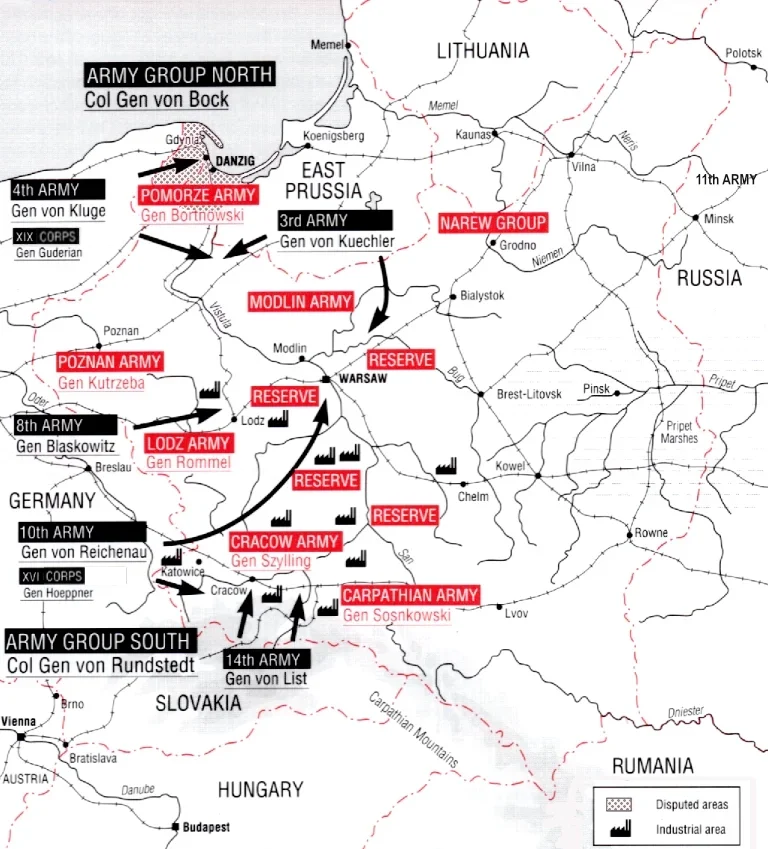
Map showing the German invasion of Poland in September 1939 with Army Groups North and South advancing toward Warsaw
Strategic map of the German invasion of Poland in September 1939, showing Army Groups North and South advancing from East Prussia and Silesia toward Warsaw.
2nd September 1939
Between 6:05pm and 6:25pm the Westerplatte fort is attacked by the Luftwaffe, as 60 Ju-87 Stukas in two attack waves drop a total of 27 tonnes of explosives, leaving the fort surrounded in smoke. The raid destroys Guardhouse V, a number of Polish mortars, along with the fort's only radio and a large amount of its food supply. The key town of Wielun, having been devastated by Luftwaffe raids the previous day is captured by the German 10th Army, thus clearing it’s way through the Polish border defences as it drives towards Warsaw. The Polish 10th Cavalry Brigade, under heavy pressure from the 2nd Panzer Division of the German 14th Army, is forced to withdraw from Jordanow south of Kraków. Following an artillery barrage, XXI Corps renews its assault at 8 a.m. with the aim of further expanding its bridgehead across the river Osa. The attack falls heaviest on the 16th Infantry Division’s sector, forcing it to retreat in disorder. By the afternoon, the Germans have broken the forward defence lines and are attacking the 208th Reserve Infantry Regiment, which shows signs of panic. To relieve pressure, the 4th Infantry Division launches a counterattack at 8 p.m. towards Melno with the aim of restoring the defensive line along the river Osa. The assault initially caused some surprise to the Germans, leading them to abandon Annowo, Gruto, and Nicwald before stabilizing the front line. Aircraft from Luftflotte 1 launch a daylight air raid on Warsaw, targeting military installations, communication infrastructure, and government buildings. The attack caused substantial damage and resulted in numerous civilian casualties. Luftwaffe units also bomb the railway station in Koło, central Poland, targeting a train carrying refugees fleeing east from Krotoszyn and nearby towns. The train had stopped on a siding near the station when German aircraft launched a surprise raid, dropping bombs and strafing passengers as they fled. The station roof collapsed under the bombardment. At least 111 civilians were killed, with some estimates suggesting up to 150 fatalities. Poland again calls for help from Britain and France under the terms of the mutual assistance pact signed on the 25th August. The French Ambassador meets von Ribbentrop at 10am to press for a German response to the message delivered by the British Ambassador the previous evening, but again receives no indication as to whether Germany will comply. At 12:30pm, France sends an additional message to Germany to withdraw its troops from Poland. Mussolini offers to host a conference to resolve the Danzig question, but the French and British agree that this should be conditional on a German withdrawal from Poland first. At 5pm, having still not having received any response to their approaches, the British and French begin to discuss giving Hitler a time limit to respond, and late into the evening following many telephone calls and telegrams they agree to this approach.
3rd September 1939
With German 4th Army formations having crossed the Vistula in strength near Kulm (Chełmno) to the south of Graudenz, 2nd Motorized Division successfully links up with 73rd Infantry Division from 3rd Army near Nowe (Neuenburg), re-establishing the land connection between East Prussia and the German Reich, effectively erasing the "Polish Corridor" that had severed the two regions since the 1919 Treaty of Versailles. This link-up not only fulfils a major German political objective but also physically isolates the Polish forces remaining on the Baltic coast from the rest of the country. With the Pomorze Army facing the growing threat of encirclement, Polish forces destroy the remaining bridges across the Vistula river and withdraw towards the southeast, establishing a new defensive line behind the Drwęca River. The Polish Modlin Army, having been attacked by the German 3rd Army for three days in its fortified positions along the northern border with East Prussia, is defeated around Mława. Facing the risk of being bypassed, it begins a fighting withdrawal towards the Narew and Bug rivers and the fortress of Modlin, northwest of Warsaw. General Tadeusz Kutrzeba, commander of the Poznań Army, recognizing that the German 8th Army has exposed its northern flank during its rapid advance, proposes a major counter-offensive to strike the German flank and relieve the pressure on southern Polish forces. However, the proposal is rejected by the Polish High Command, as Marshal Rydz-Śmigły orders the Poznań Army to continue its withdrawal toward Warsaw to avoid isolation. In the south, Walther von Reichenau’s 10th Army, possessing the bulk of the German Panzer divisions, forces its way over the Warta River and drives toward the "Piotrków Gap." To prevent the Polish Prusy Army from fully concentrating its reserves, the 1st and 4th Panzer Divisions push rapidly toward the River Pilica, threatening to break the entire Polish southern front. This advance is marked by increasing brutality toward civilians, as elements of the 4th Panzer Division round up and shoot 55 Polish peasants in the village of Truskolasy, in a reprisal following skirmishes with the Polish Wołyńska Cavalry Brigade. Following clashes between retreating Polish forces and local ethnic Germans in Bydgoszcz, German troops and paramilitary units execute hundreds of Polish civilians, among whom were several dozen Boy Scouts, who were lined up and shot against a wall in the city's Old Market Square. Britain issues a final ultimatum to Germany at 9am, giving the Germans until 11am to agree to withdraw their troops from Poland. Just after the deadline a German response is received in the form of an 11 page document, which confirms their refusal to withdraw from Poland. At 11:15am Prime Minister, Neville Chamberlain announces that ‘no such undertaking has been received’ from Germany to withdraw their forces and he therefore declares that ‘Britain is now at war with Germany’. The declaration also commits Australia and New Zealand to the war, having been agreed in advance with their governments. Similarly France also declares war on Germany at 5pm following the expiry of its own ultimatum.
United Kingdom Flag

Neville Chamberlain

Prime Minister of the United Kingdom

Radio Broadcast to the British People on the 3rd September 1939

‘I am speaking to you from the cabinet room at 10 Downing Street. This morning the British ambassador in Berlin handed the German government a final note stating that unless we heard from them by 11 o’clock that they were prepared at once to withdraw their troops from Poland, a state of war would exist between us. I have to tell you now that no such undertaking has been received, and that consequently this country is at war with Germany.’
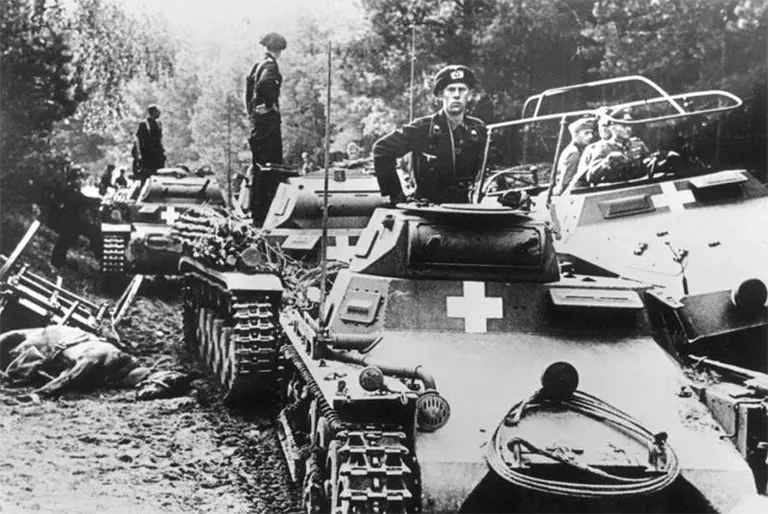
German Panzer I and II tanks advancing in column formation during the Invasion of Poland, September 1939
German Panzer I and II light tanks advance in column formation during the September 1939 campaign in Poland. Early armoured thrusts by Army Group North and South formed the spearhead of Germany’s rapid encirclement strategy in the opening weeks of the war.
4th September 1939
The German battleship Schleswig-Holstein, supported by the minesweeper Von der Groeben and torpedo boat T196, continues the bombardment of Westerplatte, hitting the “Wal” outpost, but there are no Polish casualties as the position had already been abandoned in favour of more defensible inner lines. 3rd Army (General Küchler) completes the capture of Graudenz (Grudziądz) with elements of the XXI Army Corps, including the 21st and 218th Infantry Divisions, entering the city following the strategic withdrawal of the Pomorze Army. This consolidation secures the newly re-established land bridge to East Prussia, allowing German logistics to flow freely across the former "Corridor." As the situation rapidly deteriorates in the South, 10th Army spearheads the advance, with some panzer units covering up to 50 miles in a single day. Having crossed the River Pilica, German armoured columns curve northeast toward Warsaw. This rapid movement effectively outflanks the Polish Łódź Army, severing its primary supply routes and threatening its rear elements with total encirclement. In the industrial heart of Upper Silesia, the German 8th Infantry Division (14th Army) captures Katowice despite a determined last stand by Polish self-defence units and Boy Scouts. The fall of Katowice continues to fragment the Kraków Army’s defensive line and hands the Reich control over Poland’s vital coal and steel resources. With the military situation growing increasingly desperate for Poland, and fearing that the rapid German armoured advance from the south could soon threaten the capital, the government takes the decision to begin evacuating Warsaw. Prime Minister, Felicjan Sławoj Składkowski orders the removal of state archives and the nation’s gold reserves, with government departments instructed to relocate to Lublin in the east, a move intended to ensure the continuity of the Polish state.
5th September 1939
A meeting of officers is held at Westerplatte to discuss a potential surrender to the Germans. Major Sucharski, the fort’s commander, affirms that his orders only required them to hold out for 12 hours, whereas they have resisted for five days. He argues that due to the large number of wounded requiring urgent medical attention, combined with dwindling supplies of food, water, and ammunition, they should surrender. His deputy, Franciszek Dąbrowski, remains staunchly opposed and convinces the other officers that they should hold out longer. Army Group South’s advance through central and southern Poland intensifies as its penetration of the frontier defences is completed. The German 8th Army (Blaskowitz) drives northeast of Sieradz toward Łódź, engaging the Polish Łódź Army (Gen. Juliusz Rómmel). The Polish 28th and 30th Infantry Divisions, supported by elements of the Wołyń Cavalry Brigade, fight desperate delaying actions around Widawa and Pabianice before withdrawing toward the city. The 10th Army (Reichenau) breaks through beyond Częstochowa, striking the still-forming Prusy Army (Gen. Stefan Dąb-Biernacki). Reichenau’s left wing, X Army Corps, pushes to the outskirts of Łódź, while his right wing, XVI Motorized Corps, closes on Kielce. The 1st and 4th Panzer Divisions smash Polish defences around Piotrków Trybunalski, encircling large parts of the 19th and 29th Infantry Divisions. The pocket collapses under heavy air and armour attack, with approximately 10,000 to 15,000 Polish troops captured. Survivors retreat east in disorder as the road toward Tomaszów Mazowiecki lies open. To the south, the 14th Army (List) advances from the Carpathian frontier toward Kraków, forcing the Vistula near the city and establishing bridgeheads on the eastern bank. The Polish Kraków Army (Gen. Antoni Szylling), including mountain and mechanized elements under Col. Stanisław Maczek, conducts rearguard actions before withdrawing east of the river. Across the front, Polish formations, with the notable exception of the Poznań Army on the western flank, begin to fall back toward the Vistula to regroup and establish a new defensive line. The Polish Prime Minister, Felicjan Składkowski, officially leaves Warsaw for Lublin. This departure follows the strategic decision made the previous day and marks the beginning of the "wandering" phase for the Polish government as it attempts to relocate the civil administration to ensure the continuity of the state.
6th September 1939
The Polish garrison on Westerplatte repels several renewed German assaults, inflicting more heavy losses on the attackers. Inside the fort, Major Sucharski again proposes surrender as many of the wounded are now suffering from gangrene for which no treatment is available. Again, his deputy, Captain Dąbrowski, refuses, arguing that every additional day of resistance aids Poland’s wider defence by tying down German naval and land assets. Recognising the speed and depth of German penetrations, the Polish Commander-in-Chief, Marshal Rydz-Śmigły, issues a formal order for a general withdrawal. The Łódź, Kraków, and Prusy Armies, though many of their units are already fragmented after a week of constant attack, are to abandon their current positions and attempt to form a new defensive line behind the Narew, Vistula, and San rivers. As news of the order and the government's departure spreads, a "Great Panic" takes hold in Warsaw. Thousands of civilians, fearing the imminent arrival of German Panzers, begin a mass exodus from the capital. In the north, Army Group North’s 3rd Army continues its drive south from East Prussia toward Mława and Modlin, while the 4th Army pushes east of the Vistula, threatening Toruń. The Polish Modlin Army begins a fighting withdrawal toward Warsaw. In central Poland, the German 8th and 10th Armies converge from the north and south on the Łódź region. The Luftwaffe continues to bomb the city, setting fires across the urban centre as civilian authorities begin an evacuation. Simultaneously, elements of the XVI Motorised Corps reach Tomaszów Mazowiecki, cutting the main Warsaw–Piotrków road and tightening the encirclement of the Polish Łódź Army and other forces still engaged near the German frontier. The Luftwaffe intensifies its campaign across Poland, striking rail junctions at Kielce, Radom, and Skierniewice, crippling communications and forcing civilians onto roads, already clogged with troops retreating east. Following a disciplined rearguard action by the Polish 10th Mechanised Cavalry Brigade (Colonel Stanisław Maczek), Kraków falls to the 14th Army (List). To spare the city from destruction, the Kraków Army withdraws toward Bochnia and Tarnów. Further south, German troops secure the vital industrial centres of Upper Silesia, while units of the XVIII Corps cross the Carpathian passes near Nowy Targ and Jasło, widening the German advance in the south.
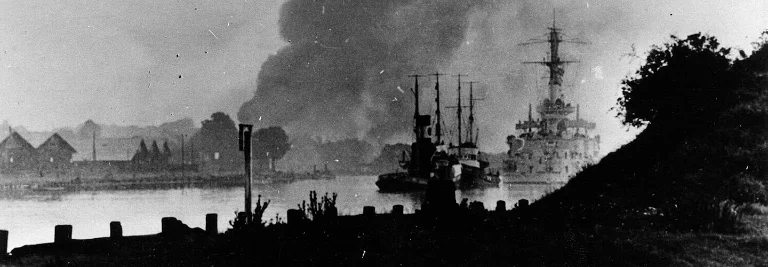
German battleship Schleswig-Holstein bombarding Westerplatte during the invasion of Poland, September 1939
The German battleship Schleswig-Holstein bombards the Westerplatte peninsula in September 1939, as sustained naval gunfire supports repeated assaults on the Polish garrison during the opening days of the war.
7th September 1939
At 04:30, the Germans begin an intensive barrage against the Westerplatte garrison, supported by the battleship Schleswig-Holstein, lasting until 07:00. During the bombardment, Guardhouse II is destroyed, while Guardhouses I and IV are severely damaged. By 09:45, Major Henryk Sucharski, with the full agreement of his deputy, Franciszek Dąbrowski, agrees to surrender and orders a white flag to be raised above the position. During the week-long siege, the small Polish garrison suffers 15 killed and approximately 40 wounded. German casualties are heavier, with roughly 50 killed and about 150 wounded. In a rare gesture of military respect, the German commander, General Friedrich-Georg Eberhardt, allows Sucharski to retain his sabre as he is taken into captivity. In the north, the 3rd Army captures Pułtusk and Ciechanów, threatening to encircle Warsaw from the north and cutting off the Modlin Army’s lines of communication. In central Poland, the strategic situation reaches a breaking point as the German 10th Army exploits the collapse of the Piotrków line. The 4th Panzer Division, under General Georg-Hans Reinhardt, leads a high-speed dash toward the capital, bypassing fragmented Polish pockets. By nightfall, German armoured units reach the southwestern outskirts of Warsaw. Simultaneously, to the west, the 8th Army forces a crossing of the Warta River near Sieradz, leaving the Łódź Army in a precarious position, severely fragmented and retreating under constant aerial bombardment. Amidst this deteriorating situation, the Polish Supreme Command officially relocates from Warsaw to Brześć (Brest-Litovsk). While intended to keep the military leadership safe from the advancing Panzers, the move begins to severely hamper communication between Marshal Rydz-Śmigły and the frontline commanders at a critical juncture. With the enemy at the gates of the Capital, General Walerian Czuma is officially appointed commander of the Warsaw Defence Command. He begins the desperate task of organising a perimeter from arriving reinforcements and local volunteers. The 40th "Children of Lwów" Infantry Regiment, led by Lieutenant Colonel Józef Kalandyk, deploys to the western districts of Wola and Ochota straight from transport trains. These regular troops are bolstered by the Warsaw Defence Brigade and the Worker’s Brigade for the Defence of Warsaw, a civilian volunteer force that begins digging anti-tank trenches and erecting barricades across the city's main thoroughfares. In the south, 14th Army continues its relentless pursuit of the Kraków Army, with 4th Light Division and elements of the 2nd Panzer Division capturing Tarnów as Polish forces continue their withdrawal towards the river Dunajec and the eventual safety of the San River line. With Army Groups North (Bock) and South (Rundstedt) within 40 and 25 miles of Warsaw respectively and recognising that the Polish forces are attempting an eastward escape, the German High Command revises its original plan of encirclement along the Vistula, instead extending the envelopment to the River Bug. This strategic shift aims to trap the bulk of the Polish military in two massive "pincers" concentrated around Kutno and Warsaw. Throughout the day, Polish Radio continues to broadcast Chopin’s Polonaise in A Major, a defiant signal to the world that Warsaw has not surrendered.
8th September 1939
In West Prussia, units of the 4th Army’s I Corps (Landespolizei-Regiment, bolstered by the 207th Infantry Division), commanded by General Leonhard Kaupisch, begin a concerted assault against the Oksywie Heights (Kępa Oksywska). This strategically vital plateau north of the isolated port city of Gdynia serves as the final stronghold for the Polish coastal defence. Meanwhile, Army Group North’s 3rd Army (Kuechler) continues its push southwards in pursuit of the Modlin Army, which is conducting a fighting retreat toward the "Warsaw-Modlin" triangle. The German objective is to link up with the 10th Army east of Warsaw to complete the encirclement of the capital. At approximately 15:00, the 4th Panzer Division (XVI Panzer Corps, 10th Army) reaches the southwestern suburbs of Warsaw near the Ochota and Wola districts. Believing the city's defences to be in collapse, the division launches an immediate armoured assault into Ochota at Grójecka Street. They are met by a fierce and unexpected defence from the 40th "Children of Lwów" Regiment and civilian volunteers. Using well-placed anti-tank guns and street barricades, the Poles repel the assault, destroying or disabling approximately 30 German tanks. The 4th Panzer Division is forced to withdraw to the outskirts to await heavy artillery and infantry reinforcements. From about 16:00, the Luftwaffe intensifies its effort to break the city's will, deploying roughly 140 Ju-87 Stukas to strike Polish army positions in the western suburbs of Wola and Ochota, as well as the eastern district of Praga. The bombardment causes widespread fires across the city. As night falls, the German High Command prematurely announces the capture of Warsaw over international radio. In a defiant response, the Mayor of Warsaw, Stefan Starzyński, takes to the airwaves, broadcasting to the population and officially declaring the city a fortress. He calls for a total civilian and military defence of every street and building. South of Warsaw, the 10th Army’s XV and XIV Motorised Corps manage to pin elements of the Polish Prusy Army (3rd, 7th, and 19th Infantry Divisions) against the Vistula River west of Radom. With German motorised units controlling the river crossings, the Polish troops have no clear line of retreat and are subjected to relentless artillery and Luftwaffe bombardment. Already fragmented from previous fighting at Piotrków, these units begin to break apart into smaller groups attempting to swim across the Vistula or hide in the local forests. With thousands of Polish soldiers killed or captured, the southern wing of Poland's central reserve is effectively destroyed. West of the capital, General Tadeusz Kutrzeba, commander of the Poznań Army, completes the concentration of his forces near the Bzura River. Recognising that the German 8th Army has left its northern flank dangerously exposed in its rush toward Warsaw, Kutrzeba receives formal permission from the Supreme Command to launch a massive counter-offensive, set to begin the following day. In the south, the main body of the German 14th Army clears the region around Tarnów. Simultaneously, lead motorised elements, including the 4th Light Division, push toward the San River in pursuit of the Kraków Army and the strategic city of Sandomierz.
Polish Flag

Stefan Starzyński

Mayor of Warsaw

8th September 1939

‘I wanted Warsaw to be great. I believed that it would be. And today I see it is great.’
9th September 1939
To the north, the advance of Guderian’s XIX Motorised Corps (4th Army) is stalled by the Polish bunker line at Wizna. A tiny force of approximately 700 Poles, commanded by Captain Władysław Raginis, who has sworn a solemn oath to hold the line at the cost of his life, faces around 40,000 German troops supported by more than 300 tanks. Because the surrounding marshlands are impassable for armour, Guderian is forced to funnel his corps into a narrow "land bridge" directly into the Polish line of fire. Personally intervening at the front, Guderian orders a shift from armoured thrusts to close-quarters combat using engineers with flamethrowers and satchel charges; yet the defenders continue to hold, significantly disrupting the German timetable for the encirclement of eastern Poland. To the west of Warsaw, the Poles launch a massive counter-offensive. General Tadeusz Kutrzeba, commanding the combined Poznań and Pomorze Armies, strikes the exposed northern flank of the German 8th Army (Blaskowitz). Three Polish infantry divisions (the 14th, 17th, and 25th) cross the Bzura River and smash into the German 30th Infantry Division. The Germans, caught while on the march toward Warsaw, are completely surprised. The Polish forces recapture Łęczyca and Piątek, forcing the German 8th Army to halt its advance and scramble for reinforcements. The 4th Panzer Division launches another determined assault against the Ochota and Wola districts of Warsaw. Attempting to break into the city centre, the tanks are again unable to breach the defensive barricades and well-placed Polish anti-tank guns. Polish defenders use turpentine and oil to create "walls of fire," trapping tanks in the narrow streets. By the time the assault is repulsed, the 4th Panzer Division has lost roughly 80 tanks and 1,000 men in just 48 hours, forcing the German command to abandon any thoughts of an early capture of the city by direct assault and instead move to a static siege. In the south, the German 14th Army (General Wilhelm List) reaches the River San near Przemyśl, establishing positions on the banks both above and below the city and threatening to encircle the strategic fortress. By the evening, German patrols also cross the San near Sanok, successfully penetrating the last major natural defensive line in the south. Amidst the deteriorating tactical situation and the collapse of the central front, the Polish Government is forced into a further eastward relocation to maintain state authority. While President Ignacy Mościcki moves toward the relative safety of the south (near Załucze), Prime Minister Felicjan Sławoj Składkowski and the cabinet establish a temporary seat of government in Łuck (Lutsk). Simultaneously, Marshal Rydz-Śmigły relocates the General Staff to the fortress at Brześć nad Bugiem.
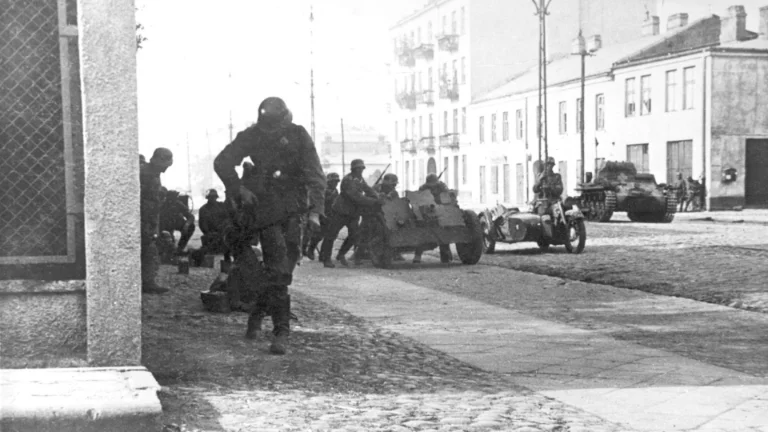
German 4th Panzer Division troops and vehicles preparing to advance on Grójecka Street during the assault on Warsaw, September 1939
German troops of the 4th Panzer Division assemble with armoured vehicles on Grójecka Street during the early assault on Warsaw’s Ochota district, 9 September 1939, where determined Polish resistance halts the advance.
10th September 1939
Despite determined resistance from Polish forces near Puck and Wejherowo to the north of Gdynia, the German 207th Infantry Division breaches the outer defence lines, pushing them back towards Gdynia. The Polish commander of the city’s defences, Colonel Stanisław Dąbek, realizing that a protracted fight in the city would cause heavy civilian casualties, begins preparations to withdraw his forces north of the city’s port facilities and anchor his defences around the heavily forested Kępa Oksywska and use the port’s ship canal to protect his southern flank, with the coast to his east. Facing German threats to execute prisoners and having exhausted the last of their ammunition, Captain Władysław Raginis orders his surviving men to surrender their positions at Wizna. Staying true to his oath to never leave his post alive, Raginis commits suicide with a grenade. The fall of Wizna clears the path for Guderian’s XIX Motorised Corps to race south toward Brześć. To the west, the Modlin Army continues its retreat toward the Bug River. Despite reinforcements from Operational Group Wyszków under General Wincenty Kowalski, Polish forces are unable to hold the Narew line against the German 3rd Army and are forced to fall back. The Polish counter-offensive by the Poznań and Pomorze Armies continues along the Bzura River, recapturing Walewice and Piątek. The growing threat to the German 8th Army forces the German High Command to divert the 1st and 4th Panzer Divisions from the outskirts of Warsaw to contain the breakthrough. German forces transition to a formal siege of Warsaw, using heavy artillery and the Luftwaffe to begin a systematic bombardment of the city’s civilian infrastructure. Inside the capital, Mayor Stefan Starzyński organises civilian labour battalions to reinforce barricades and dig anti-tank trenches as the defence shifts into a grim struggle for survival. The German 14th Army’s 4th Light Division, having reinforced its initial crossing from the previous day, achieves a tactical breakthrough at Radymno, north of Przemyśl. This penetration, combined with German probes near Sanok, creates a critical vulnerability in the San River defense line. The maneuver begins to outflank the strategic fortress of Przemyśl and poses an immediate threat to the retreat routes of Army Kraków and Army Karpaty. Late in the evening, Marshal Rydz-Śmigły issues the "General Order" from his headquarters in Brześć. He commands all remaining Polish forces to abandon the now-compromised Vistula and San lines and begin a general withdrawal south toward the Romanian and Hungarian borders. This region, to be known as the Romanian Bridgehead, is where they intend to form a final defense line and wait for a major Allied offensive in the West to draw off German forces.
11th September 1939
Following the withdrawal from Gdynia, Colonel Stanisław Dąbek consolidates his remaining forces, around 15,000 men, on the Kępa Oksywska plateau. German units of the 207th Infantry Division, supported by heavy artillery and naval gunfire from the battleship Schleswig-Holstein, intensify their assault. Using dense forests and commanding high ground, the Polish defenders temporarily stall the German advance, turning the plateau into a formidable defensive stronghold. With the German 8th Army under immense pressure from the continuing Polish Bzura offensive, the Luftwaffe launches its largest air-interdiction operation of the campaign to date. Nearly every available bomber in Air Fleets 1 and 4 is diverted to the Bzura sector. Around 800 aircraft relentlessly strike Polish troop concentrations and river crossings, severely hampering General Kutrzeba’s ability to coordinate the offensive. In Łowicz, the Polish 16th Infantry Division (Army Pomorze) is locked in a fierce struggle with the German 18th and 24th Infantry Divisions. The town is physically divided by the Bzura River, with fighting centred on the bridges and the central market square. Polish infantry engages in brutal house-to-house combat, clearing buildings with bayonets. By the afternoon, German reinforcements from the 1st Panzer Division arrive from the Warsaw front and stabilise the situation, using their armour to block the Polish advance through the narrow streets. The 4th Light Division (XVIII Army Corps) captures Jarosław in a lightning advance. The seizure of this vital rail and road hub east of the river allows the Germans to bypass the remaining river fortifications entirely, turning the Polish flank and effectively collapsing the San defensive line, forcing Polish forces to retreat toward Lwów. With the San line breached, the historic fortress city of Przemyśl becomes partially encircled as units of the 7th Infantry Division reach the city’s outskirts, where the Polish garrison prepares its defence using the ring of older Austro-Hungarian forts. The Polish high command’s general withdrawal toward the Romanian Bridgehead is now in full effect, but execution becomes increasingly difficult. Roads across southern Poland are clogged with hundreds of thousands of refugees and retreating military columns, all vulnerable to persistent German strafing attacks.
12th September 1939
Polish forces are driven from Mechelinki, north of Gdynia, and fall back along the coast toward the Kępa Oksywska plateau. With German units breaking into Gdynia’s northern outskirts, Colonel Stanisław Dąbek orders the evacuation of the city to spare it further destruction and concentrates all his remaining troops on the heights of the Kępa Oksywska defensive position. Elements of Brigade “Lötzen” of the German 3rd Army break through the remaining Polish screening positions and reach the northern and western outskirts of Białystok by late afternoon. The defenders, composed of remnants of the Podlaska Cavalry Brigade and locally organised volunteer battalions, engage in sharp fighting that temporarily delays the German entry into the city. The Polish Bzura counter-offensive is halted as General Kutrzeba recognises that the southward drive toward Łódź can no longer be sustained in the face of overwhelming Luftwaffe air superiority and the arrival of German armoured formations. With his forces increasingly threatened by encirclement in the Vistula bend, he orders the Poznań and Pomorze Armies to reorient offensive operations and prepare for an eastward breakout across of the Bzura and through the Kampinos Forest in a bid to reach Warsaw. Motorized vanguards of the German 1st Mountain Division (XVIII Army Corps) reach the outskirts of Lwów. At midday, the Germans launch a surprise attack along the Gródecka Road in an attempt to quickly seize the city before its defences can consolidate. They are repulsed by a hastily organised garrison composed retreating elements of the 35th Infantry division, local militia units, police detachments, and student volunteers under General Władysław Langner. Although German forces secure the strategically important Kortumówka Heights, the defenders prevent a breakthrough into the city itself. The Luftwaffe carries out a devastating air raid on the south-eastern town of Krzemieniec, which is serving as the temporary headquarters of the Polish Ministry of Foreign Affairs and the Diplomatic Corps. The attack strikes areas housing foreign ambassadors and senior government officials. Although the diplomats manage to evacuate south toward the Romanian border, the bombardment inflicts heavy civilian casualties.
13th September 1939
The Polish Submarine ‘Wilk’ receives orders to break out of the Baltic Sea and attempt the risky journey to reach the United Kingdom. After a night of heavy skirmishing, the German 3rd Army’s Brigade "Lötzen" launches a final assault on Białystok. Outmatched by German artillery and facing the threat of total encirclement by Guderian’s XIX Corps moving rapidly to the east, General Ludwik Kmicic-Skrzyński orders a fighting withdrawal towards Wołkowysk. By late afternoon, the Germans are in control of Białystok and its strategic rail hub, allows them to consolidate their hold on northeast Poland. The Battle of the Bzura enters its most critical phase as General Kutrzeba begins the mass withdrawal of the Poznań and Pomorze Armies at the attempt to breakout toward the east. Fierce combat erupts for the vital river crossings at Sochaczew, where the Polish 25th Infantry Division battles elements of the German 4th Panzer Division in a bid to secure a path toward the Kampinos Forest. To the south, the 13th Infantry Division is nearly annihilated during a disastrous attempt to cross the Vistula at Maciejowice whilst under relentless German air and ground fire. Warsaw endures intensified Luftwaffe bombardment as attacks increasingly target vital infrastructure. The Central Water Filter Station and power facilities in Powiśle are hit, disrupting water and electricity supplies and hampering efforts to contain widespread fires. Despite mounting civilian hardship, Mayor Stefan Starzyński continues his defiant radio broadcasts, urging the population to hold firm. South of Warsaw, near Radom, the remnants of Armia Prusy, shattered after days of fighting against the German 10th Army and driven back toward the Vistula, begin to capitulate. An estimated 50,000 to 60,000 Polish troops fall into German captivity as the army ceases to exist as an organised force. Its collapse marks the destruction of the Polish centre and enables German motorised formations to intensify their advance toward the encirclement of Warsaw. In the far south, the fortress city of Przemyśl is almost surrounded by the German 7th Infantry Division of XXII Corps as shelling of its outer defensive works begins. To the east, the 1st Mountain Division tightens its grip around Lwów, using the captured Kortumówka Heights to direct artillery fire into parts of the city. Despite the growing threat, General Langner’s forces repel repeated German infantry probes along Gródecka Street and prevent a breakthrough into the western districts. The Polish High Command shifts its strategic focus to the defence of the “Romanian Bridgehead,” ordering all available southern formations to withdraw into this defensive region in south-eastern Poland between the Dniester and the Romanian frontier. The aim is to preserve a foothold from which organised resistance can continue while maintaining access to Romanian supply routes. Citing alleged “sniper” attacks by civilians against German troops, the German military leadership formally endorses a policy of targeting noncombatants and taking hostages in so called “pacification” actions. The declaration codifies the principle of collective responsibility and seeks to legitimise summary executions and the burning of villages, measures that have already cost thousands of Polish civilians their lives.
14th September 1939
The Polish submarine ORP Orzeł docks in the neutral port of Tallinn, Estonia, seeking medical assistance for its commanding officer, Lieutenant-Commander Henryk Kłoczkowski, who has fallen seriously ill. Under international law the vessel is permitted a short stay; however, under intense German diplomatic pressure, the Estonian authorities move to intern the submarine and its crew, beginning the process of removing its torpedoes and seizing its navigation charts. Following the Polish evacuation two days earlier, German troops of Corps Eberhardt officially occupy the city of Gdynia. The remaining 15,000 Polish defenders under Colonel Stanisław Dąbek are now surrounded on the Kępa Oksywska Plateau, enduring constant heavy bombardment from German land batteries and the long-range guns of the battleship Schleswig-Holstein. Advance elements of General Heinz Guderian’s XIX Motorised Corps reach the outskirts of Brest-Litovsk (Brześć). The city and its extensive fortress complex are defended by a small garrison under General Konstanty Plisowski, consisting of several battalions of fortress troops and elements of the 9th Infantry Division. German forces from the 10th Panzer and 20th Motorised Infantry Divisions begin probing attacks against the defences, but the Polish garrison behind the thick masonry fortifications repels the initial assaults. Forced to regroup, the Germans bring forward heavy artillery and anti-tank guns to begin a systematic reduction of the citadel. The German 3rd Army captures the strategic rail and road junction of Siedlce after intense street fighting. The loss of this vital hub further isolates Warsaw from the eastern provinces and complicates the withdrawal of Polish formations toward the Romanian Bridgehead. While a complete encirclement of the capital has not yet been achieved, the city is feeling increasingly cut off, with only a narrow corridor from the southeast still open. At the same time, massive columns of civilian refugees fleeing the fighting around the Bzura and across central Poland crowd the roads leading toward Warsaw. German aircraft repeatedly attack the congested routes, causing panic and heavy civilian casualties further sowing chaos among retreating Polish units. German reinforcements, including panzer units from XVI Motorised Corps, begin tightening the ring around Polish forces fighting along the Bzura, as German formations move to cut the remaining escape routes of Army Poznań and Army Pomorze west of Warsaw. With the Battle of the Bzura entering a desperate phase for the Polish units, the Wielkopolska Cavalry Brigade and the 25th Infantry Division launch a fierce counterattack to seize the village and bridge at Brochów. Polish cavalry and infantry clear German motorised units from the town, briefly reopening a vital crossing that allows elements of Army Poznań to cross the river and withdraw into the relative safety of the Kampinos Forest. Marshal Edward Śmigły-Rydz orders the abandonment of the middle Vistula defensive line. With the German breakthrough at Siedlce and the collapse of the Radom pocket, the Polish High Command recognises that the river has been outflanked and directs surviving formations to withdraw toward the Romanian Bridgehead in south-eastern Poland. German motorised units of the 1st Mountain Division reach the eastern outskirts of Lwów, securing the Kortumówka Heights, overlooking the city. The Polish defenders under General Władysław Langner prepare to resist behind makeshift urban barricades.
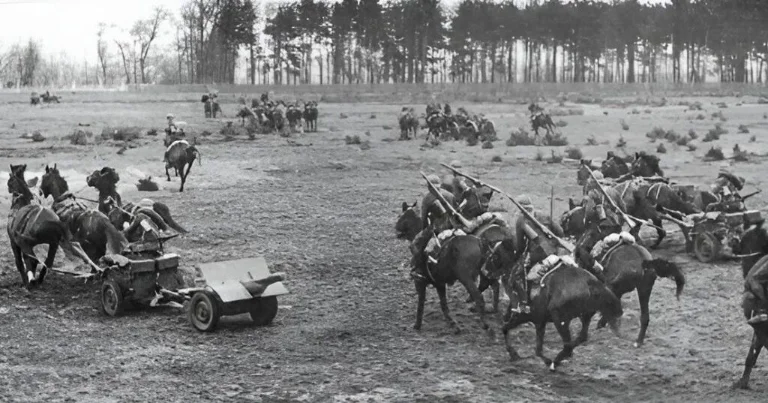
Polish cavalry units advancing during the Battle of the Bzura, September 1939
Polish cavalry units of the Wielkopolska Brigade advance during the Battle of the Bzura in mid-September 1939, part of the largest Polish counter-offensive of the campaign as forces attempt to break through German encirclement toward Warsaw.
15th September 1939
At Brest-Litovsk, General Heinz Guderian, frustrated by the Polish refusal to surrender, orders a massive coordinated assault by the 10th Panzer Division against the inner citadel. Despite the crumbling outer fortifications and the overwhelming weight of German heavy artillery, General Konstanty Plisowski’s garrison continues to hold the central structures, engaging in brutal room-to-room fighting. In a coordinated pincer manoeuvre, elements of the German 3rd Army pushing from the north and the 10th Army advancing from the south link up east of the Vistula River. This movement severs the final land corridors to Warsaw, officially placing the city under siege. The Battle of the Bzura transitions into a desperate struggle for survival for the Polish forces as German pressure from the 8th and 10th Armies compresses the developing pocket from several directions. In an attempt to widen the narrow corridor leading eastward, the Poles launch a major assault along the Sochaczew–Ruszki axis to secure bridges and fords that would allow an orderly withdrawal across the Bzura River, enabling Army Poznań and Army Pomorze to reach the Kampinos Forest. The 25th Infantry Division under General Franciszek Alter attacks toward Sochaczew, while to the north the 15th Infantry Division under General Zdzisław Przyjałkowski advances toward Ruszki and the surrounding heights, supported by 7TP tanks from the 2nd Armoured Battalion. The Polish assaults run directly into the blocking positions of the German XVI Motorised Corps, particularly the 4th Panzer Division positioned along the Bzura line, and are repulsed with heavy casualties. Unable to break through the strengthening German defences, Polish formations begin to fragment under relentless Luftwaffe air attacks, artillery fire, and disrupted communications. As the pocket tightens, thousands of soldiers from Army Poznań and Army Pomorze begin converging on the limited river crossings near Witkowice, creating severe congestion as units attempt to withdraw eastward toward the relative sanctuary of the Kampinos Forest. After several days of fighting around the historic Austro-Hungarian fortress system, the Polish garrison defending Przemyśl, composed mainly of elements of the 24th Infantry Division and 38th Infantry Division is forced to abandon the city under pressure from the German 7th Infantry Division. The fall of Przemyśl allows German forces to cross the San River in strength, breaking one of the last major natural defensive barriers protecting the western approaches to the Romanian Bridgehead. As the military situation becomes increasingly critical, the Polish government and High Command begin the sensitive operation of moving national archives and the gold reserves of the Bank of Poland toward the Romanian border. This logistical effort is intended to ensure that even if the territory falls, the financial and legal continuity of the Polish state can be preserved to support a government-in-exile.
16th September 1939
Corps Eberhardt launches a series of coordinated infantry and tank assaults against Polish positions on the Kępa Oksywska Plateau. Supported by the guns of the battleship Schleswig-Holstein, German troops capture the village of Mosty on the northeastern edge of the plateau, further compressing the Polish pocket. Despite mounting casualties and a severe shortage of medical supplies, Colonel Stanisław Dąbek’s forces continue to hold the northern ridges. At Brest-Litovsk, XIX Army Corps, spearheaded by the 10th Panzer Division and the 20th Motorised Infantry Division, renews its assault on the central citadel. The 9th Infantry Division under General Konstanty Plisowski, along with the remainder of the fortress garrison, resists stubbornly, repelling several waves of German infantry and tank attacks in close-quarters fighting. By evening, German artillery has breached the main walls in several places. Realising the position is no longer tenable, the wounded General Konstanty Plisowski orders the surviving defenders to attempt a night-time breakout across the Bug River to the south. Under a cloudless sky, the Luftwaffe concentrates around 800 aircraft over the shrinking Bzura pocket, systematically destroying the last remnants of organised Polish transport and supply columns. With the German 10th Army capturing Kutno and its vital road and rail links, the Polish command structure inside the pocket begins to collapse. As Army Poznań and Army Pomorze attempt to force their way through the Bzura crossings at Witkowice and Brochów, the congested escape routes come under devastating German artillery and air attack. The crossings quickly become deadly bottlenecks of burning wagons, shattered vehicles, and dead livestock as bombs and shells rain down on the packed columns. With the encirclement of Warsaw now firmly established and German artillery batteries taking up positions in the suburbs of Praga and Wola, the German command issues an ultimatum via radio and air-dropped leaflets demanding the city’s unconditional surrender within 24 hours to “avoid total destruction.” General Walerian Czuma and Mayor Stefan Starzyński reject the demand, signalling their resolve to defend the capital. The German 1st Mountain Division launches a probing infantry attack toward Lwów’s city centre. General Władysław Langner’s defenders, reinforced by local volunteers, hold their ground in fierce fighting along Gródecka Street, frustrating German attempts to seize the city before further Polish reinforcements can arrive.
Polish Flag

General Mieczysław Smorawiński

Polish Army

17th September 1939

‘We will fight to the last man, to the last bullet, for our freedom, for our independence.’
17th September 1939
In the early hours, the surviving defenders of Brest-Litovsk begin their breakout from the fortress in small groups, attempting to cross the Bug River and withdraw southward. Many are intercepted by German patrols and forced to surrender. At dawn, German troops enter the inner citadel of Brest-Litovsk to find it largely abandoned. With Poland already severely weakened by the German invasion, the Soviet Union executes the secret clauses of the Molotov–Ribbentrop Pact, signed the previous month, which provides for the partition of Poland between Nazi Germany and the Soviet Union. In the early hours, after delivering a diplomatic note to the Polish ambassador in Moscow declaring that the Polish state has ceased to exist and claiming the need to protect Ukrainian and Belarusian populations, Soviet forces cross the eastern frontier at around 03:00. Two major formations advance into Poland: the Belorussian Front in the north under Mikhail Kovalyov and the Ukrainian Front in the south under Semyon Timoshenko. The invasion force, numbering roughly 600,000 troops with around 4,700 tanks and over 3,000 aircraft, meets only scattered resistance, as most Polish units are already engaged against Germany in the west and eastern defences consist largely of Border Protection Corps units with limited artillery and air support. In response, Marshal Edward Śmigły-Rydz issues the directive: “The Soviets have entered. I order a general withdrawal toward Romania and Hungary... Do not fight the Bolsheviks unless they attack.” German heavy artillery and Luftwaffe bombing of Warsaw set the Royal Castle ablaze. As the historic landmark burns, civilian volunteers and museum staff risk their lives attempting to salvage national treasures from the flames. The bombardment intensifies across the city following the rejection of the previous day's German ultimatum. The Bzura pocket is compressed into a roughly 20 km² “cauldron” centred on Iłów. The Witkowice ford becomes an impassable “death zone” of wreckage from the previous day’s air raids, blocking the retreat of thousands of Polish soldiers. Recognising the situation is hopeless, General Tadeusz Kutrzeba orders all remaining heavy artillery and transport to be destroyed. Polish forces break into improvised “combat groups” of varying sizes and begin a frantic, disorganised push toward the Kampinos Forest in an attempt to escape the tightening German encirclement. The First Battle of Tomaszów Lubelski begins as General Antoni Szylling’s Army Kraków and General Tadeusz Piskor’s Army Lublin attempt a desperate breakout to the south-east toward Lwów and the Romanian Bridgehead. Supported by the last remnants of their armoured forces, including the Warsaw Armoured Motorised Brigade, Polish units launch a series of heavy assaults against German positions held by XXII Motorised Corps under General Ewald von Kleist. German formations in the sector, including the 2nd Panzer Division and 4th Light Division, resist the attacks as the Poles attempt to force open a route of escape. With the Soviet 6th Army advancing from the east, the situation at Lwów becomes increasingly desperate as the Soviet 24th Tank Brigade reaches the eastern outskirts of the city by evening. German forces of the 1st Mountain Division remain to the west, placing Lwów under threat from both directions. General Władysław Langner now faces the impossible task of maintaining a defensive perimeter against two invading armies simultaneously, yet despite the hopeless situation he refuses to surrender the city. The Polish Air Force scores its final aerial victories of the campaign. Near Nadwórna, Second Lieutenant Hieronim Kulbacki of the 122nd Fighter Escadrille, flying a PZL P.11c, shoots down a Soviet I-16 fighter, marking the first and only confirmed Polish air victory against the Red Air Force. In the Lwów–Łuck sector, Second Lieutenant Tadeusz Koc of the 161st Fighter Escadrille intercepts and downs a German Dornier Do 17Z bomber from 7./KG 3. These engagements represent some of the final sorties of the Polish Air Force, which by 16:00 receives orders to evacuate their remaining airworthy aircraft to Romania to prevent their capture. That night the Polish government, headed by President Ignacy Mościcki, together with Commander-in-Chief Edward Śmigły-Rydz and senior members of the High Command, crosses the border into neutral Romania with the intention of continuing on to France to establish a government-in-exile. However, under diplomatic pressure from Germany and the Soviet Union, the Romanian authorities intern the Polish leadership instead.
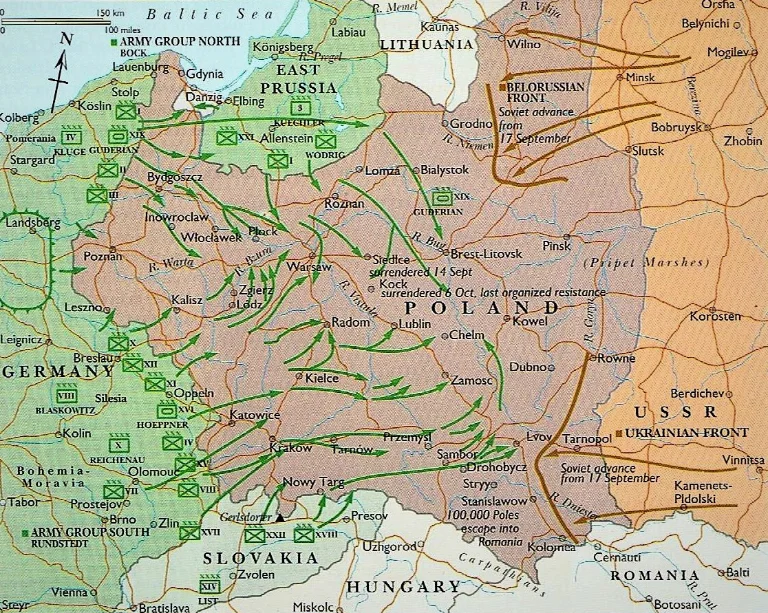
Map showing the Soviet invasion of Poland on 17th September 1939 and the advance of Soviet forces from the east
Map illustrating the Soviet invasion of eastern Poland on 17th September 1939, as Red Army forces advance from the east while German armies continue their campaign from the west.
18th September 1939
The crew of the Polish submarine ORP Orzeł, interned in the Estonian port of Tallinn since the 14th, overpower their guards and slip out of the harbour during the early hours. With the ship’s captain, Lieutenant-Commander Henryk Kłoczkowski, left behind in hospital due to illness, command falls to the executive officer Lieutenant Jan Grudziński, who leads the escape. Navigating the Baltic Sea without charts, the crew’s navigation officer, Lieutenant Marian Mokrski, reconstructs their route from memory using hand-drawn maps, beginning a perilous journey through the Baltic towards Britain. The Soviet 24th and 27th Light Tank Brigades of the 11th Army, Belorussian Front, reach Wilno (Vilnius) by late morning and launch a coordinated attack from multiple directions. Elements of the 35th Infantry Division, local garrison, police units, and student volunteers engage in fierce street fighting, slowing the Soviet advance. By evening, Soviet tanks have pushed into the outskirts of the city, forcing Colonel Jarosław Okulicz-Kozaryn to order some Polish units to begin a withdrawal toward the neutral Lithuanian border. Hundreds of small-unit skirmishes erupt as Polish troops attempt to escape the Bzura pocket through the dense, marshy Kampinos Forest. Navigating without maps, they repeatedly collide with blocking elements of the German 4th Panzer Division and 2nd Light Division near Budy Stare and Kamion, positioned east of the Bzura to seal the approaches to Warsaw. As the pocket collapses, German forces capture tens of thousands of Polish soldiers, particularly those trapped near the river crossings. However, elements of the Podolska and Wielkopolska Cavalry Brigades under General Roman Abraham successfully bypass German armour and begin reaching the northern outskirts of Warsaw, providing important reinforcements to the capital’s defences. Under the command of General Wilhelm Orlik-Rückemann, around 3,500–4,000 troops of the Border Protection Corps (KOP) launch a surprise counter-attack near Szack against the advancing Soviet 52nd Rifle Division. In the fighting they destroy six Soviet tanks and inflict heavy losses, with an estimated 300–400 Soviet soldiers killed. Polish casualties are comparatively light, with around 30–40 killed and roughly 100 wounded. The successful ambush temporarily halts the Soviet advance, allowing Orlik-Rückemann’s force to continue its withdrawal toward the Bug River. Polish formations of Army Lublin renew their assaults against the German XXII Motorised Corps around Tomaszów Lubelski. Supported by the remaining tanks of the Warsaw Armoured Motorised Brigade, Polish units achieve several local penetrations, but German anti-tank guns, artillery, and repeated Luftwaffe attacks prevent any sustained breakthrough. As the day progresses, German reinforcements press in from multiple directions, tightening the encirclement around the Polish forces attempting to force a path toward the Romanian Bridgehead. Following his internment in Romania the previous evening, President Ignacy Mościcki, recognising that he can no longer exercise his duties on Polish soil, begins the legal process to ensure the continuity of the Polish Republic. Invoking the April Constitution of 1935, which allows the president to designate a successor in wartime and initially appoints General Bolesław Wieniawa-Długoszowski as his successor to lead the Polish government in exile. However, under strong diplomatic pressure from the French government, Mościcki soon withdraws the nomination and instead turns to Władysław Raczkiewicz, who is already travelling to Paris. Members of the Polish Cipher Bureau cross into Romania, carrying with them replica German Enigma machines and crucial cryptographic materials. The codebreakers, including Marian Rejewski and Jerzy Różycki, eventually make their way to France, where they resume work decrypting German communications at the secret codebreaking centre known as PC Bruno near Paris.
19th September 1939
The remaining Polish forces, surrounded at Kępa Oksywska near Gdynia, with supplies nearly exhausted and having suffered around 2,000 casualties since 14th September, surrender shortly after Colonel Stanisław Dąbek takes his own life, bringing the Polish defence of the Baltic coast to an end. Hitler arrives at the Kasino Hotel in the Sopot area of Danzig following his triumphant entry into the city that morning. Later in the afternoon he gives a speech at the Artushof proclaiming that Germany ‘through me, embraces and admits you (Danzig) into our eternal community, and which never again shall release you.’ Despite the heroics of the remaining Polish units, the Soviet 24th and 27th Light Tank Brigades secure Wilno city centre. By late afternoon and with organized resistance crumbling, the Polish command is forced to withdraw their remaining forces of about 10,000 soldiers toward the Lithuanian border to seek internment rather than face captivity by Soviet forces. In the Kampinos Forest west of Warsaw, the remnants of Army Poznań and Army Pomorze in the Bzura pocket continue their desperate struggle eastward to reach the safety of the Warsaw perimeter. As Polish units emerge from the eastern edge of the forest, they find the road to the capital blocked by dug-in German forces. Near the village of Pociecha, General Mikołaj Bołtuć, the legendary commander of Operational Group "East", is killed while personally leading a bayonet charge against the infantry and machine gun positions of the 2nd Light Division in an attempt to break the blockade. About 8 km further east, the 14th Jazłowiec Uhlan Regiment, having bypassed the fighting at Pociecha, reach the forest's edge at Wólka Węglowa. Under the direction of Colonel Edward Sas-Świstelnicki, they launch a full-speed cavalry charge through the bivouac and screening elements of the German 1st Panzer Division and 29th Motorised Division. Suffering 20% casualties, they succeed in breaking through the German line and reach the Warsaw defensive perimeter at Młociny. The German 8th Army and 3rd Army consolidate their grip on the capital clearing the last significant Polish resistance in the outskirts. In the city, the situation becomes dire as the Lindley Water Filtration Plant (near Koszykowa Street) is damaged by incessant German shelling, leaving a large portion of the population without running water. With Army Lublin exhausted, out of ammunition, and the tanks of the Warsaw Armoured Motorised Brigade out of fuel, General Tadeusz Piskor realises that a breakout to the Romanian Bridgehead is no longer possible and signs the surrender of his army to prevent further needless slaughter. Although General Antoni Szylling and elements of Army Kraków continue to fight in isolated pockets to the south, this effectively brings the first Battle of Tomaszów Lubelski to an end, resulting in the capture of over 20,000 Polish soldiers. Early in the morning, the 24th Light Tank Brigade and 5th Cavalry Corps of the Soviet 6th Army (Ukrainian Front) reach the eastern suburbs of Lwów. As the Soviet tank columns move through the suburb of Winniki to link up with German forces encircling the city from the west, they are accidentally engaged by the German 1st Gebirgsjäger Division. This sharp, confused skirmish results in several destroyed tanks and casualties on both sides before senior officers can coordinate a ceasefire. Later that day, Soviet envoys approach the Polish lines to begin negotiations for a surrender; they claim the Red Army has arrived to "protect" the city from the Germans, but General Władysław Langner and his staff firmly refuse. Lavrentiy Beria, head of the NKVD, issues Order No. 0308, establishing the Directorate for Prisoners of War to manage the influx of Polish POWs captured during the Soviet invasion. Detention camps are ordered to be set up across the USSR. Not being a signatory to the 1929 Geneva Convention, the Soviet Union claims it is not bound by international rules regarding the treatment of captives. Of the approximately 240,000 Polish POWs taken by the Red Army, tens of thousands would perish due to systematic maltreatment, starvation, and poor conditions, particularly among the 37,000 designated for forced labour in mines and heavy industry.
German Flag

Adolf Hitler

Chancellor and Führer of Germany

19th September 1939

‘Not only you experience this moment with deepest emotion, nay, the entire German nation experiences it with you, and I, too, am aware of the greatness of the hour when I, for the first time, tread on the soil which German settlers occupied five centuries ago and which for five centuries was German, and which henceforth you may rest assured ‘will remain German....’
20th September 1939
The Polish submarine Wilk successfully reaches Rosyth Naval Base in Scotland following a dangerous journey through the Baltic and North Sea. Wilk is the first Polish naval vessel to arrive in Britain, symbolising the continuation of Polish resistance, with it and other ships later integrated into the Royal Navy's operations against the Kriegsmarine. The Red Army’s 15th Tank Corps of the 3rd Army reaches the outskirts of Grodno, where it meets unexpectedly fierce resistance from a small garrison of police units and student volunteers. Using Molotov cocktails and improvised obstacles, the defenders knock out around ten Soviet tanks and inflict several hundred casualties in the narrow streets as brutal house-to-house fighting turns Grodno into a symbolic centre of resistance to the Soviet invasion. Elements of the German 8th Army and XIV Motorised Corps conduct final mopping-up operations against Polish forces of the Bzura pocket trapped in the Kampinos Forest. Although elements of the 15th and 25th Infantry Divisions manage to slip through the encirclement and reach the Warsaw perimeter, the remaining forces of Army Poznań and Army Pomorze are overwhelmed and forced to surrender, with an estimated 120,000 to 170,000 Polish soldiers taken prisoner. As General Juliusz Rómmel’s Warsaw garrison is bolstered by thousands of survivors from the Bzura breakout, the German 8th and 10th Armies intensify their siege of the capital, with sustained artillery fire and Luftwaffe bombardment of residential districts causing a sharp rise in civilian casualties and rapidly worsening conditions for the population. Elements of Army Prusy, Army Lublin, and Army Modlin, grouped as the Front of the Northern Armies under General Stefan Dąb-Biernacki, along with the remnants of Army Kraków (General Antoni Szylling), attempt a desperate breakout toward the south and the Romanian Bridgehead. In what becomes known as the Second Battle of Tomaszów Lubelski, they find the town firmly held by the German 2nd Panzer Division and 28th Jäger Division. Despite their exhaustion, Dąb-Biernacki orders repeated assaults to break through the German ring, but these are repulsed. German forces in eastern Poland begin a phased withdrawal toward the demarcation line agreed with the Soviet Union under the secret protocol of the Molotov–Ribbentrop Pact. As German units pull back, Red Army formations advance into the vacated territories, taking over control of eastern Poland. In the south, elements of the German XVIII Corps disengage from positions west of Lwów and withdraw toward the San line, leaving the capture of the city to Soviet forces.
21st September 1939
Following his visit to Danzig, Hitler inspects the Westerplatte, where Polish troops had stubbornly held out against German efforts to capture the fortress for seven days earlier in the campaign. The battle for Grodno continues into a second day as the Soviet 15th Tank Corps attempts to break the city’s stubborn defence and force its way through Polish barricades. Soviet tank crews reportedly use civilians and scouts as human shields, placing them on the hulls of tanks to deter Molotov cocktail attacks. By nightfall, the overwhelming weight of Soviet armour and artillery begins to suppress the remaining centres of resistance, forcing Polish units to start withdrawing toward the Lithuanian border to avoid encirclement and capture. Forces of the German 8th Army continue “mopping up” operations against isolated Polish units in pockets south of the Bzura, capturing thousands of soldiers from Army Poznań who had been holding out in the marshes and forests following their encirclement after the main battle. With these pockets eliminated and rear-area supply lines secured, the Wehrmacht shifts its logistical focus towards the investment of Warsaw and Modlin. The German High Command (OKH) finalises plans for a decisive assault on Warsaw, “Operation Reinhardt.” Frustrated by the tenacity of the defenders, Adolf Hitler orders a shift from tactical military strikes to systematic terror bombing (Terrorflüge) designed to break civilian morale. The Luftwaffe intensifies its attacks on the city centre and densely populated residential districts. Within the perimeter, the humanitarian crisis peaks as food shortages become severe and horses are slaughtered for sustenance. The lack of running water hampers efforts to extinguish fires caused by relentless shelling. The situation for the Front of the Northern Armies under General Stefan Dąb-Biernacki and elements of Army Kraków turns catastrophic as German VIII and XVII Corps close the encirclement around Tomaszów Lubelski and the surrounding forests. Under constant fire and facing the prospect of certain defeat, the Polish command structure begins to break down as General Dąb-Biernacki controversially leaves his command in an attempt to escape toward Hungary. General Antoni Szylling remains with his men, attempting to organise a final defence of the trapped units in the absence of a central command structure, as isolated Polish units begin to surrender under mounting pressure. With Red Army units having taken over German positions west of Lwów and preparing to assault the city, the Polish command under General Władysław Langner initiates surrender talks, recognising that further defence is hopeless and would only lead to unnecessary civilian casualties and destruction, while seeking terms that would allow their forces to withdraw or go into internment rather than fall into Soviet captivity. Reinhard Heydrich issues directives to Einsatzgruppen commanders initiating the concentration of Jews in urban areas and the establishment of Jewish Councils, marking the beginning of systematic German policies against the Jewish population in occupied Poland. Gestapo and Einsatzgruppen units begin systematic selections within prisoner holding camps, identifying high-ranking officers, members of the Polish intelligentsia, and Jews, and separating them from the general prisoner population as part of the early implementation of German policies aimed at eliminating Poland’s leadership class.
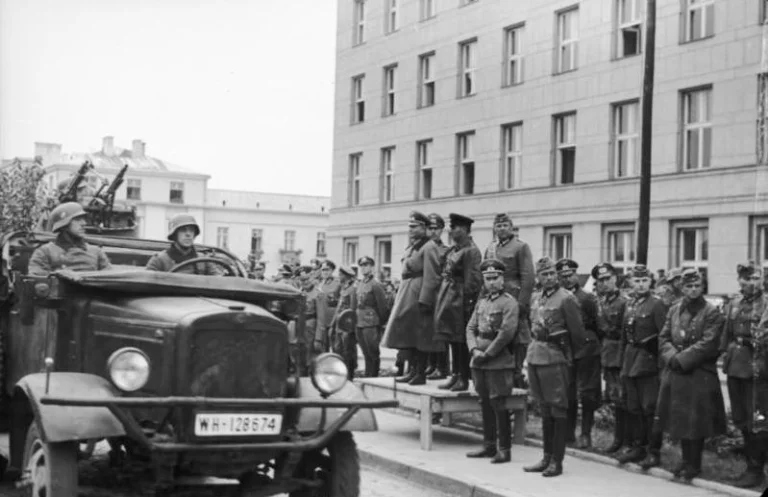
German and Soviet officers standing together beside a military vehicle during the Brest-Litovsk parade, 22nd September 1939
German and Soviet forces take part in a joint parade at Brest-Litovsk on 22nd September 1939, marking the handover of the city following the division of Poland.
22nd September 1939
Following the capture of Grodno, Red Army units and NKVD troops carry out summary executions of several hundred captured defenders, including youths accused of attacking Soviet tanks with improvised weapons. German and Soviet forces conduct a ceremonial handover at Brest-Litovsk as the city passes to the Red Army, in accordance with the Molotov–Ribbentrop Pact. At around 4pm, units of General Heinz Guderian’s XIX Corps withdraw in a formal parade, marching past Guderian and the Soviet commander, Kombrig Semyon Krivoshein, who jointly review the column as it departs the city and crosses back over the Bug River to the agreed demarcation line. Soviet troops, including elements of the 29th Tank Brigade, observe as German motorised units pass before moving in to occupy the city. As the German 8th and 10th Armies tighten their grip on Warsaw, the city is subjected to sustained artillery bombardment and repeated Luftwaffe air raids. Attacks increasingly target infrastructure as well as defensive positions, causing widespread fires and further straining the city’s already failing water and medical services. While observing front-line operations near the Praga district on the outskirts of Warsaw, Generaloberst Werner von Fritsch, the former Commander-in-Chief of the German Army, now serving in a ceremonial capacity as Colonel-in-Chief of Artillery Regiment 12, is killed in action. Struck in the thigh by Polish fire, the wound severs a major artery and proves fatal within minutes. Units of the German 8th Army execute approximately 50 Polish prisoners of war in the village of Boryszew. The victims, largely soldiers from Army Poznań captured after the Battle of the Bzura, are killed under the pretext of alleged “partisan” activity. Polish forces continue their efforts around Tomaszów Lubelski to break through German positions, but under sustained artillery fire and Luftwaffe attack, and as the 2nd Panzer Division and 28th Jäger Division tighten the encirclement, their ability to coordinate further assaults rapidly deteriorates. Following negotiations, General Władysław Langner formally surrenders Lwów to the Soviet 6th Army. Under the terms of the capitulation, approximately 1,500 Polish officers are promised safe conduct and the option to depart for neutral countries, while around 8,500 other ranks are to be demobilised and allowed to return home. These assurances are soon broken as the NKVD begins detaining officers and officials shortly after occupying the city. Many are subsequently transported to prisons in the Soviet Union, where around 22,000 Polish prisoners are later executed by the NKVD in the spring of 1940, including approximately 4,400 at the Katyn Forest near Smolensk, 6,300 at Mednoye near Kalinin, and 3,800 at Piatykhatky near Kharkiv. The fall of the city marks the collapse of one of the last major Polish defensive centres in the southeastern “Romanian Bridgehead” region. Small groups of Polish troops continue crossing into Romania and Hungary via the Romanian Bridgehead, both still neutral, with the aim of reaching France to continue the fight against Germany. Although Romania, under German pressure, interned many of these personnel, it remained relatively friendly toward the Poles. Hungary provided aid to Polish soldiers and civilian refugees, helping facilitate their onward movement to other friendly nations.
23rd September 1939
The Red Army’s 2nd Tank Brigade of the 15th Tank Corps is repulsed near Kodziowce in north-eastern Poland by elements of the Polish 101st Uhlan Regiment, commanded by Major Żukowski. The Polish forces reportedly destroy seven armoured vehicles and inflict around 25 casualties, forcing a local Soviet withdrawal. North of Warsaw, the Modlin Fortress, defended by the remnants of Armia Modlin and bolstered by thousands of exhausted troops who had retreated from the Battle of the Bzura, is now coming under heavy bombardment from German 3rd Army siege artillery, including 210mm Mörser 18 howitzers, and intensified aerial attacks from the Luftwaffe. Isolated and low on supplies, General Wiktor Thommée rejects German surrender demands, vowing to hold what he termed the "last gate to Warsaw." Inside Warsaw, the lack of clean water following the destruction of the city's Water Filtration Plant a few days prior leads to the first reported cases of typhus. Mayor Stefan Starzyński issues a desperate plea for the burial of the dead to help combat the spread of disease; however, with the city’s cemeteries under sustained fire, residents are forced to bury family members in city parks, public squares, and even the courtyards of apartment blocks.During a live broadcast on Polskie Radio, the renowned Polish pianist Władysław Szpilman is performing Chopin’s Nocturne in C-sharp Minor when German shells strike the Praga power station. The strike abruptly cuts short the broadcast, silencing Warsaw's radio for the remainder of the siege. As the Second Battle of Tomaszów Lubelski becomes increasingly desperate, Polish forces attempt to break out to the south-east through the wooded Roztocze region toward the Romanian Bridgehead. Near Krasnobród, the 25th Uhlan Regiment of the Nowogródzka Cavalry Brigade clears the town in fierce close combat following a charge against German infantry and artillery positions of the 4th Light Division. The success is short-lived, however, as German forces quickly counterattack with armoured support, forcing the Poles to withdraw. Under mounting German pressure and with the encirclement tightening, Polish resistance continues to fragment, with exhausted units breaking into smaller groups in an attempt to escape through the forests. Following the surrender of Lwów the previous day, Soviet forces begin a systematic sweep of the surrounding countryside to disarm scattered Polish units. In the forested regions of eastern Poland, NKVD “Operational Groups” follow closely behind the Red Army, identifying and arresting so-called “class enemies,” including local police, foresters, and landowners.
24th September 1939
The NKVD execute 42 staff and patients at a Polish military hospital in the village of Grabowiec. German Einsatzgruppe IV, under the command of SS-Brigadeführer Lothar Beute, executes approximately 800 Polish intellectuals, political leaders, and members of the Polish elite as part of a campaign to eliminate potential resistance to German occupation. The atrocity is committed near Bydgoszcz, a site that became known as the ‘Valley of Death’ due to the numerous killings carried out during September and October 1939. The Soviet Union as per the Secret ‘Spheres of interest’ Clause agreed in the Molotov–Ribbentrop pact, demands of the Estonian Foreign Minister in Moscow that Estonia sign a treaty of ‘mutual assistance’, allowing for the Soviet Union to occupy key Estonian military bases.
25th September 1939
At 0800, in coordination with the German Army heavily shelling Warsaw, the Luftwaffe begins a massive bombing attack against the city, launching 1,150 sorties and dropping 500 tons of high explosive and 72 tons of incendiary bombs over the course of the day. Nicknamed ‘Black Monday’ the attack badly damages the centre of Warsaw, bursting water mains and knock out electricity. However, because of the fires obscuring the view of later waves of aircraft, the Luftwaffe also manages to inadvertently drops some of its bombs onto the positions held by German infantry units that have penetrated into the northwest of the city, inflicting heavy casualties. Polish casualties in Warsaw since the start of the war now stand at approximately 18,000 civilians and 23,000 military dead and wounded.
26th September 1939
Germans forces encircling Warsaw launch a coordinated attack to break in and capture the city. Assaulting from both the Western and Eastern sides simultaneously, with 5 and 4 divisions respectively, and supported by 150 artillery batteries, they succeed in capturing the crucial forts of Mokotów, Dąbrowski, and Czerniaków, significantly weakening Warsaw’s defensive capabilities.
27th September 1939
At 12pm a cease fire is agreed between German and Polish forces in Warsaw and at 2pm the city officially surrenders to the Wehrmacht. During the siege 18,000 civilians were killed and approximately 50% of the city is heavily damaged. A Gestapo–NKVD meeting in Brześć initiates the coordination of prisoner transfers and joint security operations between Nazi Germany and the Soviet Union. This marks the beginning of formal collaboration in managing occupied Polish territories. Further meetings are planned for October and November to oversee the reorganization of these areas and the handling of civilian populations.
German and Polish officers meeting during surrender negotiations in Warsaw, September 1939
German and Polish military officers confer during surrender negotiations in Warsaw in late September 1939, as the siege of the capital came to an end and organized resistance in the city ceased.
28th September 1939
Troops of the Polish Border Defence Corps (KOP) engage elements of the Red Army’s 52nd Rifle Division defending Szack in Eastern Poland, destroying several T-26 tanks and routing the defending infantry force, briefly liberating the town. However, they withdrew later in the day as Red Army reinforcements arrive. German and Soviet Foreign Ministers meet in Moscow and agree to modify the secret “spheres of influence” protocol originally outlined in the August 1939 Molotov–Ribbentrop Non-Aggression Pact. The resulting agreement, known as the German–Soviet Treaty of Friendship, Cooperation and Demarcation, formalizes the division of Poland and adjusts territorial claims: Lithuania is transferred to the Soviet sphere, while Germany retains all of ethnically Polish territory and gains land on the left bank of the River Scheschupe from Lithuania. The treaty includes secret protocols providing for reciprocal population and prisoner exchanges, as well as a mutual commitment to suppress Polish resistance and nationalist agitation within their respective zones of occupation. With the build-up of Soviet ground forces along the Estonian border becoming increasingly more apparent and with Soviet Air and Naval forces provocatively flying over and sailing through their territory. The Estonian government seeing no other choice, signs the ‘mutual assistance’ treaty, thereby allowing Soviet naval, air and army bases to be established across the country.
29th September 1939
As part of the conditions of Warsaw’s surrender, the 140,000 soldiers of its garrison begin to leave the city and head towards German lines to be made prisoners of war. With the surrender of Warsaw, General Wiktor Thommée, in command of the Polish forces defending the Modlin Fortress and the surrounding area northwest of Warsaw, agrees to surrender to the Germans. These forces are the remnants of the Modlin Army, which were encircled on the 13th of September and number approximately 35,000 officers and men.
30th September 1939
Polish President Moscicki, officially relinquishes office to Wladyslaw Raczkiewicz in Paris, who immediately takes the constitutional oaths at the Polish Embassy, becoming President of the Republic of Poland and establishing the government in exile. Raczkiewicz then appoints General Wladyslaw Sikorski as his Prime Minister.

October 1939

1st October 1939
German forces begin to enter and occupy Warsaw. The Polish Independent Operational Group ‘Polesie,’ commanded by General Franciszek Kleeberg and organised around the remnants of the 60th Polish Infantry Division ‘Kobryń,’ as well as the Podlaska and Nowogródzka Cavalry Brigades, along with several other improvised units, moves towards Kock, approximately 120 km southeast of Warsaw. With intelligence reports indicated the presence of General Gustav Anton von Wietersheim’s XIV Motorized Corps (including the 3rd and 29th Motorized Infantry Divisions) under 10th Army, Army Group South. This prompted Kleeberg to issue orders for defensive preparations and reconnaissance operations. The Polish Cipher Bureau arrives in Paris to continue their work in conjunction with French and British intelligence to break the German Enigma code.
2nd October 1939
The Battle of Kock begins with initial skirmishes near the villages of Serokomla and Wola Gułowska. The German 13th Motorized Infantry Division launches an attack, aiming to break through the defensive positions of the Polish 60th Infantry Division. However, the Polish forces successfully repulse the assault, forcing the German division to regroup. Both sides suffered several hundred casualties in the fierce fighting. Following a month-long siege and with dwindling supplies and morale, 3,000 Polish troops of the Hel Peninsula garrison, led by Rear Admiral Włodzimierz Steyer, surrender to German forces. The German Department of Justice, within the General Government, begin using Pawiak Prison in Warsaw. In March 1940, the prison was transferred to the Warsaw District’s SIPO (Sicherheitspolizei) and SD (Sicherheitsdienst) security agencies, which implemented a brutal regime of torture and execution for the prisoners incarcerated there. This continued until the prison was destroyed by German forces on August 21, 1944. During this time, approximately 100,000 prisoners passed through its gates, with 37,000 executed and 60,000 sent to concentration camps.
3rd October 1939
Despite being outgunned and poorly equipped, Polish forces under General Franciszek Kleeberg launch a surprise counteroffensive in the Kock area, attacking the German XIV Motorized Corps on both flanks. The bold manoeuvre results in the successful recapture of Serokomla, forcing the Germans to retreat across the Tyśmienica River. Lithuanian Foreign Minister Juozas Urbsys, arrives in Moscow ostensibly to resolve the status of the Vilnius Region with the Soviet Union, but during the meeting Stalin informs Urbsys about the secret protocols in the amended Molotov–Ribbentrop pact and demands that Lithuania sign a treaty of ‘mutual assistance’ similar to Estonia and Latvia, allowing Soviet forces to be based in the country, although two additional elements were included. The first, was to cede territory west of the Scheschupe River to Germany and the second would allocate a portion of the Vilnius Region including Lithuania’s historical capital of Vilnius back to Lithuania from Poland. Urbsys, shocked by the demands postpones any answer and returns to Lithuania to consult with the government.
4th October 1939
With the Battle of Kock intensifying, German forces deploy additional units, including tanks and armoured cars, to break through Polish defences. Fierce fighting erupts near Adamów and Wola Gułowska, where the Nowogródzka Cavalry Brigade successfully repulses multiple German attacks. However, despite their resilience, the brigade suffers mounting losses, that cannot be replaced.
5th October 1939
Adolf Hitler takes the salutes of the German Army during the ‘Siegesparade’ (Parade of Victory) through Warsaw. Under mounting pressure from stronger German forces, supported by an unopposed Luftwaffe, Polish defences begin to crumble in the Battle of Kock, with German units breaking through several positions. Despite fierce resistance, Polish troops, running low on ammunition and food, initiate an organised withdrawal. General Kleeberg, recognising that continued resistance is unsustainable, begins surrender negotiations with the Germans. Latvia having seen Estonia sign a ‘mutual assistance’ treaty with the Soviet Union and with no other options, sends its Foreign Minister Vilhelms Munters to Moscow to sign its own ‘mutual assistance’ Treaty with the Soviets allowing them to establish military bases in Latvia at Libau and Windau.
6th October 1939
Marking the final act of the Battle of Kock, General Franciszek Kleeberg, formally surrenders the remaining units of his Independent Operational Group ‘Polesie,’ to German forces, effectively ending all organized Polish military resistance to the German invasion of Poland. Total Polish casualties during the battle are approximately 4,000 killed and wounded, with 8,000 captured. German casualties are estimated at between 1,000 and 1,500 over the course of the engagement. In a speech to the Reichstag, Hitler asks why Britain and France should continue the fight against Germany? ‘For restoration of Poland? ...Poland of the Versailles Treaty will never rise again. This is guaranteed by two of the largest States in the world. Final re-organization of this territory and the question of re-establishment of the Polish State are problems which will not be solved by a war in the West but exclusively by Russia on the one hand and Germany on the other.’
7th October 1939
A Lithuanian delegation returns to Moscow with counter proposals for the ‘mutual assistance’ pact, but Stalin refuses them, although he does agree to reduce the Soviet garrison to 20,000. With the Soviet’s wanting an immediate answer, the Lithuanian delegation stalls for time and returns home.
8th October 1939
Hitler signs a decree formally annexing parts of western Poland to Germany and officially establishing the new regions of Reichsgau Posen (renamed Reichsgau Wartheland in January 1940) and Reichsgau West Prussia. Smaller areas were incorporated into the existing Reichsgau East Prussia and Reichsgau Upper Silesia. German forces, comprising Gestapo officers and members of the ethnic German paramilitary group Selbstschutz, carry out a mass execution at the Jewish cemetery on Polna Street in Świecie, Poland. Around 50 Jewish men are forced to dig a large trench, then made to lie down in it before being shot.
9th October 1939
The killings resume at the Jewish cemetery in Świecie with German forces bringing approximately more 20 Jewish women with children and 30 Polish civilians to the site. All are executed and buried in the same mass grave as the previous day’s victims.
10th October 1939
A third Lithuanian delegation arrives on Moscow in an attempt to demand as much of Vilnius Region be transferred from Poland as possible before signing the ‘mutual assistance’ agreement, but they find Stalin inflexible. With little choice but to sign or face a Soviet invasion, they sign the proposed treaty hoping to keep some degree of autonomy.
14th October 1939
Following its daring escape from internment in Estonia the previous month, the Polish submarine Orzeł safely arrives in Rosyth, Scotland, after navigating a perilous journey through the Baltic Sea and North Sea.
18th October 1939
The Soviet Union begins preparations to transfer Polish prisoners of war and civilians to the Germans who have ended up on the "wrong side" of the newly established German–Soviet border in occupied Poland.
21st October 1939
As part of a broader Nazi campaign to Germanize the territories of western Poland recently annexed into the Reich, German authorities begin the mass deportation of Polish civilians from Posen (Poznań) and its surrounding areas. Forcibly loaded onto trains, these civilians were transported east to the future borders of the General Government (an area of Poland not annexed but under German control) and left to fend for themselves.
22nd October 1939
Soviet authorities hold staged “elections” in occupied eastern Poland, now called Western Ukraine and Western Byelorussia, to legitimize annexation. Following the vote, the USSR begins a harsh campaign of repression: Polish property is confiscated, the ruble replaces the złoty, and thousands are added to NKVD deportation lists. Polish institutions are dismantled, religious practices banned, and cultural life suppressed as Sovietization intensifies.
24th October 1939
Germany begins the transfer individuals to the Soviet Union under the terms of the German–Soviet Treaty of Friendship, Cooperation and Demarcation. The first group includes part of the 13,575 individuals agreed upon—primarily ethnic Ukrainians, Belarusians, and Jews who had resided in the Soviet sphere before the war. The exchange is coordinated alongside the Soviet handover of 19,000 Polish prisoners to Germany.
26th October 1939
The General Government is established in Poland under Hans Frank to administer those areas of Poland, not annexed into Reich. Its headquarters are at Wawel Castle in Kraków.
31st October 1939
Vyacheslav Molotov, the Soviet Foreign Minister, delivers a speech to the Supreme Soviet in Moscow, justifying the invasion of Eastern Poland on 17 September 1939 as a necessary step for the protection and security of the Soviet Union. Molotov also expressed disdain for Britain and France, accusing them of aggression and attempting to push the Soviet Union into a war with Germany. The SS begins enforcing a series of harsh and arbitrary regulations targeting Polish civilians, aimed at breaking morale and asserting German dominance over daily life. Among the restrictions are bans on using public phone booths and wearing felt hats—violations of which can result in severe punishment, including the death penalty.
Soviet Union Flag

Vyacheslav Molotov

Soviet Union Foreign Commissar

31st October 1939

‘One swift blow by the German army, followed by another from the Red Army, and nothing remained of this ugly offspring of the Versailles Treaty.’

November 1939

1st November 1939
Danzig and the Polish Corridor, along with all territories that were forcibly transferred to Poland under the 1919 Versailles Treaty following World War 1, are officially restored to the German Reich.
3rd November 1939
The areas of Eastern Poland occupied by the Red Army are officially annexed by the Soviet Union, being split between the Belarusian and Ukrainian SSR’s. The only area to avoid this fate is the Wilno area, which is transferred to Lithuania.
6th November 1939
Germany completes the second phase of its prisoner and civilian exchange with the Soviet Union. The remaining individuals from the agreed 13,575 total are handed over, including more ethnic minorities and political detainees. This coincides with the Soviet transfer of an additional 23,492 Polish prisoners to German custody.
14th November 1939
The Polish government-in-exile in Paris, forms the Związek Walki Zbrojnej (ZWZ), or Union of Armed Struggle, to coordinate resistance activities in Poland against the Nazi and Soviet occupiers.