WorldWar-2.com

Eastern Europe

September 1939 – May 1945

‘The troops of the Don Front at 4pm on the 2nd February 1943 completed the rout and destruction of the encircled group of enemy forces in Stalingrad. Twenty two divisions have been destroyed or taken prisoner.’
Lieutenant General Konstantin Rokossovsky - Commander of the Don Front - 2nd February 1943

Eastern Europe Overview

The war in Eastern Europe unfolds as the largest and most destructive land struggle of the Second World War, marked by vast distances, ideological ferocity, and battles fought on an unprecedented scale. What begins as a regional crisis in Poland rapidly expands into a titanic confrontation between Nazi Germany and the Soviet Union, transforming the eastern theatre - Eastern Front - into the central battleground of the war in Europe. From the Baltic to the Black Sea, control of territory, resources, and transport corridors shapes the course of the conflict and determines the fate of millions. The fighting in the east opens with the twin invasions of Poland in September 1939, followed by further Soviet expansion along its western frontier. For a time, an uneasy and temporary balance exists between Berlin and Moscow, but beneath the surface both powers prepare for a far larger reckoning. That moment arrives in June 1941 with Operation Barbarossa, the massive German invasion of the Soviet Union. What begins as a campaign of rapid encirclement and dramatic territorial gains soon evolves into a grinding war of attrition as Soviet resistance stiffens and the German advance begins to stall. Between 1941 and 1943 the centre of gravity shifts decisively. Battles such as Moscow, Stalingrad, and Kursk mark turning points in both momentum and scale, as the Red Army absorbs the initial blows and then begins to push westward. The eastern theatre becomes a relentless struggle of industrial capacity, manpower, and endurance, fought across devastated cities, open steppe, forests, and frozen winter fronts. Partisan warfare, occupation policies, and the brutal treatment of civilian populations further intensify the character of the conflict. From 1944 onward, Soviet offensives gather unstoppable force. German Army Groups are shattered in a series of massive operations that drive the front steadily toward Central Europe. One by one, occupied territories are liberated or overrun as the Red Army advances through Poland and into the Balkans and eastern Germany. By the spring of 1945, Soviet forces reach Berlin itself, bringing the eastern war in Europe to its violent conclusion and sealing the fate of the Third Reich. This Eastern Europe overview page serves as a gateway to the major campaigns, turning points, and battles across the theatre, tracing the conflict from the opening invasions in Poland to the final Soviet advance into the heart of Nazi Germany.
What’s New

8th April 2026

The Invasion of Poland timeline has been further expanded with four new photographs and two additional contemporary quotations, providing greater visual and first-hand context for key stages of the campaign. Entries for 18th to 22nd September 1939 have also been thoroughly revised and expanded, continuing the detailed reworking of the final phase of the campaign.

20th March 2026

The Invasion of Poland timeline has been significantly revised once again, with the entries for 14th to the 17th September 1939 thoroughly overhauled to improve coverage of the final phase of the campaign. A new campaign map has also been added for 17th September, illustrating the Soviet invasion of Poland and the widening collapse of Polish resistance from both east and west.

3rd March 2026

The Eastern Europe section now features a dedicated overview page, providing a central hub for the major campaigns and timelines across the Eastern European theatre. Following recent work to the Invasion of Poland timeline, significant updates have also been applied to the period 9th–13th September 1939, expanding coverage of key operations and developments during this critical phase of the campaign.

Weapons of War

Flag of the Soviet Union

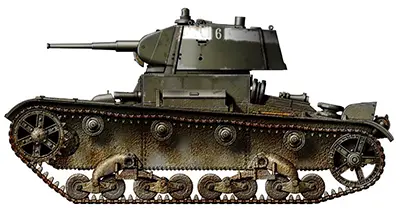
T-26

Light Tank

Soviet T-26 light tank armed with a 45 mm gun, 1930s design

The T-26 was the Red Army’s most numerous light tank at the start of World War II. Based on the British Vickers 6-Ton, it became the backbone of Soviet armoured forces during the 1930s. Armed with a 45 mm gun and a coaxial machine gun, it was effective against early Axis armor but its 15–25 mm riveted armor offered little protection by 1941. The T-26 saw action in the Spanish Civil War, at Khalkhin Gol, during the Winter War, and in the opening battles of 1941–42. More than 10,000 were built, including flame-thrower and engineer variants, but it was gradually replaced by the T-34. Though obsolete by 1942, the T-26 played a crucial role in the Red Army’s early campaigns and remains one of the most significant interwar tanks.

Timeline Highlights

1st September 1939

At 4:45am, Fall Weiss (Case White), the German Invasion of Poland begins and 2 minutes later at 4:47am the opening shots of World War 2 are fired by the German Battleship Schleswig-Holstein which had taken up a position in Danzig Bay opposite the Polish fort at Westerplatte. She opened up with a full broadside by her 11-inch guns at point blank range against the fort. German marines then attacked the Polish outposts, but were bloodily repulsed. At 7:40am the Schleswig-Holstein once again opened a barrage against the fort for about an hour, before a second attack by the marines was launched around 8:35am, which was also repulsed by the Poles.

3rd September 1939

Britain issues a final ultimatum to Germany at 9am, giving the Germans until 11am to agree to withdraw their troops from Poland. Just after the deadline a German response is received in the form of an 11 page document, which confirms their refusal to withdraw from Poland. At 11:15am Prime Minister, Neville Chamberlain announces that ‘no such undertaking has been received’ from Germany to withdraw their forces and he therefore declares that ‘Britain is now at war with Germany’. The declaration also commits Australia and New Zealand to the war, having been agreed in advance with their governments. Similarly France also declares war on Germany at 5pm following the expiry of its own ultimatum.

17th September 1939

With Poland already significantly weakened by the German invasion, the Soviet Union executes the secret clauses of the Molotov–Ribbentrop Pact, signed the previous month, which agreed the division of Poland between Nazi Germany and the Soviet Union, and begin an invasion from the east. Declaring that Poland no longer exists as an independent state and under the pretext of protecting the Byelorussian and Ukrainian populations living in Poland, two Soviet Fronts, Byelorussian in the north and the Ukrainian in the south, cross the frontier into Poland. The Soviet forces, numbering around 600,000 troops, 4,736 tanks, and 3,300 aircraft, encounter little resistance, as the Polish Army in the east consists mainly of border guards with very little artillery or air support.

27th September 1939

At 12pm a cease fire is agreed between German and Polish forces in Warsaw and at 2pm the city officially surrenders to the Wehrmacht. During the siege 18,000 civilians were killed and approximately 50% of the city is heavily damaged. Gestapo–NKVD meeting in Brześć initiates the coordination of prisoner transfers and joint security operations between Nazi Germany and the Soviet Union. This marks the beginning of formal collaboration in managing occupied Polish territories. Further meetings are planned for October and November to oversee the reorganization of these areas and the handling of civilian populations.

1st December 1939

The Soviet Union officially establishes the Finnish Democratic Republic, a puppet government led by Finnish communist Otto Wille Kuusinen, in the town of Terijoki, which immediately accedes to the Soviet demands. The Soviet Union broadcasts propaganda messages claiming this government, which is intended as a Soviet-friendly alternative to the legitimate Finnish government, has the support of the Finnish people. This was an attempt to undermine the Finnish government and justify the invasion. In Central Finland, the Soviet 163rd Rifle Division and an independent tank brigade having crossed the border at Juntusranta, while the 44th Rifle Division crossed at Raate, force the defending Finnish forces of about battalion strength, to conduct a fighting retreat towards the village of Suomussalmi.

7th January 1940

Finnish forces complete the destruction of the Soviet 44th Rifle Division along the Raate Road, as its remaining elements are forced to surrender, having been surrounded without supplies since the 1st January. In what became known as the Raate Road Massacre, many Red Army soldiers froze to death near the road, lacking adequate winter equipment and being unable to move off-road due to the Finnish ski troops controlling the surrounding countryside.

23rd February 1940

The Soviet Union announces its final conditions for peace with Finland. These included ceding a significant amount of territory in Karelia, including the city of Viipuri. Additionally, areas around Salla were also demanded, along with a thirty-year lease for a naval base on the Hanko Peninsula and various islands in the Gulf of Finland.

German Flag

Adolf Hitler

Chancellor and Führer of Germany

15th September 1942

‘The war will be decided by the strength of our arms and the will of our people.’

Leaders and Commanders

Marshal Edward Rydz-Śmigły, Supreme Commander of Poland during the 1939 invasion
Polish Flag

Edward Rydz-Śmigły

Marshal of Poland (promoted 10th November 1936) and General Inspector of the Armed Forces (1935–1939)

Service: 1911 – 1941

Marshal Edward Rydz-Śmigły’s military career begins in the Austro-Hungarian Army before joining Józef Piłsudski’s Polish Legions during World War I, where he distinguishes himself in several engagements. After Poland regains independence, he plays a leading role in the Polish–Soviet War, earning national recognition for his leadership. Following Piłsudski’s death in 1935, Rydz-Śmigły becomes General Inspector of the Armed Forces and, in 1936, is elevated to Marshal of Poland, solidifying his status as Piłsudski’s successor. During the Invasion of Poland in September 1939, he serves as Supreme Commander of the Polish Armed Forces. Despite determined resistance, Poland is overwhelmed by the combined German and Soviet assaults. Rydz-Śmigły flees to Romania, later returning secretly to Warsaw under the alias Adam Zawisza. He died of a heart attack on 2nd December 1941 in Nazi-occupied Warsaw. His legacy remains complex — celebrated for his patriotism and service yet criticised for strategic decisions made during Poland’s darkest hour.