WorldWar-2.com

Operation Weserübung

April 1940 - June 1940

‘I have no doubt that our action, which at the last moment forestalled the execution of the Allied plan and which under all circumstances will stop France and England from getting a foothold in Scandinavia, will have consequences which will be a blessing to the Scandinavian peoples.’
Adolf Hitler - Chancellor and Führer of Germany - 24th April 1940

Introduction to Operation Weserübung

Operation Weserübung (Exercise Weser) was Nazi Germany’s surprise invasion of Denmark and Norway, launched at dawn on the 9th April 1940. The campaign aimed to occupy Denmark within hours and secure the Norwegian coast, including the vital iron-ore supply route through the port of Narvik, while preventing Britain and France from establishing naval and air bases in Scandinavia during World War II. Denmark capitulated almost immediately, but the invasion of Norway sparked fierce resistance, supported by British, French, and Polish troops. The fighting combined naval landings, paratroop assaults, and mountain warfare, dramatically illustrated by the sinking of the German cruiser Blücher in Oslofjord and the naval battles for Narvik. Although the Allies briefly recaptured Narvik in May, Germany’s simultaneous offensive in France forced their withdrawal from Norway. By the 10th June 1940, Norwegian forces surrendered and the government fled into exile, leaving Germany in control of Denmark and Norway. Operation Weserübung secured the Scandinavian coastline, safeguarded critical resources, and gave the Wehrmacht a strategic advantage in the North Sea and Arctic campaigns of World War II.

April 1940

2nd April 1940
Adolf Hitler issues Directive No. 25, setting the 9th April as the date for the invasions of Denmark and Norway (Operation Weserübung). The plan aims to secure the North Atlantic approaches and safeguard shipments of Swedish iron ore through Narvik.
5th April 1940
Britain notifies Norway and Sweden of Allied intentions to mine Norwegian coastal waters in order to disrupt German use of the vital iron-ore supply route.
8th April 1940
The British destroyer HMS Glowworm is sunk in action with the German heavy cruiser Admiral Hipper while shadowing the invasion fleet bound for Trondheim. Earlier in the day, the Polish submarine Orzeł torpedoes and sinks the German transport ship Rio de Janeiro off Lillesand, revealing German troops bound for Norway, though Oslo does not order full mobilisation.
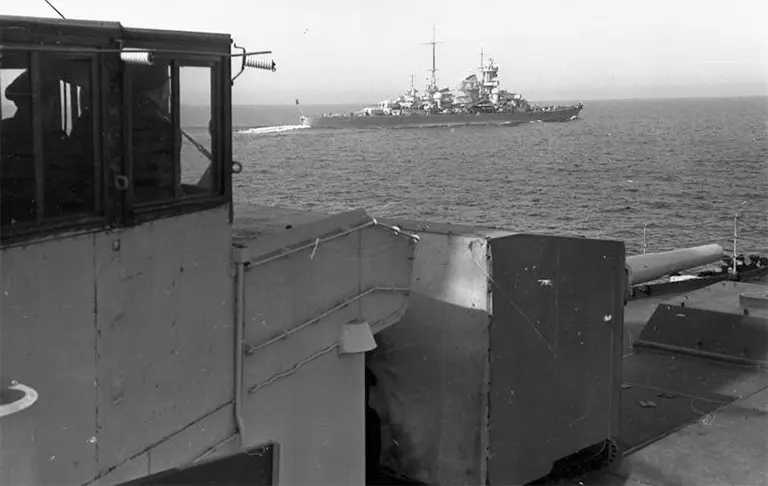
German Kriegsmarine task force sailing toward Norway during Operation Weserübung to support the invasion of Oslo, April 1940
German Kriegsmarine warships sail toward Norway during Operation Weserübung in April 1940, forming part of the naval assault groups tasked with transporting invasion troops and seizing strategic ports including Oslo during the opening phase of the campaign.
9th April 1940
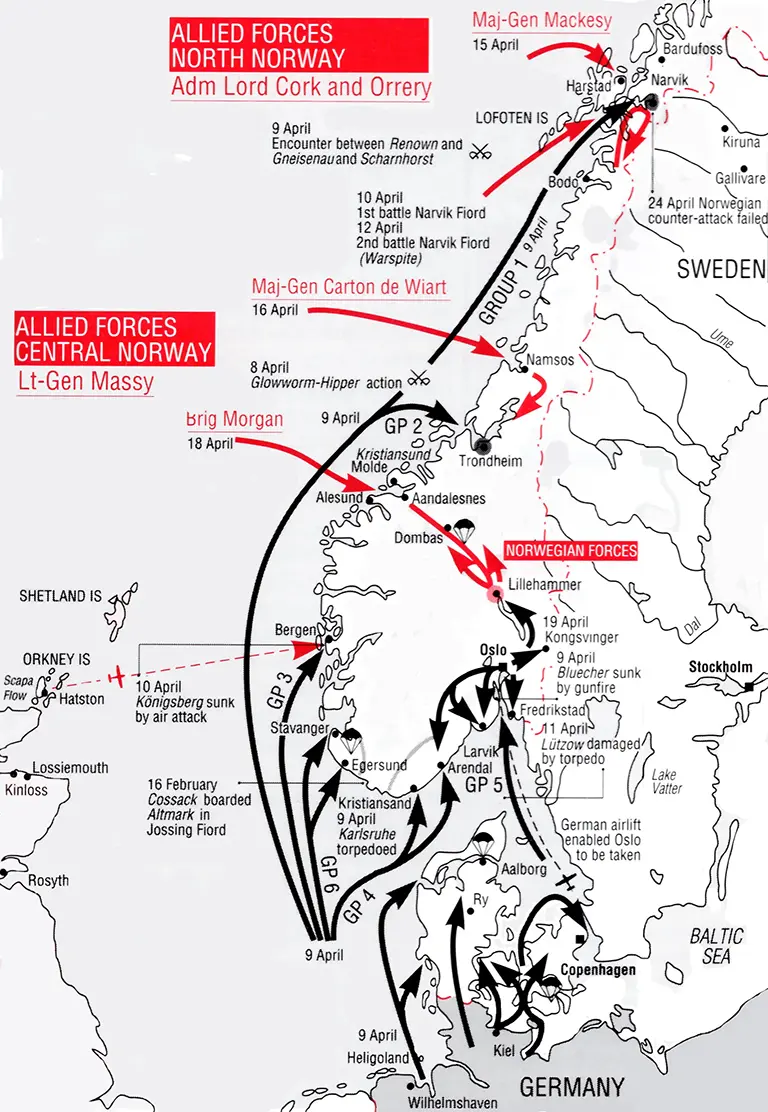
Germany launches simultaneous invasions of Denmark and Norway (Operation Weserübung). In Denmark, German troops cross the border at dawn and occupy Copenhagen and key cities within hours, forcing a swift capitulation. In Norway, German naval groups land at Bergen, Trondheim, Kristiansand, Stavanger, Narvik, Arendal, Egersund, and Oslo. However, at Oslofjord, the German heavy cruiser Blücher—leading the task force carrying troops to capture the Norwegian capital—comes under fire from the coastal fortress at Oscarsborg. The fortress commander orders his guns to open fire without awaiting confirmation from higher command. The fortress’s heavy guns score direct hits on Blücher, and two torpedoes from an underground battery strike her amidships. The cruiser catches fire and sinks, resulting in the loss of around 830 German sailors and troops. Although the sinking delays the capture of Oslo by several hours, German airborne forces soon land at Fornebu Airport, and by the afternoon the capital falls. King Haakon VII, the royal family, and the Norwegian government escape northwards, refusing to surrender. The battleship HMS Renown clashes with Scharnhorst and Gneisenau in the North Sea; both sides sustain damage, but the Germans withdraw. German aircraft sink the destroyer HMS Gurkha and damage HMS Rodney. Meanwhile, the submarine HMS Truant torpedoes and sinks the cruiser Karlsruhe. Vidkun Quisling announces a German-backed government in Oslo, though it lasts only five days.
operation-weserubung-german-naval-groups-allied-counter-landings-norway-denmark-1940
Operational map of Operation Weserübung illustrating German naval assault groups launching coordinated invasions of Denmark and Norway on 9 April 1940. The map also shows Allied counter-landings at Narvik, Namsos, and Åndalsnes, highlighting the multi-front struggle for control of Norway’s strategic ports and sea routes.
Flag of Denmark

Thorvald Stauning

Prime Minister of Denmark

9th April 1940

‘The government has yielded to superior force. To resist further would mean useless bloodshed and the bombing of Copenhagen. We must seek to safeguard our people under these difficult circumstances.’
10th April 1940
In what becomes known as the First Naval Battle of Narvik, five British destroyers under Captain Bernard Warburton-Lee launch a surprise attack on the German flotilla anchored in Narvik harbour. In a fierce engagement fought through snow and low visibility, two German destroyers (Wilhelm Heidkamp and Anton Schmitt) and several merchant ships are sunk, but two British destroyers (HMS Hardy and HMS Hunter) are also lost. Captain Warburton-Lee is killed on the bridge of Hardy and is later awarded the Victoria Cross posthumously for his leadership. The German flotilla commander, Commodore Friedrich Bonte, is also killed when his flagship explodes. British Skua dive-bombers attack Bergen, sinking the damaged cruiser Königsberg—the first major warship ever sunk by air attack in open water. The German heavy cruiser Lützow (formerly Deutschland) is also seriously damaged in the Kattegat by the British submarine HMS Spearfish.
Flag of Norway

King Haakon VII

King of Norway

10th April 1940

‘For my part, I cannot accept the German demands; it would be a violation of our constitution. If the government feels it cannot follow me in this, there is no longer any need for me to remain king.’
11th April 1940
King Haakon VII appeals to Norwegians to continue resistance. The first British troop convoys sail for Norway—some units missing heavy equipment due to the speed of deployment. Allied air and naval operations increase as the Luftwaffe expands bombing raids across western and central Norway.
12th April 1940
Norwegian authorities acknowledge German control of Kristiansand, Stavanger, Bergen, Trondheim, and Narvik, while reorganising inland forces to continue the fight. Allied submarines intensify attacks on German shipping.
13th April 1940
The Second Naval Battle of Narvik: nine British destroyers, supported by HMS Warspite, annihilate the remaining eight German destroyers in Ofotfjord. A Swordfish aircraft from HMS Furious sinks U-64, the first U-boat destroyed by an aircraft in World War II. Surviving German sailors—about 2,600 men—form ad hoc naval battalions to fight ashore. Meanwhile, the German 163rd Infantry Division advances north from Oslo towards Eidsvoll and Kongsberg.
United States Flag

Franklin Roosevelt

President of the United States

13th April 1940

‘FORCE AND MILITARY AGGRESSION are once more on the march against small nations, in this instance through the invasion of Denmark and Norway... If civilization is to survive, the rights of the smaller nations to independence, to their territorial integrity, and to the unimpeded opportunity for self‑government must be respected by their more powerful neighbours.’
14th April 1940
British destroyers sink U-49 near Harstad. The first detachments of the 24th Guards Brigade land at Harstad and Namsos. Heavy fighting breaks out at Dombås between Norwegian troops and German paratroopers of the 1st Fallschirmjäger Regiment, most of whom are eventually captured.
15th April 1940
The bulk of the British 24th Guards Brigade under Major General William Mackesy arrives at Harstad to prepare for operations against Narvik. German reinforcements continue to land in Oslo, including the 196th Infantry Division, while the 181st Infantry Division secures Trondheim.
16th April 1940
The British 146th Infantry Brigade under Major General Adrian Carton de Wiart lands at Namsos and advances to Steinkjer. German forces push north from Oslo in three thrusts: through Østerdalen, along both sides of Lake Mjøsa, and toward Hønefoss, supported by tanks, artillery, and airpower. In Narvik, General Eduard Dietl secures the town and its approaches to the Swedish border.
18th April 1940
The British 148th Infantry Brigade under Major General Harold Morgan lands at Åndalsnes south of Trondheim, intended to link with the Namsos force. At the same time, two battalions of the French 1st Chasseurs Alpins Division arrive at Namsos.
19th April 1940
The French cruiser Émile Bertin is badly damaged by German air attack at Namsos and withdrawn, replaced by Montcalm. The Allied advance on Trondheim continues to stall under heavy German resistance and air superiority.
21st April 1940
Heavy fighting intensifies across Norway as German columns advance from Oslo and Allied troops dig in around Namsos, Åndalsnes, and Narvik. Luftwaffe raids inflict mounting losses on supply depots and shipping.
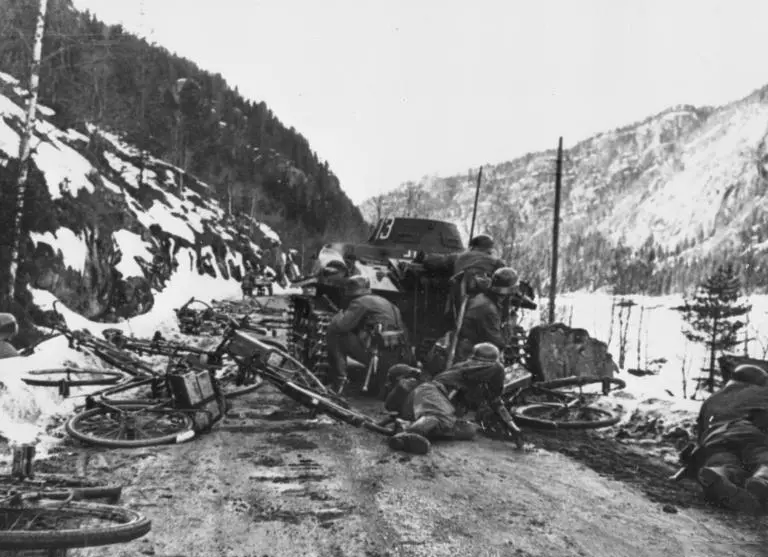
German Wehrmacht infantry and bicycle troops take cover behind a Panzer I light tank on a mountain road during the invasion of Norway, Operation Weserübung, April 1940
German infantry supported by a Panzer I light tank advance along a narrow mountain road during Operation Weserübung, April 1940. Bicycles and abandoned equipment litter the route, illustrating the difficult terrain, logistical improvisation, and resistance encountered during the German advance into Norway.
22nd April 1940
Meeting in Paris, the Allied Supreme War Council agrees to concentrate main efforts on the Narvik and Trondheim sectors, reaffirming their commitment to Norway despite German gains.
23rd April 1940
The British 15th Infantry Brigade under Major General Paget lands at Åndalsnes near Molde, reinforcing the Allied presence in southern Norway.
24th April 1940
French reinforcements arrive at Åndalsnes. British troops north of Trondheim pull back after sharp fighting, while Norwegian attacks south of Narvik are repelled.
25th April 1940
With Luftwaffe dominance making the position untenable, Allied forces begin evacuating from Åndalsnes while covering Norwegian withdrawals inland.
26th April 1940
Britain informs French and Norwegian commanders that the southern Norway campaign will be abandoned; extraction planning accelerates at Åndalsnes and Namsos.
28th April 1940
Three battalions of the French Chasseurs Alpins land at Harstad to reinforce the northern front near Narvik.
29th April 1940
King Haakon VII and the Norwegian government are evacuated by sea from Molde to Tromsø, preserving national leadership and directing resistance from the north.
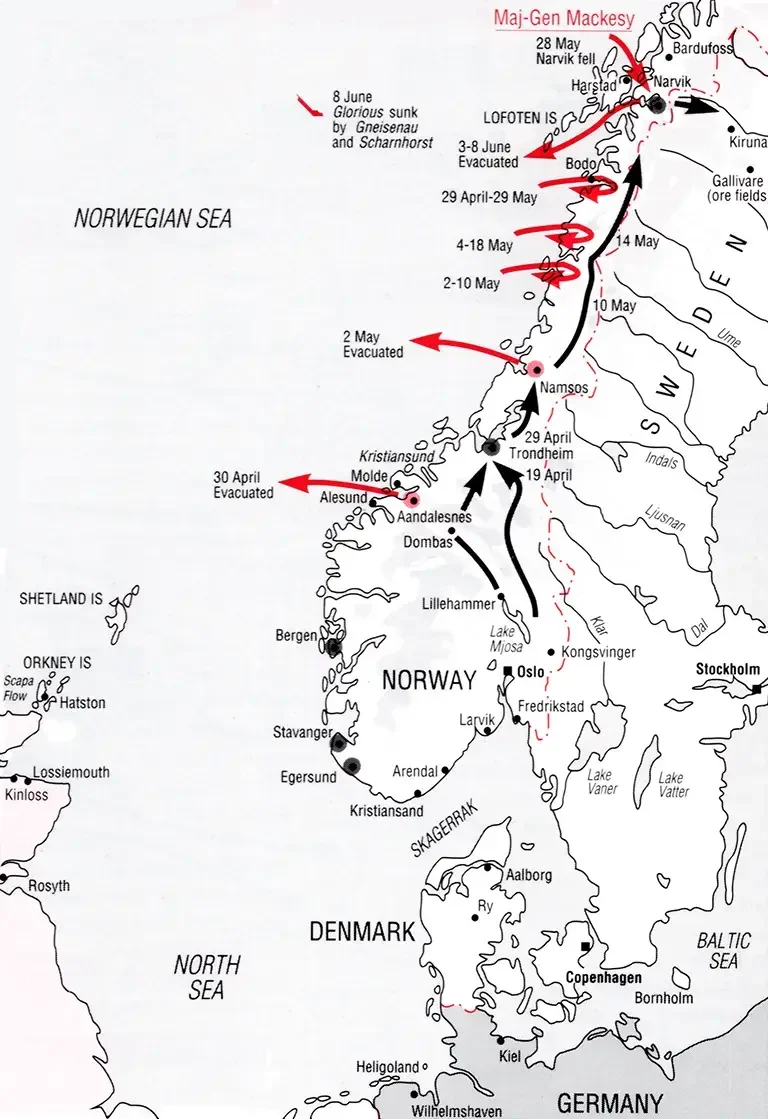
Map of Operation Weserübung showing the German advance through Norway, major landings and naval actions, and Allied evacuations from April to June 1940
Campaign map of Operation Weserübung showing the German advance through Norway, major coastal landings, land and naval engagements, and the phased Allied evacuations from central and northern Norway between April and June 1940.
30th April 1940
Allied forces begin evacuations from Åndalsnes under air attack; nearly 10,000 troops are withdrawn over the next days. German advances link Oslo and Trondheim zones, tightening their grip on central Norway.

May 1940

1st May 1940
Around 2,500–3,000 Norwegian troops, primarily from the 11th Infantry Regiment (Oppland Regiment), surrender to German forces at Lillehammer. This marks a significant setback for the Allies in southern Norway, as German forces consolidate control over the Gudbrandsdal valley and push northward. The evacuation of Allied troops from Åndalsnes is carried out as part of the wider Allied withdrawal from central Norway. Approximately 5,000–6,000 British troops, including elements of the 148th Infantry Brigade, the 15th Infantry Brigade, and supporting units, are embarked by Royal Navy vessels under persistent Luftwaffe air attack. Much of their equipment is abandoned due to Luftwaffe air superiority and severe logistical challenges. The withdrawal is chaotic, as German aircraft target Allied transports and supply ships along the coast. The Norwegian troopship Dronning Maud is sunk by German bombers, and several other vessels are damaged or lost during the evacuation.
2nd May 1940
German troops enter Åndalsnes following the Allied withdrawal, completing the German capture of the port. On the same day, the Allied evacuation from Namsos is completed, bringing the allied campaign in central Norway campaign to an end. Around 4,000–4,500 British and French troops, mainly from the 146th Infantry Brigade and French Alpine units, are successfully withdrawn by sea despite heavy Luftwaffe bombing, which leaves much of Namsos virtually destroyed. In London, Prime Minister Neville Chamberlain announces that British forces are to withdraw from southern Norway altogether.
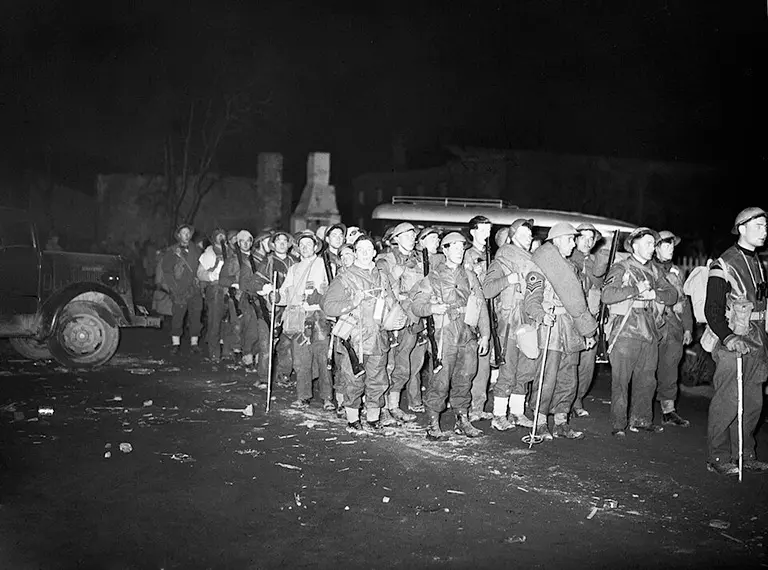
British troops assembled on the quay at Namsos, Norway, preparing for evacuation under Luftwaffe attack during Operation Weserübung, 2 May 1940
British troops assemble on the quay at Namsos, Norway, on 2 May 1940 awaiting embarkation aboard Royal Navy transports. The evacuation follows sustained Luftwaffe air attacks and marks the collapse of the Allied campaign in central Norway during Operation Weserübung. Operation Weserübung.
3rd May 1940
As the final ships depart the Namsos area, German dive bombers attack the evacuation fleet. The French destroyer Bison is sunk after a bomb strikes her forward magazine, killing 136 crew members. HMS Afridi rescues survivors but is also sunk shortly after, with the loss of 49 British sailors, 14 soldiers, and 35 of the rescued French crew. These losses mark the end of Allied operations in central Norway, as attention shifts to the northern front around Narvik.
5th May 1940
The French 13th Foreign Legion Demi-Brigade and the Polish Podhale (Carpathian) Mountain Brigade arrive at Harstad, reinforcing Allied strength in northern Norway.
8th May 1940
Allied command narrows its objectives to the Narvik sector, abandoning plans for renewed offensives in central Norway and reallocating resources northwards.
10th May 1940
Britain and France begin to reassess their commitments in Norway following the launch of Germany's offensive in the West against France, Belgium, and the Netherlands. The British 24th Guards Brigade begins redeployment from Harstad toward Bodø, following the strategic shift to reinforce the northern front.
13th May 1940
Germany’s 2nd Gebirgsjäger Division continues its advance north from Trondheim, aiming to relieve General Dietl’s isolated forces in Narvik. The division, composed largely of Austrian mountain troops, undertakes a grueling overland march through rugged terrain, facing logistical challenges and harsh conditions. Their objective is to link up with the 3rd Gebirgsjäger Division, which has been under sustained Allied pressure in the Narvik area. Fierce mountain fighting erupts near Narvik as Norwegian, French, Polish, and British units, including the Polish Independent Highland Brigade and French Chasseurs Alpins, launch coordinated attacks to push German forces back toward the Swedish frontier. The mixed German force, consisting of the 3rd Gebirgsjäger Division and Kriegsmarine personnel pressed into ground combat following the sinking of their ships by the British, is low on supplies and relies heavily on Luftwaffe air drops. They dig into defensive positions in the surrounding hills and fjords. Despite the difficult terrain and determined German resistance, Allied forces begin to make tactical gains, gradually tightening the noose around Narvik. The battle marks one of the most intense phases of the Norwegian campaign, showcasing multinational cooperation and alpine warfare at its peak.
14th May 1940
The Polish transport ship Chrobry, carrying elements of the British 24th Guards Brigade, is bombed by a Heinkel He 111 and set ablaze in the Vestfjord while en route to Bodø. The attack results in the loss of much of the brigade’s heavy equipment and the deaths of several senior officers, including the commanding officer and company commanders of the 1st Battalion Irish Guards. The ship is abandoned under fire, with many of the Polish crew fleeing. Captain David Gordon-Watson of the Irish Guards takes command of the evacuation, organizing the safe transfer of survivors and wounded to escorting destroyers, despite the threat of explosion from onboard ammunition. The loss of Chrobry severely hampers the operational capability of the 24th Guards Brigade in northern Norway and the brigade withdraws back to Harstad to regroup, marking a significant setback in Allied efforts to reinforce the Bodø sector.
15th May 1940
A Luftwaffe parachute battalion from Fallschirmjäger-Regiment 1 is dropped to reinforce the Narvik area. Soon after, additional companies of the 137th Regiment (3rd Gebirgsjäger Division) are hastily trained and deployed by air. Norwegian He 115 floatplanes attack and destroy several German Ju 52 transports parked on the frozen lake at Hartvikvann near Narvik.
20th May 1940
The Allied high command decides Narvik must be taken. Preparations intensify for a combined land and sea assault on the town.
21st May 1940
The isolated German garrison at Narvik, cut off since April, faces shortages of food and ammunition. Morale declines as Allied pressure increases, and the prospect of disaster looms for General Dietl’s forces.
24th May 1940
Allied forces complete preparations for the main assault on Narvik, synchronizing naval gunfire support with mountain advances to break German defensive lines.
27th May 1940
Beginning at 23:40, Royal Navy ships bombard German positions around Narvik throughout the night in advance of an amphibious landing.
28th May 1940
Allied forces launch a coordinated amphibious and overland assault on Narvik. After fierce fighting, German troops abandon the town and retreat eastward toward the Swedish border. General Dietl’s surviving force is reduced to about 1,500 men. The recapture of Narvik marks the first major Allied land victory of the war.
29th May 1940
The worsening situation in France prompts the British Cabinet to order a full evacuation of Allied forces from Norway despite success at Narvik.
30th May 1940
Evacuation planning accelerates in northern Norway. Embarkation schedules are fixed and secrecy measures imposed to minimize the risk of German air or naval interdiction.
31st May 1940
Harstad is designated the main embarkation port for the Allied evacuation. Rearguard and deception measures are finalized to shield the withdrawal.

June 1940

1st June 1940
British forces evacuate the Bodø region, about 120 miles southwest of Narvik, as part of the northern withdrawal. Embarkations also begin from Harstad and nearby anchorages under naval protection, while Norwegian troops continue to hold inland positions.
3rd June 1940
British and French units commence evacuations from the Narvik area. Successive lifts carry troops back to the United Kingdom, with remaining equipment destroyed to deny it to the Germans.
5th June 1940
Polish contingents complete their embarkation for Britain as the Allied footprint shrinks to rearguards covering the last departures from northern Norway.
7th June 1940
With the imminent threat of capture by German forces, King Haakon VII, Crown Prince Olav, Prime Minister Johan Nygaardsvold and the Norwegian government leave Tromsø aboard the British cruiserHMS Devonshire and arrive safely in Britain later the same day, landing at Greenock, where they are formally received by British authorities. The evacuation preserves Norway’s legitimate political leadership and enables the continuation of a government-in-exile based in London, immediately recognised by the British government as the sole legal authority of the Kingdom of Norway. Operating under the Elverum Authorization, the government retains full constitutional authority to govern from abroad, coordinate resistance inside occupied Norway, and cooperate militarily with the Allied powers. British and French forces begin their withdrawal from Narvik, initiating the final Allied evacuation from northern Norway. With the evacuation already under way, Norwegian Commander-in-Chief Otto Ruge is informed later that day that the Allies have decided to abandon Norway.
8th June 1940
The evacuation of British, French, and Polish forces from Narvik and Harstad is completed, with approximately 24,000 troops withdrawn by sea. With Allied forces now gone, Norwegian forces are left to continue the fight alone, without prospect of further external support. The British aircraft carrier HMS Glorious and her two destroyer escorts, HMS Ardent and HMS Acasta, are intercepted in the Norwegian Sea, roughly 315 km west of Narvik, by the German battleships Scharnhorst and Gneisenau, operating under Operation Juno. The British vessels are returning independently to Scapa Flow, sailing without air patrols and at reduced readiness. At around 16:00 hours, Scharnhorst’s lookouts sight the carrier at long range, and both German ships close in to engage. Ardent is the first to be hit and sinks after a gallant torpedo attack. Glorious is struck several times soon after—shells tear through her hangar deck, setting aircraft and aviation fuel ablaze. Acasta presses home a desperate counterattack, launching torpedoes that strike Scharnhorst and cause heavy damage, but she too is destroyed by gunfire. HMS Glorious sinks around 18:10 hours, followed by Acasta and Ardent. Of the combined complement of approximately 1,519 men aboard the three British ships, only 43 survive. The Germans suffer minor casualties, though Scharnhorst is seriously damaged by Acasta’s torpedo.
9th June 1940
Norwegian representatives open talks with German authorities to arrange terms of capitulation. With Allied support gone, continued resistance is impossible.
10th June 1940
Norway formally capitulates. The last organized force, the 6th Division, surrenders near Tromsø. Although the country is placed under full German occupation, King Haakon VII and the government-in-exile vow to continue the struggle from Britain.

July 1940

12th July 1940
Adolf Hitler appoints Josef Terboven as Reichskommissar, granting him supreme authority in occupied Norway. This move sidelines both Vidkun Quisling and the Norwegian Administrative Council, placing the country under direct German rule.