Introduction to Weapons of War
World War 2 is a war of machines, and few shape the battlefield more than armoured fighting vehicles. From fast tankettes and light tanks built for reconnaissance, to medium tanks that form the backbone of armoured formations, and heavy breakthrough tanks designed to smash defences, AFVs define how armies move, fight, and survive on land. In this section, Weapons of War, we focus on the vehicles that bring armour, firepower, and mobility together: tanks, armoured cars, tank destroyers, self-propelled guns, assault guns, and specialised variants created for recovery, engineering, and battlefield support.
Every nation approaches armoured warfare differently. Germany refines combined-arms tactics around Panzer divisions and later fields heavier, more complex designs. The Soviet Union prioritises rugged, mass-produced vehicles that can operate in brutal conditions. Britain develops cruiser and infantry tank concepts for different battlefield roles, while the United States standardises production and builds versatile platforms that can be manufactured at scale. Across Europe and the Pacific, the constant contest between armour and anti-tank weapons drives rapid innovation in guns, protection, engines, suspension, and crew ergonomics.
These vehicles are more than hardware: they reflect doctrine, industry, and the realities of supply. A tank’s impact depends on fuel, maintenance, spare parts, training, and the terrain it must cross. On this page, you’ll find AFVs organised by country, with clear profiles that explain design features, intended roles, and how each vehicle performed in the conditions of World War 2.
Belgium

T15
Light Tank
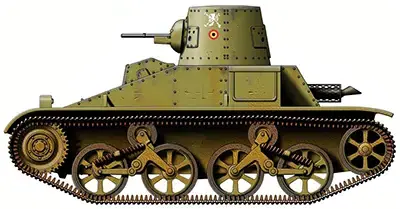
The T15 was a Belgian light reconnaissance tank developed during the mid-1930s and based on the British Vickers-Carden-Loyd Light Tank Mk III. Designed to provide mobility and battlefield awareness rather than engage enemy armour, it became an important component of Belgium's cavalry formations and the elite Chasseurs Ardennais. The vehicle reflected Belgium's defensive military doctrine during the years preceding the Second World War. Weighing just under four tonnes, the T15 was operated by a two-man crew and armed with a 13.2 mm Hotchkiss heavy machine gun mounted in a small turret. Its light armour offered only limited protection against small-arms fire and shell fragments, but its speed and agility made it well suited to reconnaissance duties. A total of 42 vehicles were produced before the German invasion of May 1940, when they were deployed in small detachments to delay advancing German forces. Although outmatched by German tanks and anti-tank weapons, the T15 provided valuable reconnaissance capabilities and represented one of the few modern armoured vehicles available to the Belgian Army.
France

Renault Char-D2
Medium Tank

The Renault Char D2 was a French medium tank developed during the early 1930s as an improved successor to the Char D1. Intended to provide greater protection and mobility than earlier French designs, it was conceived as a more practical and affordable alternative to the much heavier Char B1. The vehicle incorporated modern welded and cast armour construction and was among the better-protected medium tanks of its era. Armed with a 47 mm gun and supported by machine guns, the Char D2 was operated by a three-man crew and protected by armour up to 40 mm thick. Although its firepower and protection compared favourably with many contemporary tanks, the vehicle suffered from mechanical reliability problems, limited mobility, and production delays that restricted its operational effectiveness. Approximately 100 examples were built, and they entered combat during the Battle of France in 1940. Assigned primarily to armoured battalions supporting infantry formations, the Char D2 fought with determination despite its technical shortcomings. Although overshadowed by newer designs and produced in limited numbers, it represented an important stage in the evolution of French armoured warfare between the world wars.
Renault FT-31
Light Tank
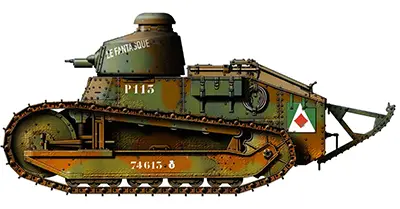
The Renault FT-31 was a modernised version of the famous Renault FT light tank, one of the most influential armoured vehicles of the First World War. Introduced during the 1930s, the upgrade programme sought to extend the service life of France's large fleet of ageing tanks while newer designs were still entering production. The principal improvement was the replacement of the original armament with a more modern 7.5 mm Hotchkiss machine gun, while some vehicles also received updated turrets and communications equipment. Despite these improvements, the FT-31 retained the slow speed, thin armour, and cramped two-man layout of the original Renault FT. Around 160 vehicles were upgraded and remained in service when Germany invaded France in 1940. Most were employed in training, airfield defence, and security duties, although some were committed to combat during the campaign. Following the French defeat, many surviving vehicles were captured by Germany and used for security, occupation, and training duties. Although obsolete as a frontline fighting vehicle, the FT-31 demonstrates the remarkable longevity of the Renault FT design and France's continued reliance on First World War equipment during the early years of the conflict. Its pioneering layout also influenced tank development throughout the interwar period.
Hotchkiss H-35
Light Tank
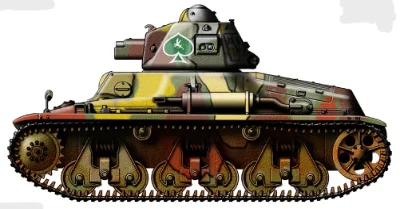
The Hotchkiss H35 was a French light tank developed in the mid-1930s to support infantry formations and provide a well-protected vehicle capable of operating alongside advancing troops. Entering service in 1936, it featured a cast-armour construction that offered impressive protection for a vehicle of its size and made it one of the more durable light tanks available at the time. The H35 was armed with a short-barrelled 37 mm SA18 gun and a coaxial machine gun. Armour protection reached up to 34 mm, providing good resistance against many early anti-tank weapons. However, the tank was powered by a relatively weak engine and retained a one-man turret, forcing the commander to act as commander, gunner, and loader simultaneously, which reduced combat efficiency. Hundreds of H35s were produced and served extensively during the Battle of France in 1940. Although their armour often proved difficult for German anti-tank weapons to penetrate, shortcomings in mobility, communications, and crew workload limited their battlefield effectiveness. Following France's defeat, many surviving vehicles were captured and subsequently reused by German forces in a variety of training and security roles.
Germany

PzKpfw I Ausf B
Light Tank
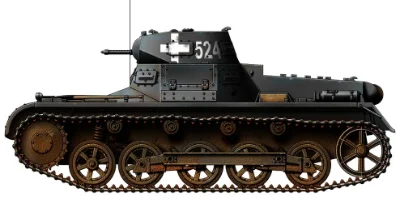
The Panzerkampfwagen I Ausführung B was an improved version of Germany’s first mass-produced tank, introduced in 1936 to address the mechanical shortcomings of the earlier Ausf. A model. The redesign included a more powerful Maybach NL 38 TR engine, a lengthened hull, and a revised suspension with five road wheels, significantly improving reliability and mobility. The tank was lightly armoured, with protection up to around 13 mm, and was armed with two 7.92 mm MG 13 machine guns mounted in a small turret. Operated by a two-man crew consisting of a commander/gunner and a driver, the vehicle was originally intended primarily as a training and development platform while more capable tanks such as the Panzer III and Panzer IV were being developed. Despite its limitations, the Panzer I Ausf. B saw extensive service during the late 1930s and early years of the war, including the Spanish Civil War, the invasion of Poland in 1939, and the campaign in France in 1940. As heavier enemy armour appeared, the type quickly became obsolete and was gradually withdrawn from frontline combat, though many chassis were later converted into specialised vehicles such as command tanks, ammunition carriers, and early self-propelled artillery platforms.
PzKpfw II Ausf C
Light Tank
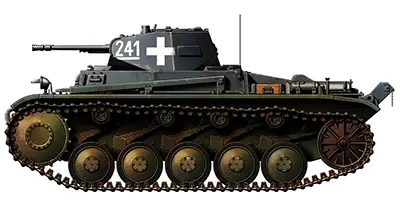
The Panzerkampfwagen II Ausf. C was one of the most widely used early German light tanks of the Second World War. Originally developed in the mid-1930s as an interim design while more advanced tanks such as the Panzer III and Panzer IV were still in development, it nevertheless became an important component of German Panzer divisions during the early Blitzkrieg campaigns. Armed with a 2 cm KwK 30 L/55 autocannon and a coaxial MG 34 machine gun, the tank had a three-man crew consisting of commander, gunner, and driver. The Ausf. C introduced an improved suspension system with five large road wheels and leaf springs, which enhanced mobility and reliability compared with earlier versions. Armour protection was relatively light, reaching about 14.5 mm on the hull and turret. The Panzer II Ausf. C saw extensive service during the invasions of Poland in 1939 and France in 1940, and later participated in the early stages of Operation Barbarossa in 1941. As the war progressed and heavier enemy tanks appeared, the type became increasingly obsolete and was gradually reassigned to reconnaissance and training roles. Its reliable chassis later served as the basis for several important self-propelled weapons, including the Marder II tank destroyer and the Wespe self-propelled artillery piece.
PzKpfw III Ausf E
Medium Tank
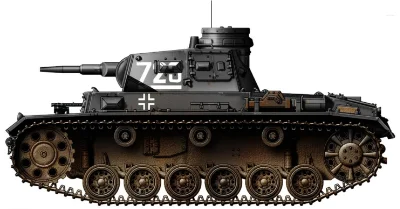
The Panzerkampfwagen III Ausf. E (Sd.Kfz. 141) was an important early-war German medium tank introduced in 1939. It represented the first fully mature version of the Panzer III series and incorporated several key improvements over earlier models. Most significant was the introduction of a torsion-bar suspension system, which greatly improved cross-country performance and reliability and became standard on all later variants. Armour protection was increased to 30 mm on the hull and turret, reflecting growing concern about anti-tank weapons on the battlefield. Powered by a 300 hp Maybach HL120 TR engine, the tank could reach speeds of around 40 km/h and had a five-man crew, allowing the commander to focus solely on battlefield awareness and coordination. The Ausf. E was armed with the 3.7 cm KwK 36 L/45 gun, supported by two MG 34 machine guns. Although only 96 vehicles of this variant were produced between 1939 and 1940, it served as the foundation for later Panzer III developments. The type saw combat during the invasions of Poland and France, where its improved mobility and crew layout helped demonstrate the effectiveness of German armoured doctrine in the early Blitzkrieg campaigns.
PzKpfw IV Ausf D
Medium Tank
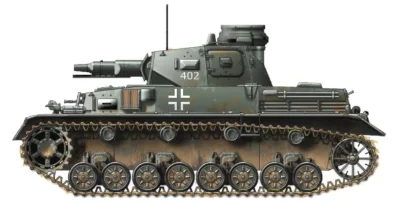
The Panzerkampfwagen IV Ausf. D was an early production variant of Germany’s Panzer IV medium tank, entering service in late 1939. Designed originally as an infantry-support vehicle, it was armed with the short-barrelled 7.5 cm KwK 37 L/24 gun, which fired powerful high-explosive shells effective against fortifications, infantry positions, and anti-tank guns. Compared with earlier versions, the Ausf. D featured improvements to armour protection, including 30 mm frontal armour and an external gun mantlet. The hull machine gun returned to the glacis plate, and many vehicles later received additional bolted armour plates to improve battlefield survivability. Powered by a Maybach HL120 TRM engine producing 300 hp, the tank could reach speeds of around 40 km/h and was operated by a five-man crew. Approximately 229 Ausf. D tanks were produced between 1939 and 1940. They saw extensive service during the early Blitzkrieg campaigns in France and the Low Countries, later fighting in the Balkans, North Africa, and on the Eastern Front. Although soon surpassed by later Panzer IV variants with more powerful guns and heavier armour, the Ausf. D helped establish the Panzer IV as Germany’s most important and versatile medium tank of the war.
PzKpfw 35(t)
Light Tank
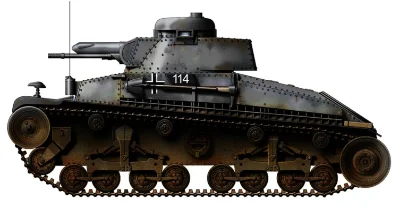
The Panzerkampfwagen 35(t) was the German designation for the Czech-designed LT vz. 35 light tank, acquired after Germany occupied Czechoslovakia in March 1939. The "(t)" stood for "tschechisch," indicating its Czech origin. Well-built and reasonably well armed for its time, the vehicle became an important component of German Panzer divisions during the early years of the war. The tank was armed with a 37 mm Škoda A3 gun supported by two machine guns and protected by armour up to 25 mm thick. It was powered by a 120 hp Škoda engine and operated by a four-man crew. In German service it was redesignated as the Sd.Kfz. 140 and issued primarily to units such as the 6th Panzer Division. The PzKpfw 35(t) saw extensive combat during the invasions of Poland and France and later participated in Operation Barbarossa in 1941. However, its relatively light armour and the complexity of its pneumatic control systems proved problematic in the harsh conditions of the Eastern Front. By 1942 the type was largely withdrawn from frontline service, though many vehicles continued to be used for training, security duties, and secondary roles.
PzKpfw 38(t) Ausf C
Light Tank
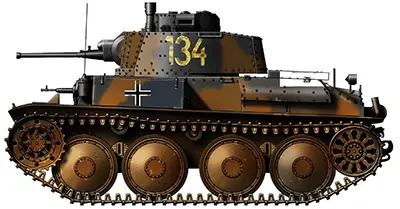
The Panzerkampfwagen 38(t) Ausf. C was a German designation for one of the early production versions of the Czech-designed LT vz. 38 light tank. Following the German occupation of Czechoslovakia in 1939, the vehicle was adopted into German service due to its excellent reliability, robust construction, and ease of maintenance. Armed with a 37 mm Škoda A7 gun and two machine guns, the 38(t) offered respectable firepower for the early years of the war. Armour protection ranged up to 25 mm, and the tank was powered by a Praga EPA engine producing 125 hp. Operated by a four-man crew, the vehicle proved mechanically dependable and highly mobile compared with many contemporary designs. The PzKpfw 38(t) saw extensive combat during the campaigns in France in 1940, the Balkans in 1941, and the early stages of Operation Barbarossa. However, as heavier Soviet tanks such as the T-34 appeared on the battlefield, the light armour and 37 mm gun quickly became inadequate. By 1942 the type was largely withdrawn from frontline tank units, though its reliable chassis continued to serve as the basis for several important German self-propelled weapons, including the Marder III tank destroyer and later the Jagdpanzer 38(t).
15 cm sIG 33 (Sf) auf Panzerkampfwagen I Ausf. B
Self-Propelled Infantry Gun
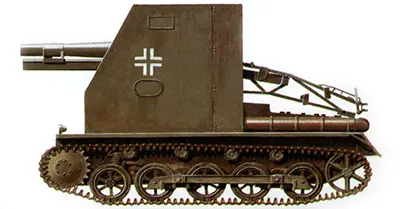
The 15 cm sIG 33 (Sf) auf Panzerkampfwagen I Ausf. B was one of Germany’s earliest self-propelled artillery vehicles, introduced in 1940. It mounted the powerful 15 cm schwere Infanteriegeschütz 33 infantry gun on a modified Panzer I Ausf. B chassis, allowing heavy infantry firepower to move with advancing armoured formations. The vehicle was designed to provide direct fire support against fortified positions, enemy strongpoints, and infantry concentrations. However, the combination of a very large gun and the small Panzer I chassis created significant problems. The vehicle had a high silhouette, thin armour, and poor mechanical reliability due to the excessive weight placed on the light chassis. Only 38 vehicles were produced and issued to schwere Infanteriegeschütz-Kompanien (mot. Sfl.) attached to Panzer divisions. They saw combat during the 1940 campaign in France, the Balkans in 1941, and the early stages of Operation Barbarossa. Although flawed, the design represented an important early step in the development of German self-propelled artillery and mobile infantry support weapons.
Sturmgeschütz III Ausf. A
Assault Gun
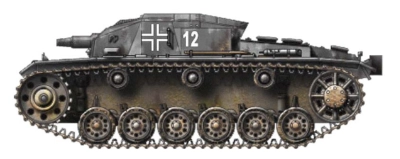
The Sturmgeschütz III Ausf. A was the first production model of Germany’s Sturmgeschütz III assault gun, introduced in 1940. Built on the chassis of the Panzer III tank, the vehicle replaced the turret with a fixed armoured superstructure mounting a 7.5 cm StuK 37 L/24 gun. It was designed to provide direct fire support to infantry by destroying bunkers, fortified positions, and enemy strongpoints. The low-profile design provided better protection and made the vehicle more difficult to detect and hit than conventional tanks. Armour protection reached up to 50 mm at the front, while the vehicle retained the reliable automotive components of the Panzer III chassis. It was operated by a four-man crew consisting of commander, gunner, loader, and driver. Approximately 30 vehicles of the Ausf. A were produced and first saw combat during the 1940 campaign in France. Although initially intended purely for infantry support, the Sturmgeschütz III later evolved into one of Germany’s most effective tank destroyers when fitted with longer anti-tank guns. The early Ausf. A marked the beginning of a vehicle family that would become the most numerous German armoured fighting vehicle of the war.
Italy

Fiat-Ansaldo L6/40
Light Tank
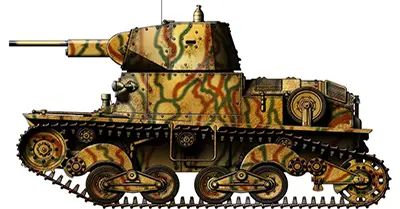
The Fiat-Ansaldo L6/40 was the principal light tank used by Italy during the Second World War. Introduced in 1940, it was designed as a fast reconnaissance and support vehicle and became the most widely produced Italian light tank of the conflict. The L6/40 was armed with a 20 mm Breda Model 35 autocannon paired with a coaxial 8 mm machine gun. Armour protection ranged up to 30 mm, and the vehicle was powered by a 70 hp SPA petrol engine. Operated by a two-man crew, the compact design provided good mobility but limited battlefield effectiveness against heavier Allied tanks. The tank saw service in several theatres, including North Africa, the Balkans, and the Eastern Front with the Italian Expeditionary Corps in Russia. Although useful for reconnaissance and infantry support, its light armour and small crew made it increasingly vulnerable as the war progressed. The reliable chassis was later adapted for other roles, most notably the Semovente da 47/32 self-propelled anti-tank gun.
Fiat-Ansaldo M11/39
Medium Tank
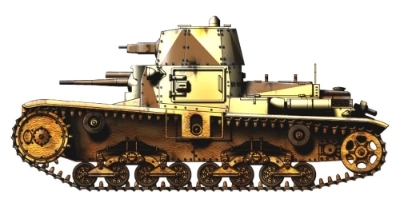
The Fiat-Ansaldo M11/39 was Italy's first modern medium tank to enter large-scale production and represented an important step in the development of Italian armoured forces. Introduced in 1939, it was designed to replace the lightly armed tankettes that had previously formed the backbone of Italy's armoured units and became one of the principal Italian tanks available during the opening stages of the North African campaign. The vehicle was armed with a 37 mm gun mounted in the hull and a twin 8 mm machine-gun turret operated by the commander. Armour protection ranged up to 30 mm, and the tank was powered by a 105 hp diesel engine. While the diesel powerplant reduced the risk of fire and offered good operational range, the unusual placement of the main gun severely limited tactical flexibility in combat. The M11/39 saw service in Libya and East Africa during 1940 and early 1941, where it faced British cruiser tanks and heavily armoured Matilda IIs. Although reasonably effective against lightly armoured opponents, its limited firepower, thin armour, and outdated layout quickly became apparent. The type was soon replaced by the more capable M13/40, but it remains an important milestone in the evolution of Italian tank design.
Fiat Ansaldo M13/40
Medium Tank
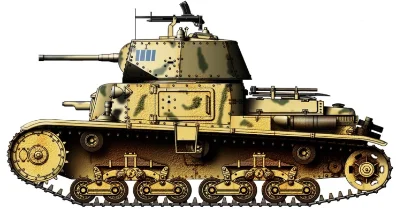
The Fiat-Ansaldo M13/40 was Italy’s principal medium tank during the early years of the Second World War. Introduced in 1940, it represented a significant step forward from earlier Italian tank designs and became the backbone of Italian armoured units in North Africa. The M13/40 was armed with a 47 mm Cannone da 47/32 main gun supported by multiple 8 mm Breda machine guns. Armour protection reached up to 42 mm on the front of the hull, and the vehicle was powered by a 125 hp diesel engine. It was operated by a four-man crew consisting of commander/gunner, loader, driver, and radio operator. Although reasonably well armed for its time, the M13/40 suffered from several design weaknesses, including thin side armour, limited mechanical reliability, and cramped internal conditions. These shortcomings became increasingly apparent during the North African campaign, where British forces equipped with more powerful anti-tank guns and cruiser tanks often held the advantage. Nevertheless, the M13/40 formed the core of Italian armoured divisions during the early desert fighting and remained in service until gradually replaced by improved variants such as the M14/41.
Semovente da 47/32 Scafo L3
Tank Destroyer
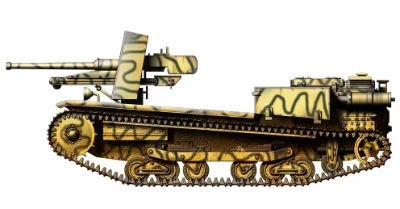
The Semovente da 47/32 Scafo L3 was an Italian tank destroyer developed during 1941 by mounting a 47 mm Cannone da 47/32 anti-tank gun onto the chassis of the obsolete L3 tankette. The design was intended to provide Italian units with a mobile anti-tank weapon capable of engaging British armour in North Africa while making use of existing vehicles already in service. The vehicle featured an open-topped fighting compartment and was operated by a small crew. Its 47 mm gun offered respectable anti-tank performance against many early-war Allied vehicles, while the lightweight chassis provided good mobility across desert terrain. However, armour protection remained extremely thin, leaving the crew vulnerable to artillery fragments, machine-gun fire, and air attack. Produced in limited numbers, the Semovente da 47/32 Scafo L3 saw service primarily in North Africa during 1941 and 1942. Although constrained by the shortcomings of the ageing L3 chassis, it represented an important step in Italy's development of self-propelled anti-tank weapons and provided valuable experience that contributed to the more successful Semovente vehicles that followed.
Japan

Type 92 Jyu-Sokosha
Tankette
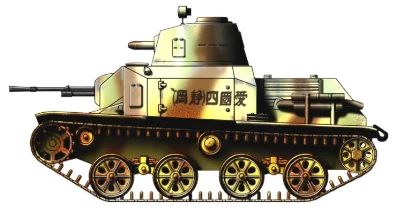
The Type 92 Jyu-Sokosha was an early Japanese tankette developed in the early 1930s to provide a fast armoured vehicle for the cavalry units of the Imperial Japanese Army. Designed as a compact reconnaissance and support vehicle, it helped introduce mechanised mobility into Japanese cavalry formations. The vehicle weighed around 3.5 tonnes and was operated by a crew of three. It was typically armed with a 13.2 mm Type 92 heavy machine gun mounted in a small turret, while armour protection ranged from about 6 to 12 mm. Powered by a 45 hp engine, the tankette could reach speeds of roughly 40–45 km/h. Produced from 1932 until the late 1930s, the Type 92 saw service in Manchuria and throughout the Second Sino-Japanese War, where its mobility made it useful for reconnaissance, infantry support, and security operations. Although lightly armoured and quickly outclassed by more modern tanks, it represented an important early stage in the development of Japanese armoured forces.
Type 94 TK
Tankette
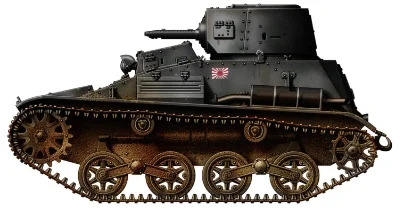
The Type 94 TK (Tokushu Keninsha, meaning “special tractor”) was a Japanese tankette developed in the early 1930s for reconnaissance and infantry support. Entering service in 1935, it was designed as a small, lightweight armoured vehicle capable of operating in rough terrain alongside infantry formations. The vehicle weighed approximately 3.5 tonnes and was operated by a two-man crew consisting of a driver and commander/gunner. It was typically armed with a 6.5 mm Type 91 or later a 7.7 mm Type 97 machine gun. Armour protection ranged from 6 to 12 mm, sufficient only against small-arms fire, while a 35 hp engine gave the vehicle a top speed of around 40 km/h. The Type 94 TK saw extensive service in China during the Second Sino-Japanese War and later in Southeast Asia during the early stages of the Pacific War. Although lightly armed and armoured, it proved useful for reconnaissance, liaison duties, and infantry support in regions where heavier tanks were difficult to deploy.
Poland

PZInż 7TP-jw
Light Tank
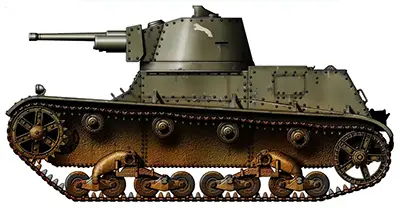
The PZInż 7TP-jw was Poland's most advanced tank at the outbreak of the Second World War and represented a significant improvement over the British Vickers 6-Ton tank from which it was derived. Developed during the 1930s by the Państwowe Zakłady Inżynierii (PZInż), the 7TP incorporated numerous improvements, including thicker armour, a more reliable diesel engine, and enhanced battlefield visibility for the crew. The single-turret (jednowieżowy, or "jw") version was armed with an effective 37 mm Bofors anti-tank gun and a coaxial machine gun. Operated by a three-man crew, it possessed firepower capable of defeating most German tanks encountered during the invasion of Poland in 1939. The use of a diesel engine was also unusual for its time, reducing the risk of fire compared with many contemporary tanks. Approximately 135 to 140 vehicles were produced before the outbreak of war. During the September Campaign, 7TP units fought with determination against numerically superior German forces and achieved a number of local successes against Panzer I and Panzer II tanks. Although ultimately overwhelmed by Germany's superior numbers and air power, the 7TP is widely regarded as one of the finest light tanks in service anywhere in Europe in 1939.
Soviet Union

BT-5
Light Tank
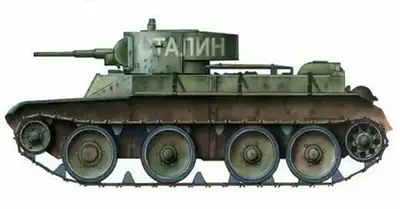
The BT-5 was a Soviet fast tank developed during the early 1930s as part of the BT (Bystrokhodny Tank, or "fast tank") series. Based on the American Christie suspension system, it was designed to exploit breakthroughs and conduct deep operations behind enemy lines. Its exceptional speed made it one of the fastest tanks of its era and an important influence on future Soviet armoured development. Armed with a powerful 45 mm 20-K gun and a coaxial machine gun, the BT-5 possessed excellent firepower for a light tank of the period. It was operated by a three-man crew and could reach speeds of over 50 km/h on tracks, with even higher speeds possible on roads when operating in wheel-drive mode. However, its relatively thin armour left it vulnerable to anti-tank guns and heavy machine-gun fire. The BT-5 saw combat in the Spanish Civil War, the Battles of Khalkhin Gol, the Winter War, and the opening stages of Operation Barbarossa. By 1941 it was increasingly obsolete, but many remained in frontline service due to the rapid expansion of Soviet armoured forces. Despite its shortcomings, the BT series played a vital role in shaping Soviet armoured doctrine and directly influenced the development of the famous T-34 medium tank.
T-26
Light Tank
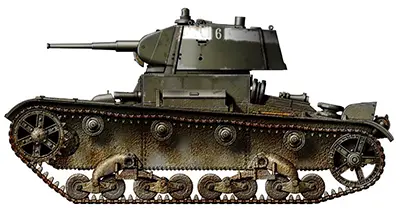
The T-26 was the most numerous tank in Soviet service at the outbreak of the Second World War and formed the backbone of the Red Army's armoured forces throughout the 1930s. Derived from the British Vickers 6-Ton design, it was progressively improved into a capable light tank armed with a powerful 45 mm gun and intended to support infantry formations during offensive operations. Operated by a three-man crew, the T-26 combined effective firepower with relatively simple construction, allowing it to be produced in large numbers. Armour protection ranged from 15 to 25 mm depending on the model, while numerous specialised variants were developed, including flamethrower tanks, artillery tractors, bridge-layers, and command vehicles. More than 10,000 examples were built, making it one of the most widely produced tanks of the interwar period. The T-26 saw action in the Spanish Civil War, at Khalkhin Gol, during the Winter War, and in the early battles against Germany in 1941. Although increasingly vulnerable to modern anti-tank weapons, it remained a significant component of Soviet armoured forces during the first year of Operation Barbarossa. Eventually replaced by newer designs such as the T-34, the T-26 nevertheless played a crucial role in the development of Soviet armoured warfare.
United Kingdom

Vickers Mk VIb
Light Tank
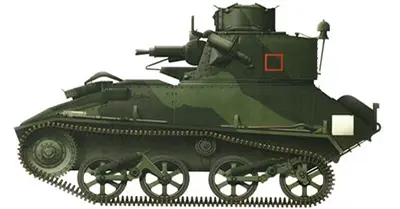
The Vickers Light Tank Mk VIb was the most numerous British light tank in service at the outbreak of the Second World War. Introduced in the late 1930s, it was designed primarily for reconnaissance, screening, and liaison duties rather than direct combat against enemy armour. Its compact size, reliability, and ease of operation made it a common sight in British armoured formations during the early years of the war. The vehicle was operated by a three-man crew and armed with a .50 inch Vickers machine gun alongside a .303 inch Vickers machine gun mounted in a small turret. Armour protection ranged up to approximately 14 mm, providing protection against small-arms fire and shell fragments but little resistance to dedicated anti-tank weapons. Powered by a Meadows petrol engine, the tank was capable of speeds approaching 55 km/h. The Mk VIb saw service with the British Expeditionary Force in France in 1940 and later participated in operations in North Africa, Greece, and the Far East. Although increasingly vulnerable as the war progressed, it remained valuable in reconnaissance roles and helped provide the British Army with important experience in mechanised warfare during the opening stages of the conflict.
Vickers Mk II
Medium Tank

The Vickers Medium Mk II was a British medium tank developed during the late 1920s as an evolution of the earlier Medium Mk I. It represented one of the most advanced tank designs of its era and played an important role in the development of British armoured doctrine during the interwar years. Although obsolete by the outbreak of the Second World War, it helped establish many concepts later adopted by modern armoured forces. The vehicle was armed with a 3-pounder (47 mm) gun and multiple machine guns and was operated by a five-man crew. Armour protection ranged up to approximately 8 mm, reflecting the belief that mobility and firepower were more important than heavy protection. Powered by a 90 hp Armstrong Siddeley engine, the tank could reach speeds of around 24 km/h. The Vickers Medium Mk II never saw major combat during the Second World War but remained in service for training and home-defence duties into the early years of the conflict. Its greatest contribution lay in providing the British Army with valuable experience in mechanised warfare and helping shape the armoured doctrines that would later be employed by British tank forces.
Cruiser Mk III (A13 Mk I)
Cruiser Tank
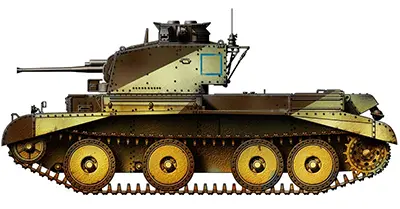
The Cruiser Mk III (A13 Mk I) was a British cruiser tank introduced in 1938 and represented a major step forward in British armoured design. Incorporating the Christie suspension system pioneered in the United States, it offered exceptional speed and cross-country mobility compared with earlier British tanks. The vehicle was intended to exploit breakthroughs, conduct reconnaissance, and operate independently of slower infantry-support tanks. Armed with the QF 2-pounder (40 mm) gun and a coaxial machine gun, the Cruiser Mk III possessed effective anti-tank firepower for its era. Operated by a four-man crew, it could reach speeds of nearly 50 km/h on roads. However, armour protection remained relatively light, ranging from around 6 to 14 mm, leaving the vehicle vulnerable to anti-tank guns and heavy machine-gun fire. Approximately 65 examples were produced and entered service before the outbreak of war. The type saw combat during the Battle of France in 1940 and helped establish the design principles that shaped later British cruiser tanks. Although produced in limited numbers, the Cruiser Mk III marked an important stage in Britain's transition towards faster and more capable armoured forces.
A13 Mk III Covenanter
Cruiser Tank
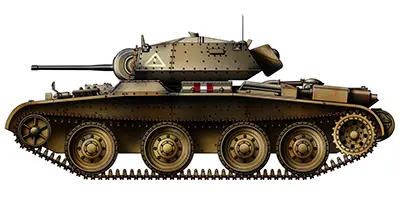
The A13 Mk III Covenanter, officially designated the Cruiser Tank Mk V, was developed in 1939 as part of Britain's rapid armoured expansion following the outbreak of the Second World War. Designed as an evolution of the earlier A13 cruiser tanks, it featured a lower profile, increased armour protection, and improved crew accommodations while retaining the mobility expected of a cruiser tank. The Covenanter was armed with a QF 2-pounder gun and a coaxial machine gun and was operated by a four-man crew. Armour protection reached approximately 40 mm in key areas, offering greater survivability than earlier cruiser tanks. However, the compact design placed the cooling system in an awkward position, creating persistent overheating problems that proved difficult to resolve. More than 1,700 vehicles were produced, but the type never served in front-line combat overseas due to its reliability issues. Instead, it was employed primarily in Britain for training, home defence, and crew familiarisation. While ultimately disappointing as a combat vehicle, the Covenanter played an important role in preparing British armoured units for service in later and more successful cruiser tanks.
A15 Crusader Mk I
Cruiser Tank
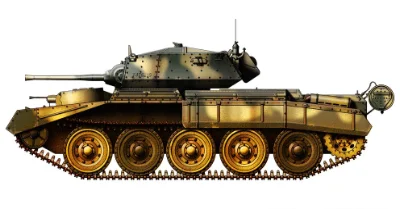
The A15 Crusader Mk I was a British cruiser tank introduced in 1941 as part of the Royal Armoured Corps' effort to field a fast and mobile tank capable of operating across the vast distances of the North African desert. Building upon earlier cruiser tank designs, the Crusader combined high speed with improved armour protection and quickly became one of Britain's most recognisable tanks of the war. Armed with a QF 2-pounder gun and a coaxial machine gun, the Crusader Mk I was operated by a four-man crew and could reach speeds of over 40 km/h. Armour protection reached approximately 40 mm, providing better protection than many earlier British cruiser tanks. Early models also featured a small auxiliary machine-gun turret mounted on the hull, although this was later removed to improve crew efficiency. The Crusader first saw extensive combat during the North African campaign, where its speed proved valuable during mobile desert operations. Although mechanical reliability problems and the limitations of the 2-pounder gun reduced its effectiveness, the type became a mainstay of British armoured forces and helped pave the way for later cruiser tanks such as the Cromwell.
Matilda Mk II
Infantry Tank
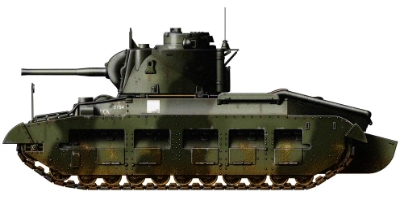
The Infantry Tank Mk II, better known as the Matilda II, was one of the most heavily armoured tanks in service at the start of the Second World War. Designed to support infantry assaults against fortified positions, it entered service in 1939 and quickly gained a formidable reputation due to armour that was largely immune to most Axis anti-tank weapons during the early years of the conflict. The Matilda II was armed with a QF 2-pounder gun and a coaxial machine gun and was operated by a four-man crew. Armour protection reached up to 78 mm in some areas, making it one of the best-protected tanks of its generation. Although relatively slow compared with cruiser tanks, its robust construction and survivability made it highly effective in deliberate offensive operations. The tank achieved particular success during Operation Compass, where it played a decisive role in the destruction of Italian fortified camps at Nibeiwa, Sidi Barrani, Bardia, and Tobruk. It later served in Greece, the Soviet Union, and the Pacific. While eventually outclassed by more powerful anti-tank weapons, the Matilda II remains one of Britain's most iconic and successful early-war tanks.
United States

M2A1
Light Tank
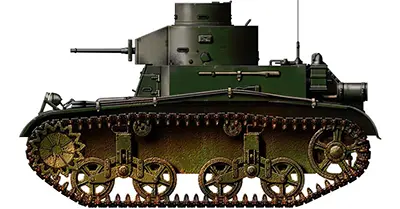
The M2A1 Light Tank was an early American light tank developed during the 1930s as the United States Army sought to modernise its armoured forces. Building upon a series of experimental designs, it represented an important step in the development of American tank doctrine and provided valuable experience in the construction and operation of modern armoured vehicles. The vehicle was armed with machine guns mounted in a rotating turret and was operated by a two-man crew. Armour protection remained relatively light, reflecting its intended role as a reconnaissance and training vehicle rather than a battlefield tank. Powered by a reliable Continental radial engine, the M2A1 offered good mobility and mechanical dependability for its era. Although the M2A1 never saw combat during the Second World War, it served as an important development platform for later American light tanks. Lessons learned from the M2 series directly influenced the design of the M3 Stuart, one of the most successful Allied light tanks of the war. As such, the M2A1 occupies an important place in the evolution of American armoured warfare.