Introduction to the Gathering Storm

In the decade before the outbreak of the Second World War, Europe experienced a steady build-up of tensions that historians often refer to as the “gathering storm.” The post-Versailles settlement was already weakening, but after Adolf Hitler came to power in 1933, the erosion became deliberate and rapid. Germany rejected disarmament limits, rebuilt its armed forces, and began overturning the territorial and political arrangements established after 1918. The response from Britain and France was cautious and divided. Scarred by the First World War, both powers hoped to avoid another conflict and hesitated to confront early acts of aggression. The League of Nations, already weakened, proved unable to check Germany’s withdrawal from international cooperation or its remilitarisation of the Rhineland. Across Central and Eastern Europe, the situation became increasingly fragile. The independence of Austria, the integrity of Czechoslovakia, and the balance of power in the region were steadily undermined by German pressure. Each crisis — from political intimidation to territorial demands — pushed Europe closer to the point where diplomacy could no longer contain events. By the summer of 1939, the gathering storm had reached its height. The collapse of Czechoslovakia, the seizure of Memel, Italy’s expansion in the Balkans, and the hardening of alliances left Europe on the brink. The remaining diplomatic barriers were fragile, and the path to war was now unmistakably clear.

1933

30th January 1933
To bring about an authoritarian state that he can control, Franz von Papen convinces President von Hindenburg that Hitler should be appointed Chancellor of Germany. He believes Hitler can be manipulated by him if he (von Papen) is appointed vice-chancellor and the Nazis are limited to only two key ministerial posts, Hermann Göring becomes a minister without portfolio and Wilhelm Frick is Minister for the Interior.
27th February 1933
The Reichstag (German Parliament building) is burned down by Dutch communist, Marinus Van der Lubbe. Hitler uses the incident to claim that the Communists are about to launch an uprising.
28th February 1933
Following the burning down of the Reichstag, Hitler persuaded President Hindenburg to enact a decree ‘for the Protection of the People and the State’, removing constitutional rights of protection for political, personal, and property.
5th March 1933
Elections are held in Germany and despite the Communists and Social Democrats being unable to canvas and the Nazis having complete control of the press, they only succeed in securing 44% of the vote.
23rd March 1933
The newly elected German Parliament delegates, minus the Communists who have been banned, meet in the Kroll Opera House and vote by 444 votes to 94 to pass the ‘Enabling Act’ giving Adolf Hitler emergency powers and virtually unlimited authority, thus creating a dictatorship in all but name.
27th March 1933
Japan leaves the League of Nations following the League’s Assembly unanimously adopting the previous month a report concluding that Japan should return Manchuria to China after Japan's invasion in September 1931.
7th April 1933
In an effort to cleanse the civil service of undesirable elements, the 'Law for the Restoration of the Professional Civil Service', was introduced effectively excluding Jews and those deemed politically unreliable from holding positions in the civil service.
14th July 1933
The ‘Law Against the Formation of Parties’ is introduced, making the Nationalsozialistische Deutsche Arbeiterpartei (Nazi Party), the only legal political party in Germany, and turning Germany into a one party state.
14th October 1933
The German government announces that it will withdraw from the League of Nations and the World Disarmament Conference, following the refusal by the Western Powers that they disarm, or Germany be allowed to rearm so that military parity be reached. President von Hindenburg, at once dissolves the Reichstag and declares new elections will be held on the 12th November, the results of which will be used to determine if the nation agrees with the decision to withdraw from the League and Arms Conference.
12th November 1933
Reichstag elections are held with an exclusive list of Nazi or Pro-Nazi candidates since all other parties are officially banned. Unsurprisingly 92.11% voted for the list, with just 7.89% voting against or spoiling their ballots in protest. The elections are held alongside a referendum on Germany’s withdrawal from the League of Nations and World Disarmament Conference the previous October, which saw a 95.1% approval with just 4.9% voting against.

1934

26th January 1934
After a month of talks, Germany and Poland sign a 10-Year non-aggression pact, normalising relations between the two countries which had been strained by various border disputes since Poland’s creation at the end of World War 1 following the Versailles Treaty.
24th May 1934
The 84 year old philosopher and political activist and ‘grand old man’ of Czechoslovak politics, Tomas Masaryk is re-elected as president for the third consecutive 7 year term (1920, 1927, 1934). The first president of Czechoslovakia following its founding in 1918, he retired in 1935.
13th June 1934
Mussolini and Hitler hold their first meeting in Venice, Italy, with Il Duce receiving Hitler dressed in full military uniform whilst Hitler was in a belted beige trench coat, striped trousers, a white shirt and tie. Mussolini later referred to him as "a silly little monkey".
30th June 1934
With the Nazi Party firmly in control of Germany and having eliminated all other political parties, the SA began to become a serious threat to Hitler. Under the control of Ernst Röhm and with more than 3 million members, the SA was a powerful force and saw itself as a natural ‘politically reliable’ replacement for the Army. This was not Hitlers plan and having tried unsuccessfully to bring Röhm to heel, finally realised that action would be needed. With the assistance of Heinrich Himmler’s SS he decided to rid himself of the problem forever and eliminate the leadership of the SA. Known as the ‘Night of the Long Knives’ the SS murdered around 400 in total, including Röhm and a number of others who had become politically inconvenient for Nazi Party leadership such as the previous Chancellor, von Schleicher and Gregor Strasser, thereby cementing power in Hitlers hands. Germany launches the new Deutschland Class Cruiser, the ‘Admiral Graf Spee’ in Wilhelmshaven. Exceeding the 10,000 ton limit imposed on all German Naval vessels by the Versailles Treaty, coming in at just over 16,000 tons when fully displaced. She mounts six 11 inch guns and had an unusually fast top speed of 28 knots, being designed to outrun and outgun all but the fastest allied Cruisers and as such was nicknamed a ‘Pocket Battleship’ by the British.
25th July 1934
The Austrian Chancellor, Dollfuss is assassinated during a failed putsch by the Nazis trying to overthrow the Austrian government.
2nd August 1934
President Paul von Hindenburg dies (aged 86), at which point a law decreed by Hitler and the Cabinet the previous day, comes into force merging the office of president with that of Chancellor, giving him the title 'Führer und Reichskanzler'.
20th August 1934
The German Government officially enacts a law, known as the ‘Law On The Allegiance of Civil Servants and Soldiers of the Armed Forces’, which stipulates that civilian officials and soldiers in the Reichswehr must swear an oath of loyalty to Hitler personally, rather than to Germany. The Civil servant oath: ‘I swear, I will be faithful and obedient to the leader of the German Reich and people, Adolf Hitler, to observe the law, and to conscientiously fulfil my official duties, so help me God!’ The Reichswehr oath: ‘I swear by God this holy oath that I shall render unconditional obedience to the Leader of the German Reich and people, Adolf Hitler, supreme commander of the armed forces, and that as a brave soldier I shall at all times be prepared to give my life for this oath.’
1st October 1934
Hitler secretly orders the creation of a new German air force ‘Luftwaffe’ and an expansion of the size of Wehrmacht and Kriegsmarine.

1935

13th January 1935
In a referendum organised by the League of Nations, 90.8% of the population of Saarland vote to re-join Germany after being forcibly separated and occupied by France following the Treaty of Versailles in 1919.
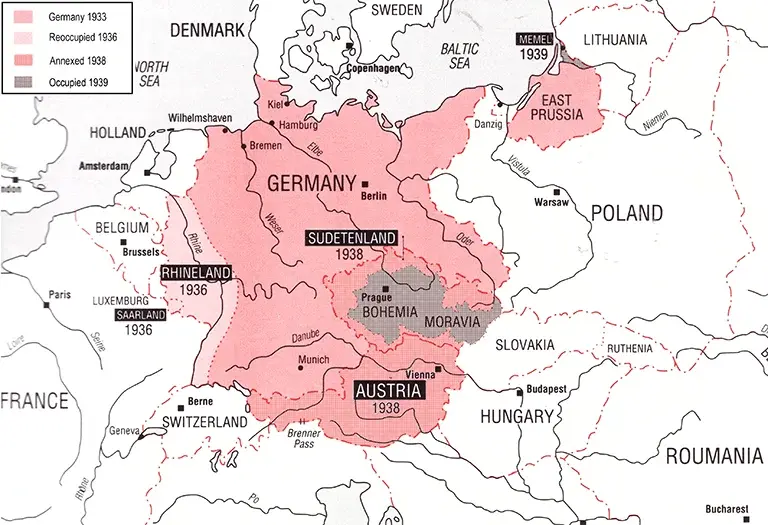
Map showing German territorial expansion in Europe from 1933 to 1939, including the Rhineland, Saarland, Austria and the Sudetenland.
Map illustrating the expansion of Nazi Germany between 1933 and 1939, including the remilitarisation of the Rhineland, the Saarland plebiscite, the Anschluss with Austria, and the annexation of the Sudetenland and Bohemia-Moravia.
17th January 1935
The reunification of the Saarland with Germany is approved by the League Council.
1st March 1935
The Saarland with its important coal production formally becomes part of Germany again after 16 years. Hitler announces that Germany ‘had no further territorial demands to make of France’.
19th May 1935
Elections in Czechoslovakia reveal overwhelming support for the Sudeten Party by the ethnic German population.
18th June 1935
The United Kingdom unilaterally signs the Anglo-German Naval Agreement in London. The treaty permits Germany to build a navy up to 35% of the tonnage of the British Royal Navy, with a provision allowing up to 45% in submarines if Britain is notified. Signed by British Foreign Secretary Sir Samuel Hoare and German Ambassador Konstantin von Neurath, the agreement marks a clear departure from the naval restrictions imposed on Germany by the Treaty of Versailles. The move shocks both France and Italy and weakens the Stresa Front, formed by all three only months earlier in April 1935 to present a united front against German rearmament.
28th June 1935
Germany Commissions its first new U-boat since the end of World War I.

1936

20th January 1936
Edward VIII accedes to the British throne following the death of George V. His reign proves brief and unstable.
7th March 1936
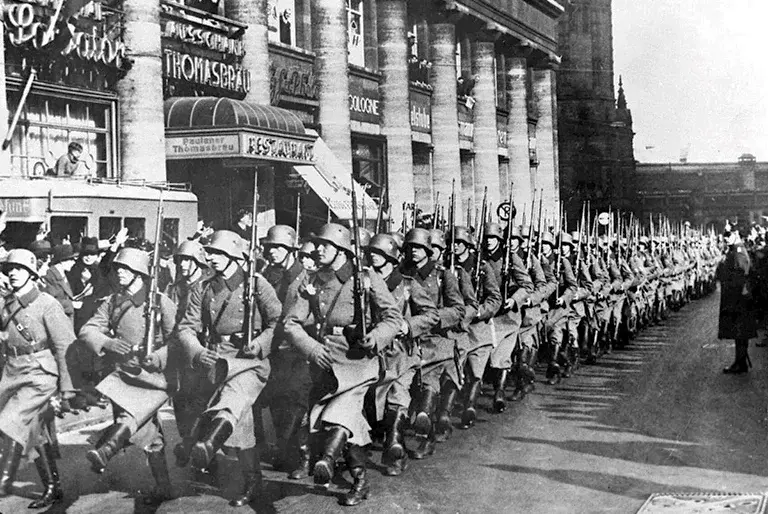
At dawn, the German Army crossed the Rhine bridges and entered the Rhineland, Germany’s industrial heartland. The area had been demilitarized since 1919 as part of the Treaty of Versailles and included all territory west of the Rhine River up to the French border, including the important cities of Cologne and Düsseldorf. Field Marshall Von Blomberg had ordered the troops to withdraw immediately if the French advanced across the German border to enforce the Treaty of Versailles. However, France’s only response was to move a small number of divisions and tanks into defensive positions near the German border. At 10 a.m., the German Foreign Minister Constantin von Neurath summoned the ambassadors of France, Britain, and Italy and presented them with a lengthy memorandum. In it, he stated that the German government had ‘restored the full and unrestricted sovereignty of the Reich in the demilitarized zone of the Rhineland.’
German troops marching into Cologne during the remilitarisation of the Rhineland, March 1936
German troops march into Cologne in March 1936 as Adolf Hitler orders the remilitarisation of the Rhineland, openly defying the Treaty of Versailles and the Locarno Treaties.
11th July 1936
The Austro-German Treaty, also known as the July Agreement, is signed by Austrian Chancellor Kurt Schuschnigg and German Minister Franz Von Papen. The treaty stated that Germany would recognize Austria’s independence, not interfere in its internal affairs, and stop supporting the Austrian Nazi Party. In exchange, Austria would declare itself a ‘German state’, align its foreign policy with Germany’s, release several Austrian Nazis from prison, and appoint two Nazis to ministerial positions in the Cabinet.
17th July 1936
A military uprising begins in Spanish Morocco, initiated by units of the Spanish Army of Africa, including the Regulares and the Spanish Legion. These forces act under the orders of senior generals, including Emilio Mola and Francisco Franco, who are opposed to the Popular Front government in Madrid. Franco, who is in the Canary Islands, issues a radio broadcast from Las Palmas, calling for the military to seize control across Spain, marking the start of the Spanish Civil War.
18th July 1936
The military uprising spreads to mainland Spain, with army garrisons in several cities rising against the Republican government. Fighting erupts in key areas including Seville, Zaragoza, and Burgos, while other cities like Madrid and Barcelona remain loyal to the Republic. General Franco flies from the Canary Islands to Spanish Morocco to assume command of Nationalist forces.
1st August 1936
Adolf Hitler opens the Berlin Games amid much celebration of Aryan racial supremacy.
30th August 1936
Britain announces the launch of its biggest naval expansion programme, calling for the building of 38 new warships.
11th December 1936
Edward VIII abdicates as King of the United Kingdom in order to wed Mrs. Simpson, leading to a major constitutional issue. His brother, George VI, ascends to the throne in his place.

1937

30th January 1937
Hitler formally renounces the Treaty of Versailles, which has stood since the peace conference in 1919.
8th February 1937
The Nationalist Army in the South of Spain, commanded by Queipo de Llano and including Moroccan colonial troops, Militia and Italian black shirts with armoured support having broken through Republican lines on the 4th February, entered Malaga which had been abandoned. Over the next several days approximately 5000 civilians lose their lives to Nationalist shelling whilst trying to escape north along the coast road.
27th May 1937
The coronation of George VI is held at Westminster Abbey in London.
28th May 1937
Following the resignation of Prime Minister Stanley Baldwin, Neville Chamberlain is elected leader of the conservative Party and then next Prime Minister of the United Kingdom.
12th June 1937
Stalin orders Nikolai Yezhov, head of the NKVD (the Soviet secret police), to begin a brutal purge of the Soviet Union’s top military leadership. Known internally as Yezhovshchina ‘the time of Yezhov’, this campaign, later called the Great Purge, started with the arrest of Marshal of the Soviet Union Mikhail Tukhachevsky, Deputy Commissar of Defence, decorated civil war hero, and brilliant military strategist, alongside seven other senior officers who were accused of treason and conspiring with Nazi Germany.
13th June 1937
Marshal Mikhail Tukhachevsky and the other high-ranking officers—Iona Yakir (Komandarm 1st rank); Ieronim Uborevich, Vitaly Primakov, Boris Feldman, and August Kork (all Komandarm 2nd rank); and Robert Eideman and Innokenty Khalepsky (both Komkor)—are all convicted in a secret trial by the Military Collegium of the Supreme Court. The trial relied on coerced confessions and fabricated evidence orchestrated by the NKVD.
14th June 1937
Marshal Mikhail Tukhachevsky and his fellow officers are executed by firing squad. This marks the beginning of a wider purge of the Soviet Military aimed at eliminating anyone capable of opposing Stalin, real or imagined. Over the next year, many thousands of officers including three of five marshals, 13 of 15 army commanders, and hundreds of divisional officers were arrested, imprisoned, or executed and would gravely weaken the Red Army’s effectiveness.
17th July 1937
Britain and Germany reaffirm the Anglo-German Naval Agreement, originally signed in 1935. Though not a new treaty, the 1937 communication reflects Britain’s efforts to manage German rearmament and maintain peace through negotiation (or appeasement) rather than confrontation.
United Kingdom Flag

Lord Halifax

United Kingdom Foreign Minister

1937

‘I often think how much easier the world would have been to manage if Herr Hitler and Signor Mussolini had been at Oxford.’

1938

12th February 1938
The Austrian Chancellor Kurt Schuschnigg meets Hitler at the Obersalzberg in Berchtesgaden in an attempt to prevent Austria being taken over by Germany. Hitler demanded that he appoint the Austrian Nazi Arthur Seyss-Inquart as Minister of Public Security with full control of the Police along with other Nazi’s in positions of power. In exchange, Hitler would publicly reassert the 11th July 1936 treaty and express his support for Austria’s national independence. Under pressure and intimidation from Hitler, Schuschnigg complied with these demands and agreed to implement them.
9th March 1938
In a last-ditch effort to thwart a German takeover, Schuschnigg declared a plebiscite in which the Austrian population would determine whether they wished to become part of Germany. Hitler was enraged. If the Austrians voted against joining Germany, his justification for invasion would be undermined.
10th March 1938
Hitler instructed his generals to ready for the invasion of Austria and demanded that Schuschnigg cancel the plebiscite and resign. Realizing that he would not receive support from Italy and that France and Britain would not intervene, Schuschnigg relented and postponed the plebiscite. Hitler, instructed the Nazi Austrian Interior Minister, Seyss-Inquart, to request German aid in re-establishing order in Austria.
11th March 1938
Schuschnigg resigns as chancellor and speaks to the Austrian people via radio. He ended his renowned address with the words ‘God save Austria’. Hitler sends assurances to the Czechoslovak government that they had no cause for concern.
12th March 1938
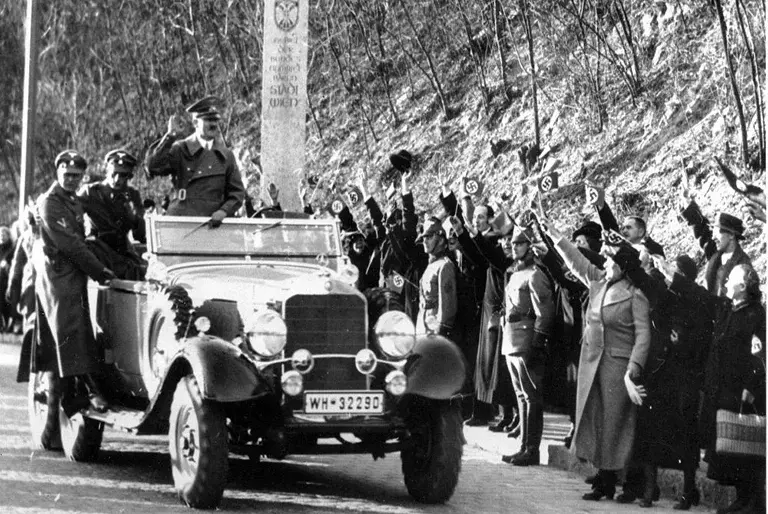
At 5am, senior Nazi officials Heinrich Himmler and Reinhard Heydrich arrive in Vienna. Thirty minutes later, under the guise of ‘suppressing public unrest’, troops of the German 8th Army cross the German-Austrian border unopposed and move towards Vienna, whilst German planes land at Capital’s airport. At 4pm, that same day, Adolf Hitler arrives in his hometown of Braunau am Inn, Upper Austria, where he is welcomed by jubilant Austrians. A Nazi government, led by Seyss-Inquart is established in Austria.
Adolf Hitler entering Austria during the Anschluss, March 1938, greeted by supporters
Adolf Hitler enters Austria in March 1938 following the German annexation of the country, an event known as the Anschluss, which united Austria with Nazi Germany and marked a major step in the expansion of the Third Reich.
13th March 1938
Germany announced the annexation, or ‘Anschluss’, of Austria to Nazi Germany. In the initial hours following the ‘Anschluss’, thousands of individuals are detained in Vienna and across Austria, eliminating a significant portion of the resistance movement.
15th March 1938
Approximately 200,000 enthusiastic Austrians assemble at the Heldenplatz (Heroes Square) in Vienna to hear Hitler deliver an address during which he proclaims, ‘As leader and chancellor of the German nation and Reich I announce to German history now the entry of my homeland into the German Reich’, and ‘The oldest eastern province of the German people shall be, from this point on, the newest bastion of the German Reich’
1st April 1938
The initial transports carrying members of the Austrian resistance arrested following the ‘Anschluss’, depart Vienna by train, bound for the Dachau concentration camp.
10th April 1938
A referendum to ratify the ‘Anschluss’ is held simultaneously in Austria and Germany. The official count shows a unanimous result with 99.73% in favour, although approximately 360,000 Austrian communists, socialists, and Jews, are prohibited from voting.
28th April 1938
Neville Chamberlain, the British Prime Minister, and Edouard Daladier, the French Prime Minister, meet in London to discuss the situation of the Sudetenland and what Hitler’s intentions might be. The outcome of the talks was an agreement that the only way to stop the complete destruction of Czechoslovakia was for the Czechs to make territorial concessions to Germany and cede the Sudetenland.
19th May 1938
The Czech intelligence service reports that Germany has positioned a significant number of military forces near their border, raising concerns about a potential attack. In response, Britain issues a warning to Germany, stating that they will stand by Czechoslovakia in the event of any attack.
20th May 1938
Czechoslovakia takes urgent measures to strengthen its border defences and issues a call to mobilize a number of its reservists.
23rd May 1938
In the absence of any concrete evidence from the Czechs regarding German military activity along the border, the tension subsides for the moment.
German Flag

Adolf Hitler

Chancellor and Führer of Germany

30th May 1938

‘It is my unalterable decision to smash Czechoslovakia by military action in the near future’
30th May 1938
Under the code name ‘Fall Grün’, Hitler orders that plans are ready by the 1st October for the invasion of Czechoslovakia.
United Kingdom Flag

Neville Chamberlain

Prime Minister of the United Kingdom

4th July 1938

‘In war, whichever side may call itself the victor, there are no winners, but all are losers.’
5th July 1938
The Non-Intervention Committee approves a proposal to withdraw all foreign volunteer forces fighting in Spain and to grant belligerent rights to both sides in the civil war. This was accepted by the republican government, but not by Franco’s nationalists.
12th September 1938
During a speech at the annual Nuremberg Rally, Hitler addresses the Party Faithful and remonstrates against what he described as the ‘unbearable oppression’ of the ethnic German population in Czechoslovakia.
15th September 1938
British Prime Minister Neville Chamberlain flies to Germany to meet with Hitler at Berchtesgaden in Bavaria. During their meeting, Chamberlain agrees to demands that Czechoslovakia should cede all territories where more than 50 percent of the population are Sudeten German’s to Germany.
Soviet Union Flag

Maxim Litvinov

Soviet Union Foreign Commissar

Speaking to the League of Nations on the 21st September 1938

‘You, fearing the supposed danger of war, don’t put up any resistance to the aggressor and capitulate yourselves, as well as force others to capitulate. We don’t want actual war and therefore resist the aggressor and call upon you to do the same. You think that the aggressor can be appeased with things not belonging to you, and that he will spare your factories, your land and your independence. We consider that the aggressor only understands force’
22nd September 1938
Chamberlain, having convinced Czech President Edvard Benes to accept Germany’s demands, flew to meet Hitler at the Rheinhotel Dreesen in Bad Godesberg near Bonn, confident that the crisis would soon be resolved. However, Hitler had changed his mind and was now demanding that the entire Sudetenland be handed over, not just the areas with a majority ethnic German population. This caused the talks to stall, with Chamberlain objecting to being presented with an ultimatum. Nevertheless, he agreed to present the new proposal to the Czechs, although he now feared that war was a real possibility.
23rd September 1938
The Czechs order a general mobilization, which enables them to deploy 37 well-equipped divisions along their heavily fortified and mountainous border with Germany.
24th September 1938
Hitler formally announces the Godesberg Memorandum, which demands that the entire Sudetenland be ceded to Germany. According to the memorandum, German forces would enter the area on the 1st October, after which a plebiscite would be held. The Czechs were not allowed to negotiate with Germany and were required to accept the memorandum by 2pm on the 28th September, or Germany would resort to using force.
25th September 1938
With the Czech, British, and French governments all rejecting the German demands outlined in the Godesberg Memorandum, the French government responds by ordering a partial mobilization of its forces.
26th September 1938
In a speech delivered in Berlin, Hitler speaks about the Godesberg Memorandum and declaring that war could break out at any moment if Czechoslovakia does not accept the demands outlined in the memorandum.
German Flag

Adolf Hitler

Chancellor and Führer of Germany

26th September 1938

‘This is my last territorial demand in Europe’
28th September 1938
After the Czechs officially rejected the Godesberg Memorandum, Hitler accepted the intervention of Italian dictator Benito Mussolini, whom Chamberlain had asked to mediate and arrange a peace conference in a final attempt to avoid war. Hitler invites Chamberlain, Daladier, and Mussolini to Munich for the conference, but excludes the Czechs. Meanwhile, the British Royal Navy began mobilizing in preparation for the possibility of war.
29th September 1938
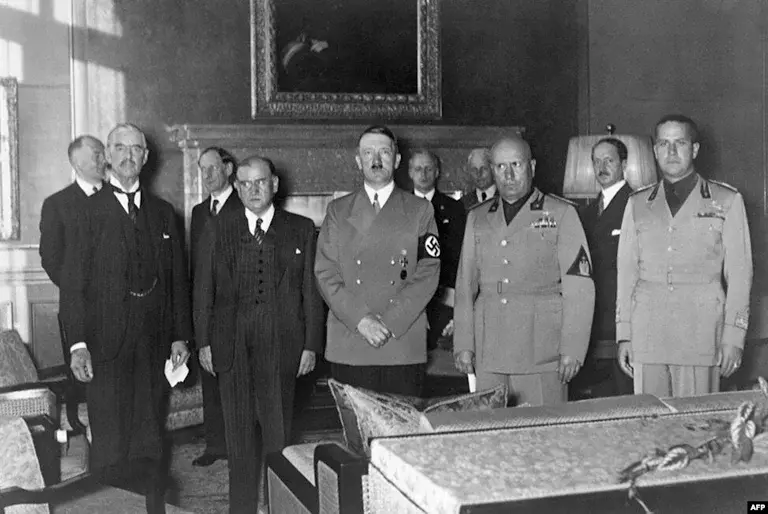
With Hitler, Mussolini, Chamberlain, and Daladier all gathered in Munich, the western leaders quickly agreed to Hitler’s demands in order to avoid a full-scale war signing the Munich Agreement, which allowed for the annexation of the Sudetenland by Germany. Czechoslovakia was not a signatory to the agreement.
Adolf Hitler with Neville Chamberlain, Édouard Daladier and Benito Mussolini at the Munich Conference, September 1938
Adolf Hitler, Neville Chamberlain, Édouard Daladier and Benito Mussolini during the Munich Conference of September 1938, which granted Germany the Sudetenland from Czechoslovakia in an effort to preserve peace in Europe.
30th September 1938
Following the signing of the Munich Agreement, Czechoslovakia is left with no choice but to comply with Germany’s demands for the surrender of the Sudetenland. This decision was further reinforced when Britain and France advised that they would not provide military support if Czechoslovakia rejected the agreement. As a result, Czech troops and police were withdrawn from the Sudetenland by 6pm. Upon their return home, both Daladier and Chamberlain were greeted by crowds of relieved citizens who believed that the threat of war had been averted. As he stepped off the plane, Chamberlain made the following statement to the press expressing this sentiment: ‘The settlement of the Czechoslovakian problem, which has now been achieved, is in my view, only the prelude to a larger settlement in which all Europe may find peace. This morning I had another talk with the German Chancellor, Herr Hitler, and here is the paper which bears his name upon it as well as mine. Some of you perhaps, have already heard what it contains. But I would just like to read it to you’, ‘We, the German Führer and Chancellor, and the British Prime Minister, have had a further meeting today and are agreed in recognizing that the question of Anglo-German relations is of the first importance for the two countries and for Europe. We regard the agreement signed last night and the Anglo-German Naval Agreement as symbolic of the desire of our two peoples never to go to war with one another again. We are resolved that the method of consultation shall be the method adopted to deal with any other questions that may concern our two countries and we are determined to continue our efforts to remove possible sources of difference and thus to contribute to assure the peace of Europe.’ To heap insult onto injury for the Czechs, Poland stabs Czechoslovakia in the back and issues an ultimatum demanding that the Trans-Olza region of Teschen Silesia be surrendered to Poland by 12pm on the 1st October.
United Kingdom Flag

Neville Chamberlain

Prime Minister of the United Kingdom

Speaking in front of Downing Street on the 30th September 1938

‘My good friends, for the second time in our history, a British Prime Minister has returned from Germany bringing peace with honour. I believe it is peace for our time...Go home and get a nice quiet sleep.’
1st October 1938
As per the agreement made in Munich, German troops entered the Sudetenland at 2pm, where they were greeted by crowds of Sudeten Germans who welcomed them with Nazi flags and showered them with flowers. In response to Poland’s demands, Czechoslovakia agreed to surrender the Trans-Olza region to Polish forces and evacuated the area.
5th October 1938
In a speech delivered to Parliament, Winston Churchill expresses his criticism of the government’s policy of appeasement towards Germany, describing it as ‘a complete and unmitigated defeat.’

1939

4th January 1939
Franklin D. Roosevelt calls on Congress to increase the United States defence budget, warning that international tensions and Axis rearmament threaten global stability.
5th January 1939
Adolf Hitler publicly reiterates Germany’s demand for the return of Danzig to the Reich, increasing diplomatic pressure on Poland while presenting the issue as one of self-determination.
9th January 1939
Hitler ceremonially reopens the Reichstag building in Berlin, closed since the 1933 fire. The act is symbolic, as legislative power remains firmly under Nazi control.
11th January 1939
British Prime Minister Neville Chamberlain meets Benito Mussolini in Rome in an attempt to stabilise Anglo-Italian relations. The talks produce no lasting diplomatic breakthrough.
19th January 1939
Hjalmar Schacht, the president of the Reichsbank, is dismissed by Hitler after cautioning that Germany’s rearmament program posed a threat to the economy.
23rd January 1939
Britain enters the so-called Dutch War Scare. Wilhelm Canaris, head of the Abwehr, circulates misleading intelligence suggesting Germany plans to invade the Netherlands in order to use Dutch airfields for attacks on Britain. The scare accelerates British rearmament planning and hardens policy towards continental commitments.
25th January 1939
At Columbia University in New York, John Dunning and his team successfully demonstrate the splitting of the uranium atom, providing the first clear experimental evidence of nuclear fission.
26th January 1939
Spanish Nationalist forces, supported by Italian troops and aircraft, capture Barcelona. The fall of the city effectively ends organised Republican resistance in Catalonia.
27th January 1939
Hitler authorises Plan Z, a five-year naval expansion programme intended to challenge British naval supremacy by the mid-1940s. The plan prioritises battleships and aircraft carriers but places heavy strain on Germany’s economy and shipbuilding capacity.
28th January 1939
A report is published in Sweden by Lise Meitner and Otto Frisch, correctly explaining nuclear fission as the splitting of the atomic nucleus and the release of immense energy. An insight that carries far-reaching military implications.
30th January 1939
On the 6th anniversary of the Nazi party coming to power, Adolf Hitler delivers a two-hour speech at the Kroll Opera House to the Reichstag delegates. He speaks about the successes of the Party, but towards the end, he makes a statement that would later be seen as a prophecy. ‘Today I will once more be a prophet: If the international Jewish financiers in and outside Europe should succeed in plunging the nations once more into a world war, then the result will not be the Bolshevization of the earth, and thus the victory of Jewry, but the annihilation of the Jewish race in Europe!’
13th March 1939
Germany demands that the Czechoslovaks dismiss the anti-Nazi ministers in their government.
14th March 1939
With the support of Germany, Dr. Josef Tiso declares Slovakia’s independence. However, in reality, Slovakia is just a puppet state controlled by Germany, with its foreign policy being determined in Berlin. To prevent a planned declaration of independence and annex the territory for itself, Hungary moves troops across the border and into the Czechoslovakian province of Ruthenia. Czech President Emil Hacha, having requested a meeting with Hitler, arrives in Berlin that evening to discuss the issues of Slovakia and Ruthenia. However, he is kept waiting while Hitler finishes watching a movie.
15th March 1939
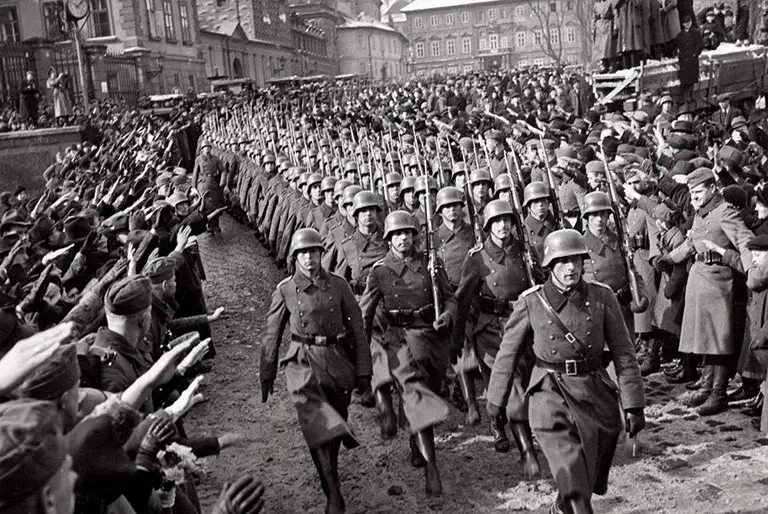
At 1:15am, President Hacha is finally seen by Hitler and is presented with a number of demands under the threat of force. He is required to acknowledge Slovakia’s independence and consent to the immediate occupation of Bohemia and Moravia by German troops, which would become a German protectorate. The remainder of Czechoslovakia is to be annexed by Hungary and Poland. With few options available, President Hacha agrees, and German troops march into Prague without opposition later that morning. Ruthenian authority’s declare their independence from Czechoslovakia and request immediate protection by Germany from the invading Hungarians. The Germans decline and advise them not to resist the Hungarian troops.
German troops marching into Prague during the occupation of Czechoslovakia, March 1939
German troops march into Prague in March 1939 as Germany occupies Bohemia and Moravia, completing the dismantling of Czechoslovakia and marking the final collapse of the Munich settlement.
16th March 1939
From Prague Castle, Hitler announces the creation of the ‘Protectorate of Bohemia and Moravia’. To lend an air of credibility, Hacha is named State President, but this is merely for show. The real power is held by the Reichsprotektor, SS-Obergruppenführer Konstantin von Neurath.
20th March 1939
German foreign Minister Ribbentrop, meeting with his Lithuanian counterpart Juozas Urbsys, demands that the City of Memel and the Klaipeda Region is returned to Germany or the country would be invaded.
22nd March 1939
With Lithuania acquiescing to German demands early that morning, the Klaipeda Region is annexed by Germany.
23rd March 1939
At 1:00am Germany and Lithuania officially sign a treaty declaring that the Klaipeda Region and Memel are to be voluntarily transferred back to Germany. This is retrospectively back dated to be effective from the 22nd March. Adolf Hitler arrives in Memel later that day having travelled across from Swinemünde on board the Heavy Cruiser Deutschland.
25th March 1939
Italy presents Albania with an ultimatum, demanding that Italian forces should be given control of strategic points in the country and that a customs union should be introduced between them. An affirmative response was required by 6th April 1939.
31st March 1939
Neville Chamberlain announces to the House of Commons ‘In the event of any action which clearly threatened Polish independence, and which the Polish Government accordingly considered it vital to resist with their national forces, His Majesty’s Government would feel themselves bound at once to lend the Polish Government all support in their power. They have given the Polish Government an assurance to this effect. I may add that the French Government have authorised me to make it plain that they stand in the same position in this matter as do His Majesty’s Government.’
6th April 1939
Following talks with the Polish foreign minister, it was agreed to formalise the assurance of support for Polish independence as the Anglo-Polish military alliance once agreement of the text had been reached.
7th April 1939
Having not received a satisfactory response from Albania, Italian troops begin their invasion landing troops at various points along the coast.
10th April 1939
With most of Albania now under Italian control King Zog flees to Greece.
12th April 1939
Italy sets up a fascist government in Albania under Shefqet Verlaci, which then votes to unite the country with Italy and proclaim King Victor Emmanuel III the King of Albania.
13th April 1939
Following the occupation of Albania by Italy, Britain and France extend their guarantee of independence to both Greece and Romania.
20th April 1939
Adolf Hitler’s 50th birthday is celebrated as a national holiday throughout Germany, with a grandiose display of events in Berlin centred around Hitler and organized by Minister of Propaganda Joseph Goebbels. The celebrations include a military parade featuring 40,000 to 50,000 German soldiers and a flypast of 162 Luftwaffe planes. The parade lasts for more than four hours and was attended by 20,000 official guests and several hundred thousand spectators. It was partly intended to serve as a warning to the Western powers of Germany’s new found military prowess.
3rd May 1939
Vyacheslav Molotov replaces Maxim Litvinov as Soviet People’s Commissar for Foreign Affairs, marking a significant shift in Soviet foreign policy. Litvinov, a proponent of collective security and closer ties with Britain and France, had been instrumental in anti-fascist diplomacy but was dismissed amid Stalin’s growing disillusionment with Western powers. Molotov’s appointment signalled the USSR’s new willingness to negotiate with Germany.
8th May 1939
Britain rejects Soviet proposals for a tripartite military alliance between the United Kingdom, France, and the Soviet Union, intended to deter German aggression. The Soviet plan called for firm mutual guarantees and military commitments, including the defence of Eastern European states, but Britain, wary of its binding obligations and suspicious of Soviet motives, offered only vague assurances in response, which only deepened Stalin’s mistrust of Britain and France.
23rd May 1939
Adolf Hitler convenes a high-level meeting at the Reich Chancellery in Berlin with key military leaders, including Hermann Göring, General Wilhelm Keitel, and Admiral Erich Raeder. Known as the ‘May 23 Conference’, the meeting addresses the strategic direction of German foreign policy and military planning. During the discussion, Hitler declares that Germany must attack Poland at the first suitable opportunity, viewing it as essential for securing Lebensraum (living space) and resolving the “Polish problem.” He acknowledges the risk of war with Britain and France but stresses that conflict with the Western powers should be avoided if possible. However, he makes it clear that Germany is prepared to face such a war if it becomes unavoidable. Hitler argues that Germany’s current military and economic position is more favourable than it will be in the future, and therefore, delay is not an option.
31st May 1939
Germany and Denmark sign a 10-year non-aggression pact, pledging to resolve disputes peacefully and refrain from hostile actions against each other.
15th June 1939
The Soviet Union declines a German proposal to begin negotiations for an economic agreement, as it continues discussions with Britain and France over a possible anti-German alliance.
23rd June 1939
France and Turkey sign a mutual assistance pact pledging military support in the event of aggression in the Mediterranean region. The treaty commits both nations to consult and cooperate militarily if either is attacked. The agreement aimed to draw Turkey closer to France and Britain, discourage alignment with Germany and Italy, and strengthen French influence in the Middle East.
20th August 1939
During a meeting with his generals at Berchtesgaden, Hitler declares that ‘the destruction of Poland.. would begin on Saturday, 26th August at 4am.’
23rd August 1939
The Molotov–Ribbentrop Pact is concluded between Germany and the Soviet Union, negotiated and named after their respective foreign ministers, Ribbentrop and Molotov. The agreement contained 7 public articles and 1 secret protocol:
  • Each nation would not attack one another, whether severally or jointly with other powers.
  • Provided that if an outsider attacked either, the signatories would not lend support.
  • Promised an open channel of communication between the Soviet Union and the German Reich.
  • That neither would join any grouping of powers aimed directly or indirectly at the other.
  • Affirmed that disputes would be settled by an arbitration commission.
  • The agreement would last ten years, with an automatic five-year extension, if neither side objected.
  • The Non-Aggression Pact would come into force immediately upon signature by Ribbentrop, Molotov, and Stalin. The Secret Protocol established Soviet and German spheres of influence in Eastern Europe. It recognized that Estonia, Latvia, Finland and Bessarabia were within the Soviet sphere of influence. Poland was to be divided along the Narev, Vistula, and San Rivers. The protocol was later amended to include Lithuania and the city of Vilnius within the Soviet sphere of influence.
Neville Chamberlain warns Germany that Britain will honour its statement of the 31st March which guarantees Polish independence.
24th August 1939
The British Parliament is recalled from its Summer recess to pass the Emergency Powers (Defence) Act 1939 in response to the signing of the Molotov–Ribbentrop Pact the previous day. This act immediately grants the government special legislative powers to implement defence regulations.
25th August 1939
The Polish-British Common Defence Pact which guarantees Polish independence, is finally signed committing both Britain and France to come to the defence of Poland in the event of an attack. Hitler hesitates following the signing and postpones the start date of the invasion until the 1st September. Unaware that Hitler had already postponed the attack on Poland, a detachment of German Abwehr agents, disguised in civilian clothes, crosses the Slovakian-Polish border that night and attempts to seize the Mosty railway station and tunnel in the Jabłonków Pass. However, quick action by soldiers from the Polish Border Guard and the 4th Podhale Rifle Regiment repel the attempt, wounding two Germans, who then withdrew back across the border. Known as the Jabłonków incident, the Polish government lodges a formal protest. Mussolini communicates to Hitler that Italy isn’t prepared for war at this time.
26th August 1939
Following the work of Birger Dahlerus, a Swedish businessman and envoy sent by Göring to Britain. Lord Halifax composed a letter to Hitler. In the letter, he expressed Britain’s desire to reach a peaceful settlement. This convinced Hitler that the Western Allies would probably not declare war on Germany if they invaded Poland. Furthermore, if they did declare war, they would be willing to negotiate a compromise that favoured Germany after its conquest. Hitler announces that Germany would respect the neutrality of Belgium, Holland, Luxembourg and Sweden.
29th August 1939
The German government expresses its willingness to begin talks with Poland regarding the return of Danzig, the Polish Corridor/West Prussia to the Reich, and the protection of the German minority in Poland. However, Poland must send a representative with full authority to sign an agreement to Berlin by the end of the following day. The Polish Minister of Foreign Affairs, orders the mobilization of the Military. However, due to pressure from Great Britain and France, the mobilization is called off soon after.
30th August 1939
Polish Commander-in-Chief, Marshal Smigly-Rydz orders the Polish Navy’s destroyer squadron consisting of the Burza, Blyskawica, and Grom to execute ‘Operation Peking’ and make their way to British ports. The plan being that they would assist the Royal Navy in transporting supplies to Poland. He also issues orders to mobilize all Polish reserve forces.
31st August 1939
Polish Ambassador Jozef Lipski visited Ribbentrop to express Poland’s willingness to negotiate. However, upon discovering that Lipski did not have the full authority to sign an agreement, Ribbentrop sends him away. Subsequently, German radio announced that Poland had rejected Germany’s offer and that negotiations with Poland had ceased. Later in the evening, the Germans initiated ‘Operation Himmler’, a series of false flag attacks on German targets near the German-Polish border. These incidents were made to appear as if they were carried out by the Polish army, providing a justification for the German invasion. The most well-known of these attacks was on the Gleiwitz Radio Tower in Upper Silesia. Prisoners, including some from Dachau Concentration camp, were dressed in Polish uniforms and shot dead at the scene to make it seem like they had been killed whilst attacking the radio station. Hitler issues Directive Number 1, the attack against Poland which is to begin at 4:45am the next morning.
Continue to the next Timeline

Invasion of Poland (1939)

Germany’s Blitzkrieg assault on 1st September 1939 and the Soviet invasion from the east crushed Poland within weeks. This timeline traces the key battles, rapid advances, and the fall of Warsaw that triggered the start of World War II.

View Timeline