10th September 1939
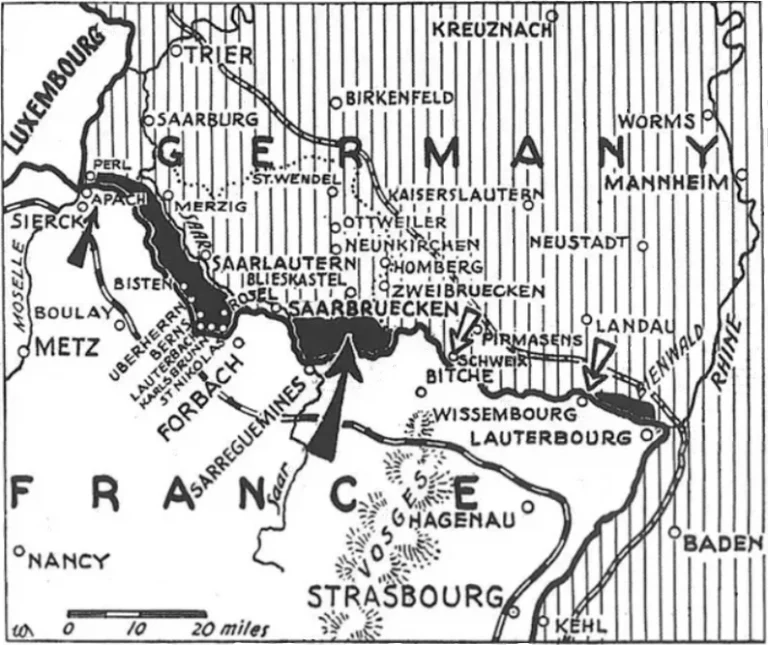
German forces launch a local counterattack in the Saar region, targeting the village of Apach, recapturing it and pushing back elements of the French 42nd Infantry Division. However, a swift French counterattack regains control of the village.
11th September 1939
Elements of the French 5th and 8th Infantry Divisions, having advanced through the Warndt Forest and the Blies Valley towards Merzig, Saarbrücken, and Überherrn, reach the outer defences of the Siegfried Line. Reconnaissance patrols begin to probe the German forward positions of the 1st Army (under Generaloberst von Witzleben), encountering bunkers, dragon’s teeth, and wire entanglements, triggering the first heavy artillery exchanges between French and German forces on the Western Front.
12th September 1939
French forces capture the German town of Brenschelbach. Following a conference of the French and British command, it’s decided to halt all further offensive operations into Germany just short of the Westwall. The Poles are not informed of this, but are told that a renewed offensive will begin on the 17th September.
17th September 1939
The French inform the Polish command that the planned renewal of the French offensive into the Saarland has been postponed until the 20th September.