September 1939
3rd September 1939
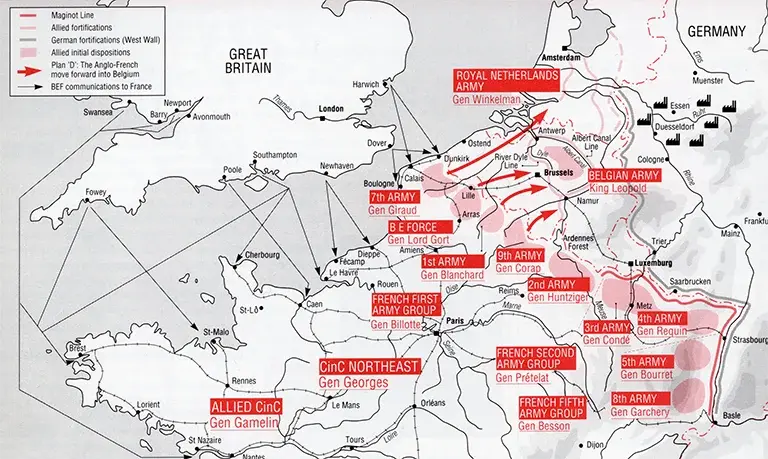
The French Army reactivates the Grand Quartier Général (GQG), after which Général d’Armée Maurice Gamelin, Commander-in-Chief of the French Armed Forces, orders the general mobilisation of the army—particularly the north-eastern army groups facing the German border, namely Army Group 2 (under General André-Gaston Prételat) and Army Group 3 (under General Charles Huntziger). Troops were moved into defensive positions along the Maginot Line, and border security was reinforced. However, no immediate offensive action was taken at the front.
Following a long period of political isolation, Winston Churchill is appointed by Neville Chamberlain as First Lord of the Admiralty, putting him in charge of the Royal Navy.
The RAF conducts its first propaganda air raid of the war, during which its bombers drop around six million pamphlets over northern Germany, which are designed to inform the German population about the reasons for Britain’s entering the war and to encourage dissent against the Nazi regime.
4th September 1939
The first major engagement between the Luftwaffe and the RAF occurs over the North Sea when 29 RAF bombers attempt to attack the German naval base at Wilhelmshaven. The Luftwaffe intercepts them with only eight aircraft managing to find and attack the target. Seven British aircraft are shot down during the operation.
Small parties from II Corps Headquarters of the British Expeditionary Force depart Portsmouth for France under Plan W4, the War Office’s pre-war scheme for the rapid dispatch of liaison and organisational teams.
The Governor-General of New Zealand, Viscount Galway, formally proclaims that New Zealand is at war with Germany, following Britain’s declaration the previous day. Prime Minister Michael Joseph Savage affirms the country’s support with his famous statement: “Where Britain goes, we go; where she stands, we stand.”
The South African parliament holds a decisive vote on whether to support Britain’s declaration of war on Germany. It narrowly rejects Prime Minister J.B.M. Hertzog’s policy of neutrality, with a vote of 80 to 67 in favour of General Jan Smuts, who supported joining the war on the side of the Allies.
Spain’s General Francisco Franco offers his country’s support to Germany while publicly declaring neutrality.
5th September 1939
President Roosevelt signs a proclamation declaring the neutrality of the United States.
American President Franklin D. Roosevelt privately asks Canadian Prime Minister William Lyon Mackenzie King whether Canada has entered the war. King replies that it has not, a response that allows the United States to continue supplying war materials to Canada without breaching its Neutrality Act, which forbids direct arms exports to belligerent nations such as Britain. The exchange highlights the delicate diplomacy shaping early North American support for the Allied cause.
South African Prime Minister J.B.M. Hertzog resigns following his loss in a crucial parliamentary debate on his proposal for South African neutrality the previous day. Jan Smuts is appointed Prime Minister later that day.
6th September 1939
South African Prime Minister Jan Christiaan Smuts declares war on Germany.
The British Expeditionary Force begins transferring combat units across the English Channel to France.
French forces along the Saar front complete preparations for a limited offensive into Germany, codenamed Operation Saar, scheduled to begin the following day.
Continue to the Saar Offensive timeline →
7th September 1939
The Canadian Parliament meets in special session to debate the nation’s response to the war in Europe. Prime Minister William Lyon Mackenzie King seeks parliamentary approval for a formal declaration of war, underscoring that Canada’s decision will be made independently under the Statute of Westminster. The motion gains broad support, laying the groundwork for Canada’s official declaration three days later.
8th September 1939
President Franklin Roosevelt advocates for strengthening the U.S. military, utilizing his constitutional authority to call up the reserves, in response to the ‘limited national emergency’ declared because of the war in Europe.
9th September 1939
Adolf Hitler issues Führer Directive No. 3, instructing that no offensive actions be taken against France or Britain. The Wehrmacht is to remain strictly on the defensive along the Westwall, with the Luftwaffe forbidden from attacking targets in either country.
The first substantial advance parties of the British Expeditionary Force cross the Channel to France, marking the true start of Britain’s troop deployment to the Western Front. Comprising elements of II Corps Headquarters and forward detachments of the 1st and 2nd Infantry Divisions, these units land at Cherbourg, Brest, and Nantes to prepare reception areas, supply depots, and transport links for the main BEF formations that will follow.
10th September 1939
In Ottawa, Canada, following debate, Parliament votes to join Britain and France in declaring war on Germany, after which the Governor-General, Lord Tweedsmuir, formally announces the decision on behalf of the Crown. However, Canada is unprepared for war, possessing only 4,500 regular soldiers and 51,000 reservists, with almost no modern equipment, few aircraft, and just six destroyers in its navy.
19th September 1939
Canada’s Cabinet War Committee approves a naval construction program to build 110 vessels for the war effort, including Flower-class corvettes and Bangor-class minesweepers. Most will be built in Canadian shipyards, marking the start of Canada’s wartime shipbuilding industry and laying the foundation for the Royal Canadian Navy’s rapid expansion.
21st September 1939
Pro-Nazi Iron Guardsmen assassinate Romanian Prime Minister Armand Calinescu amid suspicions that he is plotting to sabotage Romanian oil fields to prevent them from falling into German hands.
22nd September 1939
The British government introduces petrol rationing to ensure that essential services and military operations have adequate fuel supplies.
23rd September 1939
The German government announces that all radio sets owned by Jews are to be confiscated.
25th September 1939
Adolf Hitler issues Führer Directive No. 4, confirming that no offensive operations are to be undertaken on the Western Front. The Wehrmacht is to remain strictly on the defensive toward France and Britain, while the Kriegsmarine is authorised to intensify attacks on Allied merchant shipping. The directive formalises Germany’s cautious stance in the West pending the completion of the campaign in Poland.
Germany introduces the rationing of bread and flour in an effort to manage food supplies and ensure there is enough for both the military and civilian population.
In Canada, Quebec Premier Maurice Duplessis calls a provincial election for 25th October, arguing that the federal government’s emergency proclamations under the War Measures Act infringe upon provincial rights. He centres his campaign on autonomy and opposition to conscription, accusing Ottawa of overstepping its constitutional authority.
27th September 1939
Hitler, summoning the Wehrmacht’s leading generals to a meeting in Berlin, informs them of his intention to invade France and discusses with them the required logistics and timings of the operation.
More than 152,000 troops and 21,424 vehicles of the British Expeditionary Force under General Lord Gort (headquartered at Arras) have been landed in France through the ports of Cherbourg, Nantes, Brest, and Saint-Nazaire since the start of the war, without loss. Alongside these forces, 36,000 tons of ammunition, 25,000 tons of petrol, and 60,000 tons of frozen meat have been delivered, while Royal Engineer and Royal Army Service Corps units establish supply depots and rail links to the Channel ports, ensuring the BEF can sustain operations through the coming winter. II Corps, under Lieutenant-General Sir Alan Brooke, with the 1st and 2nd Infantry Divisions and supporting corps troops, is fully deployed in the Le Mans area. Meanwhile, only advance parties of I Corps under Lieutenant-General Sir John Dill have arrived, preparing reception and staging areas near Lille for the 3rd Infantry Division under Major-General Bernard Montgomery, which is in the process of transferring from England, with only part of the division yet landed.