WorldWar-2.com

Operation Sonnenblume (Sunflower)

February 1941 - April 1941

‘The Germans have come to aid us, but Africa remains an Italian theatre of war. We shall restore the honour of our armies.’
Benito Mussolini - Prime Minister and Duce of Italy - 1st March 1941

Introduction to Operation Sonnenblume

Following the shattering defeat of the Italian 10th Army by British and Commonwealth forces during Operation Compass, Adolf Hitler, facing the collapse of his Italian ally and the potential loss of key Mediterranean positions, orders the deployment of a small but highly mobile German force to stabilise the situation in North Africa. Under the command of Generalleutnant Erwin Rommel, and codenamed Unternehmen Sonnenblume (Operation Sunflower) this intervention marked the birth of the famed Afrika Korps. Arriving in mid-February 1941, Rommel wastes no time and by the end of March the leading elements of his force are in action against British forces defending around El Agheila, in Western Cyrenaica. In cooperation with Italian forces, Rommel’s aggressive tactics and leadership deliver a series of swift victories, driving the British back, recapturing Benghazi along with much of the territory Italy had lost over the previous months. However, the key port city of Tobruk remained in British hands, leading to a prolonged siege that would dominate the next phase of the campaign. Rommel’s offensive marked the beginning of a fierce, seesaw struggle between Axis and Allied forces that would come to define the North African Campaign.

February 1941

6th February 1941
Generalmajor Erwin Rommel is appointed to command the German expeditionary force being sent to Libya as part of Operation Sonnenblume. The German commitment to North Africa was limited, officially framed as a stabilisation force intended to support Italian forces following their heavy defeat during Operation Compass. Rommel’s command was to include the 5th Light (Leichte) Division and the 15th Panzer Division and would technically fall under the Italian High Command (Comando Supremo).
12th February 1941
Generalmajor Erwin Rommel lands in Tripoli and reports to General Italo Gariboldi, commander of the Italian 10th Army in Libya. At this time, Gariboldi commands five divisions: the infantry divisions Trento, Brescia, Pavia, and Sabratha, along with the motorised Ariete Armoured Division, which is placed under Rommel’s operational command.
14th February 1941
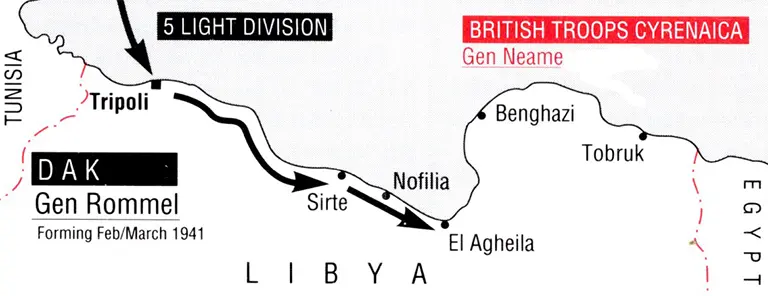
The first elements of the German 5th Light Division begin to arrive at Tripoli, Libya. Despite much of their heavy equipment still en route, advance units are immediately ordered forward to Sirte, securing key positions along the Via Balbia coastal road.
Operational map showing the arrival of the Afrika Korps and 5th Light Division at Tripoli and their advance toward El Agheila during Operation Sonnenblume, February–March 1941
Map illustrating the arrival of General Erwin Rommel’s Afrika Korps in Tripoli in February 1941 and the forward movement of the 5th Light Division along the Libyan coast toward El Agheila. The deployment marked the beginning of Germany’s intervention in North Africa under Operation Sonnenblume, setting the stage for the desert campaign against British forces in Cyrenaica.
19th February 1941
The German expeditionary force in North Africa is officially designated as the Deutsches Afrika Korps (DAK), following the arrival of the first elements of the 5th Light Division in Libya.
24th February 1941
The first encounter between British and German forces in Libya occurs at Nofilia, a coastal village along the strategically vital Via Balbia highway between Sirte and El Agheila. The skirmish involves reconnaissance elements from the recently arrived German 5th Light Division clashing with patrols of the British 11th Hussars of XIII Corps. With German troops still adapting to desert warfare, the engagement served as a probing action to assess the strength and disposition of the British forces in the area.
United Kingdom Flag

General Archibald Wavell

Commander-in-Chief Middle East

2nd March 1941

‘The arrival of German forces will stiffen the Italians, but the desert remains a battle of supply lines. Their numbers are still small; we must not exaggerate.’

March 1941

4th March 1941
The first British contingent bound for Greece began its departure from Egypt. Commanded by Lieutenant General Henry Maitland Wilson, the force comprised roughly four divisions drawn from General Archibald Wavell’s already overextended Middle East Command. Its redeployment weakened British strength in North Africa at a critical stage of the desert war.
German Flag

Generalleutnant Erwin Rommel

Commander of the Deutsches Afrikakorps

Telegram from Rommel to the OKW on 6th March 1941

‘I shall attack, come what may.’
11th March 1941
With the 5th Light Division having now fully deployed in Tripolitania, Rommel directs it to begin preparations for an attack on the key British defensive position and staging area at El Agheila along the Via Balbia highway. Capturing El Agheila would be critical to securing Axis supply routes and enabling a further advance into Cyrenaica.
19th March 1941
Having flown in the previous day, Rommel attends a meeting with Adolf Hitler, Walther von Brauchitsch (Commander-in-Chief of the Army), and Franz Halder (Chief of the General Staff) at the Chancellery in Berlin. During the meeting, he is informed that, since the 15th Panzer Division will not arrive in Libya until late May, he should remain on the defensive and focus on consolidating his position.
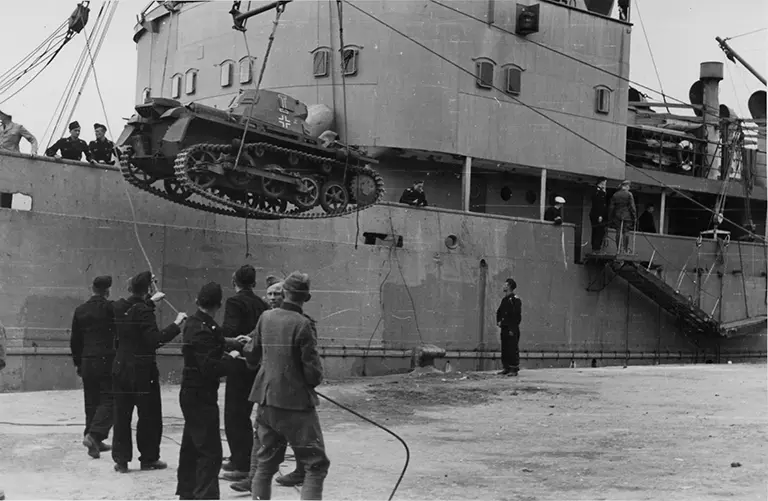
German Panzer I light tank being unloaded by crane from a transport ship at Tripoli harbour during Operation Sonnenblume, March 1941
A German Panzer I light tank of the 5th Light Division is unloaded by crane from a transport ship in the port of Tripoli in March 1941. The arrival of armoured units marked the operational beginning of Germany’s intervention in North Africa under Operation Sonnenblume, reinforcing Italian forces and preparing for the forthcoming advance into Cyrenaica.
21st March 1941
Arriving back in Libya, Rommel immediately demonstrates his aggressive leadership by disregarding orders to remain on the defensive and finalising preparations to attack the British at El Agheila.
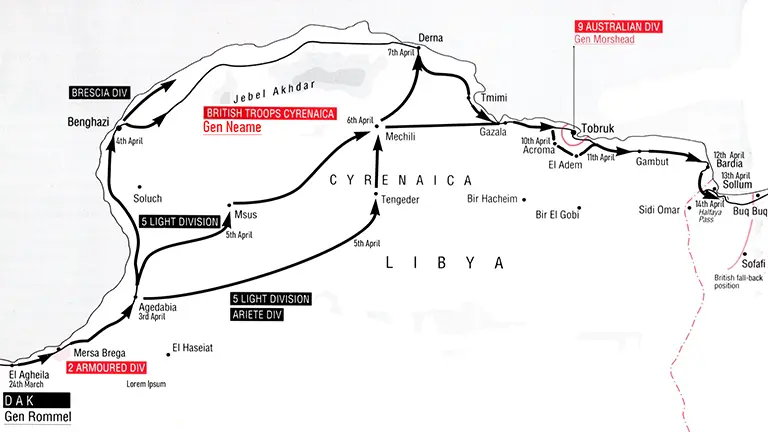
Operational map showing Rommel’s first offensive across Cyrenaica in March–April 1941, with Axis advances from El Agheila through Benghazi, Mechili, Derna and toward Tobruk
Operational map of Rommel’s first offensive in North Africa during Operation Sonnenblume. Beginning at El Agheila on 24th March 1941, German and Italian forces advanced rapidly across Cyrenaica through Benghazi, Mechili, and Derna, driving British troops eastward and leading to the encirclement and siege of Tobruk.
24th March 1941
Despite strict orders from the German and Italian High Commands to remain on the defensive until all elements of his force had arrived, Generalleutnant Erwin Rommel seizes the initiative and launches his first offensive in North Africa. At 06:00, Aufklärungs-Abteilung 3 of the 5th Light Division spearheads the assault against El Agheila, a key defensive position on the Gulf of Sirte. The small British garrison executes a skilful fighting withdrawal from the fort and through the town, attempting to delay the Axis advance. By midday, El Agheila is under complete Axis control, having met minimal resistance, although the British manage to mine the airstrip to hinder the immediate deployment of Luftwaffe units. Rommel’s forces then begin probing cautiously eastwards along the coast towards Mersa Brega, approximately 30 kilometres away, with reconnaissance elements supported by Panzer III and Panzer IV tanks from Panzer-Regiment 5.
30th March 1941
German reconnaissance units from Aufklärungs-Abteilung 3 of the 5th Light Division reach the outskirts of Mersa Brega, making contact with elements of the British 2nd Armoured Division, supported by armoured cars from the 3rd King’s Own Hussars, attached from a support group of the 7th Armoured Division. The British have hastily built a defensive line stretching from the coast, with fortified positions along key ridgelines and extending south to the salt marshes, securing their inland flank south of the town. Their objective is to funnel the German attack directly into their main defensive positions and block any further Axis advance eastwards.
31st March 1941
The terrain east of Mersa Brega consisted of flat coastal plains offering few natural obstacles. Recognising the British potential to use the town as a chokepoint to block his advance, Rommel orders the 5th Light Division, supported by Italian units, to immediately assault the British positions at Mersa Brega. By around 10:00, advance elements are within 3 kilometres of the airstrip located southeast of the town but are stalled under fire from a line of 2-pounder anti-tank guns, positioned behind two belts of mines. The Germans, having tuned into British wireless traffic, intercept messages revealing the critically thin British defensive line and their severe lack of artillery support. Sensing an opportunity, Rommel moves to exploit the situation. By the afternoon, with German pioneers having cleared paths through the minefields, Rommel orders a full divisional assault against the British positions south of the town. By evening, the British defensive line is penetrated. Facing the risk of encirclement, British forces are compelled to retreat from Mersa Brega, falling back east towards Agedabia.

April 1941

3rd April 1941
Forward elements of the 5th Light Division, supported by units of the Italian Ariete Armoured Division, reach and occupy Agedabia, which falls with little resistance. British covering forces—elements of the 2nd Armoured Division, weakened and short of serviceable tanks—have already withdrawn rather than risk encirclement. General Archibald Wavell arrives at the front and replaces General Philip Neame with General Richard O’Connor as commander of British troops in Cyrenaica. With British forces rapidly retreating eastward, Rommel seizes the opportunity and orders a three-pronged advance: along the coast road toward Benghazi, north-east toward Mechili, and eastward before turning north to Tengeder.
4th April 1941
Advance elements of the 5th Light Division and attached Italian units enter Benghazi virtually unopposed, as the British abandon the city to avoid encirclement. The Axis capture of Benghazi, with its intact port facilities, valuable supply stores, and large number of vehicles, provides an important logistical gain that supports Rommel’s further eastward drive across Cyrenaica.
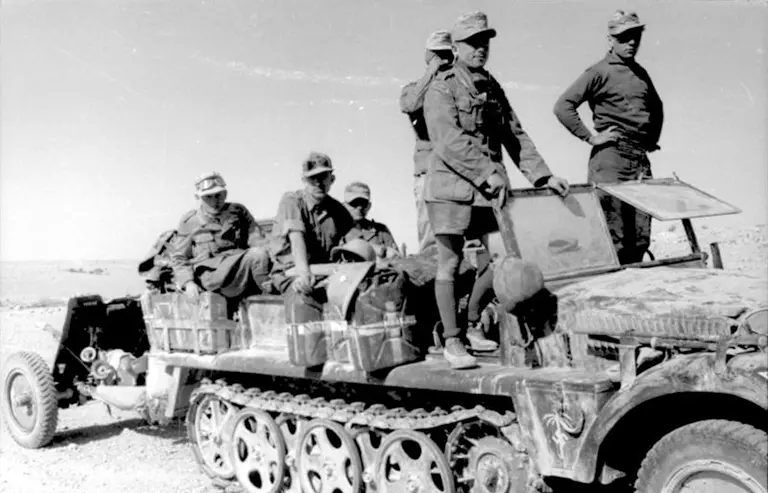
Afrika Korps Sd.Kfz. 10 half-track towing a 3.7 cm Pak 36 anti-tank gun across the North African desert during Operation Sonnenblume, 1941
Afrika Korps troops ride aboard a Sd.Kfz. 10 half-track towing a 3.7 cm Pak 36 anti-tank gun across the North African desert in 1941. The light, motorised combination reflects the mobility that defined early German operations during Operation Sonnenblume as Axis forces advanced across Cyrenaica.
6th April 1941
German forces capture Antelat and push inland toward Mechili, tightening the threat of encirclement. That night, in the confusion of Axis manoeuvres, Generals Philip Neame and Richard O’Connor are captured near Mechili. British units continue withdrawing toward Tobruk, while reinforcements, including the Australian 9th Division and some armour, arrive by sea from Alexandria to strengthen the fortress.
7th April 1941
Rommel’s advance units occupy Derna, securing its airfield for the Luftwaffe and forcing rearguards of the 9th Australian Division to fall back along the coast road. With British command already shaken by the capture of Generals Neame and O’Connor, the retreat toward Tobruk becomes increasingly disordered.
8th April 1941
The Afrika Korps pushes beyond Derna, but overstretched supply lines and shortages of fuel and water begin to slow Rommel’s rapid advance. Around Tobruk, the 9th Australian Division strengthens the defensive perimeter as reinforcements arrive by sea, marking the shift from retreat to the decision to hold the fortress.
10th April 1941
The 9th Australian Division consolidates inside Tobruk, with Major-General Leslie Morshead committing to hold the port at all costs. Rommel begins sealing off the fortress, designating the Suez Canal as his ultimate objective. Initial Axis probes against the perimeter are repelled, with the landward investment of Tobruk completed the following day.
11th April 1941
German and Italian forces complete the encirclement of Tobruk, severing the road east toward Bardia and the Egyptian frontier. Rommel launches an opportunistic assault on the fortress perimeter, focusing on the El Adem road sector held by the 20th Australian Brigade. Elements of the 5th Panzer Regiment push forward but are beaten back by concentrated Australian infantry and artillery fire, suffering tank losses in the process. After three weeks of continuous advance across Cyrenaica, Axis troops and vehicles show growing signs of exhaustion, and Rommel’s rush on Tobruk stalls against the fortress’s prepared defences.
German Flag

Generalleutnant Erwin Rommel

Commander of the Deutsches Afrikakorps

Letter to his wife on 11th April 1941

‘The Australians fight with remarkable tenacity. They are very tough opponents and it is no easy task against them.’
12th April 1941
With British forces retreating in haste towards the Egyptian frontier, Axis forces occupy Bardia, securing its port facilities and further tightening the noose around the Tobruk garrison. With Bardia in Axis hands, Rommel now controls the major coastal ports of Cyrenaica, giving him additional supply points for his drive east. However, Tobruk’s continued resistance denies him the most vital harbour on the coast, forcing supplies to be hauled over long desert routes from Tripoli. German and Italian patrols continue to test the Tobruk perimeter but are met with determined resistance from Australian and British defenders.
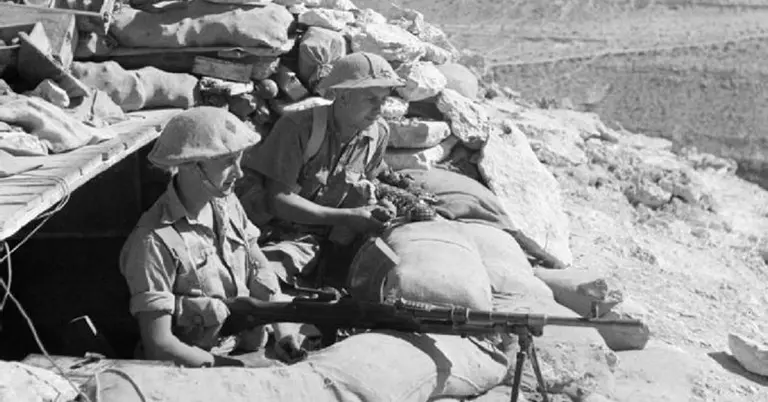
Australian 9th Division soldiers man a Bren light machine gun from a sandbagged defensive position at Tobruk during the Siege of Tobruk, 1941
Soldiers of the Australian 9th Division defend a sandbagged sangar at Tobruk in 1941. One operates a Bren light machine gun while his comrade scans the desert approaches. The steadfast defence of Tobruk during the siege frustrated Rommel’s Afrika Korps and became a defining episode of the North African campaign.
13th April 1941
After dark, Rommel launches the so-called “Easter Battle”, a major assault against the Tobruk perimeter. Infantry of the 5th Light Division, supported by armour, attempt to breach the anti-tank ditch west of the El Adem road near strongpoint R33. German tanks briefly establish a foothold, but the 2/17th Battalion of the 9th Australian Division counter-attacks at close quarters. Rommel receives orders from Berlin to consolidate on the Egyptian frontier and prioritise the capture of Tobruk. He remains inclined to bypass the fortress and strike toward the Suez Canal, but decides to delay further major assaults until the 15th Panzer Division arrives. German advance units take Sollum, a small but strategically placed port near the Libyan–Egyptian frontier. The Luftwaffe flies around 150 sorties against Valletta, Grand Harbour, and the island’s airfields, causing widespread destruction and civilian casualties. Several raid waves pound the dockyards and capital, making this one of the heaviest single days of bombing Malta endures during the spring offensive.
14th April 1941
By dawn the German attack against Tobruk is contained, forcing them to withdraw with heavy losses — 16 of 38 tanks destroyed and some 350–400 men killed or wounded — while the Australians suffer around 90–100 casualties. Axis troops push on to capture the heights of Halfaya Pass, commanding the main coastal road into Egypt. Holding this strong position allows Rommel to block British attempts to relieve Tobruk from their new defensive positions along the Egyptian border.
15th April 1941
Rommel consolidates his hold on the frontier positions, with German troops digging in at Sollum and the newly taken Halfaya Pass, while reconnaissance patrols probe towards British forward elements near the Egyptian border.
16th April 1941
German and Italian artillery and Luftwaffe bombers step up attacks against the perimeter at Tobruk, but probing attacks are repulsed by Australian defenders.
17th April 1941
Rommel establishes his headquarters at Beda Fomm, coordinating both the siege operations against Tobruk and frontier defence. The British continue attempts to reorganise their forward units around Mersa Matruh.
18th April 1941
Italian troops, supported by German detachments, strengthen outposts near Fort Capuzzo, whilst Luftwaffe raids continue against Tobruk and British supply lines.
19th April 1941
Australian units inside the Tobruk perimeter conduct aggressive night patrols, clashing with German positions near the El Adem road. Casualties are light, but the action underlines the defenders’ resolve.
20th April 1941
Rommel issues orders that the 5th Light Division and Italian units hold firm at Sollum and Halfaya to maintain control of the Egyptian frontier. Meanwhile pressure is to be intensified on Tobruk. That day the Luftwaffe launches one of its heaviest raids yet, committing around 60–80 aircraft in successive waves. Ju 87 Stukas (StG 1 and StG 2) and Ju 88 bombers strike Tobruk harbour in an effort to disrupt Allied resupply by sea, while Bf 109 fighters (JG 27) provide cover. Several vessels in the harbour are damaged, and casualties are reported among both troops and dockworkers. The Australian destroyer HMAS Waterhen comes under heavy dive-bomber attack and suffers splinter damage from near misses, but succeeds in landing supplies and troops before withdrawing — a testament to the growing ‘Tobruk Ferry Service’ that is keeping the garrison provisioned.
25th April 1941
British Mobile Force columns — drawn from the 7th Armoured Division’s Support Group (including the 11th Hussars, 3rd Regiment Royal Horse Artillery, 1st King’s Royal Rifle Corps, and 2nd Rifle Brigade) — operate aggressively around Fort Capuzzo and Sollum, probing Axis positions and launching harassing raids. German and Italian outposts, manned by detachments of the 5th Light Division and Italian frontier troops, are engaged in a series of sharp skirmishes, forcing Rommel to move in reinforcements to stabilise the line.
26th April 1941
Elements of the 5th Light Division with Italian support — launch local counter-attacks to push back the British raiding columns. Fighting centres on the approaches to Sollum and the Capuzzo sector, with the British withdrawing to avoid encirclement.
27th April 1941
Major-General Friedrich Paulus, Deputy Chief of the German General Staff, arrives at Rommel's headquarters from Berlin. He assesses Rommel’s forward positions and conveys that significant reinforcements are unlikely, urging a focus on consolidating defensive positions rather than further immediate advances into Egypt.
United Kingdom Flag

Winston Churchill

Prime Minister of the United Kingdom

Radio Broadcast on the 27th April 1941

‘Tobruk — the fortress of Tobruk – which flanks any German advance on Egypt, we hold strongly. There we have repulsed many attacks, causing the enemy heavy losses and taking many prisoners.’
30th April 1941
Rommel launches another assault on Tobruk, spearheaded by elements of the newly arrived 15th Panzer Division, including Schuetzen-Regiment 115 and tanks of Panzer-Regiment 8. Supported by artillery and Stuka dive-bombers, German troops attack the south-eastern perimeter, but the 9th Australian Division (notably the 2/48th Battalion) holds firm with support from the British Royal Horse Artillery and anti-tank guns. Several panzers are knocked out by anti-tank fire, and Australian counter-attacks succeed in restoring the line. The assault ends with Axis losses of some 650 men and 20–25 tanks, against around 250 Australian casualties, reinforcing Tobruk’s reputation as a fortress that will not easily fall.